Your price monitoring script ran overnight. By 6am you had 40,000 rows of data from competing retailers. Then you checked the logs. Amazon returned valid HTML on only 18% of requests. Walmart blocked the entire subnet after the fourth hour.
The rest came back with CAPTCHA pages, geo-restricted versions, or cached data from six hours prior. Your pricing algorithm made decisions based on corrupted input. That is not a proxy problem. That is a proxies for price monitoring problem, and it is different.
E-commerce platforms in 2026 actively fingerprint scraping behaviour. Targets like Amazon, Walmart, Zalando, and Best Buy use Akamai Bot Manager and PerimeterX to block residential IP ranges that rotate too fast, datacenter ranges that originate from known cloud providers, and any session that fails to carry consistent browser fingerprints.
I have built price intelligence pipelines for e-commerce brands and retail analytics firms over the past several years. The data quality difference between a well-configured price monitoring proxy setup and a generic residential provider is measurable in real product decisions.
These 8 providers handle the technical demands of sustained price extraction in 2026. The table below gives you the fast view.
🖥️ Why Price Monitoring Fails Without the Right Proxy
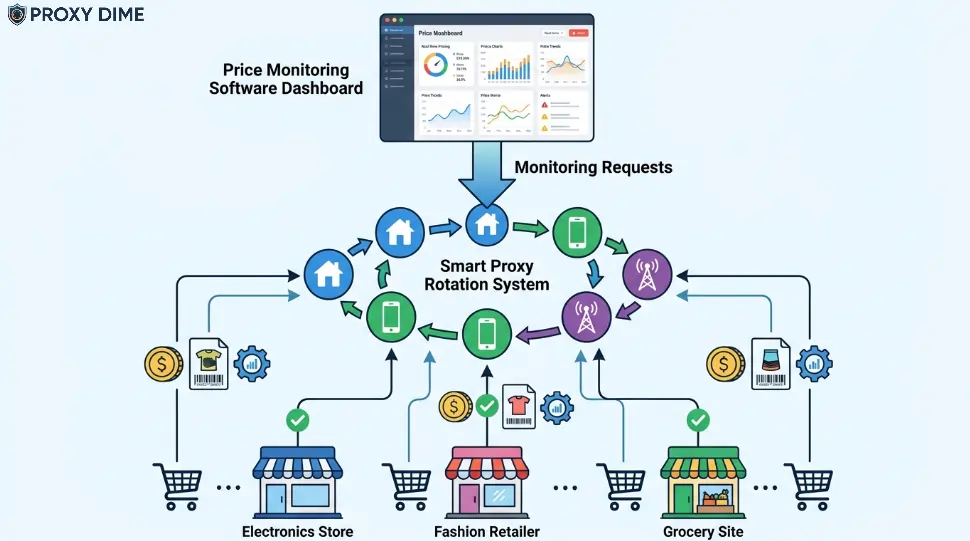
Price monitoring proxies route your scraper or pricing bot through IP addresses that target marketplaces treat as genuine consumer traffic.
Every time your tool visits Amazon, Walmart, or an individual retailer's site, the target platform records your IP, analyses your request headers, and cross-references your behaviour against known bot patterns. If your IP fails any check, it gets blocked, rate limited, or fed deliberately incorrect pricing data to mislead automated systems.
The technical workflow matters here. A price monitoring system typically sends structured HTTP GET requests to product pages or category listings, parses the returned HTML or JSON for price fields, discount flags, stock status, and seller information, then stores that in a database. That cycle may run every 15 minutes for competitive categories.
Each request looks identical to the previous one unless you rotate your IP and vary your request headers. Without rotation, a single IP generates thousands of requests per hour to the same domain. Bot detectors catch that pattern within minutes.
Residential rotating proxies are the standard choice for price extraction from consumer marketplaces like Amazon and Walmart. These IPs mimic genuine shopper traffic. ISP proxies offer datacenter speeds combined with residential trust scores, which suits high frequency polling of less aggressive targets.
Datacenter proxies work on retailer sites with basic bot detection and significantly reduce bandwidth costs at high volume. For the most hostile targets, web scraper APIs that embed proxy rotation and fingerprint management inside the API call offer the highest success rates.
Quick Tip: For price monitoring proxies, rotating residential IPs outperform raw datacenter IPs because Amazon and Walmart assign consumer trust scores to residential carrier addresses. Prioritise providers with dedicated ecommerce scraper APIs, JSON output parsing, and geo-specific ZIP or postcode-level targeting for localised price data.
🔥 8 Proxies Built for Price Intelligence in 2026
| Provider | Price Monitoring Edge | Built For |
|---|---|---|
| Decodo | Dedicated Amazon parser API | Ecommerce dev teams |
| Bright Data | ZIP-level product price targeting | Retail intelligence firms |
| Oxylabs | 100% success rate scraper API | Enterprise pricing ops |
| ZenRows | JS-rendered marketplace pages | Developer pricing teams |
| IPRoyal | Non-expiring crawl bandwidth | Budget product trackers |
| Webshare | Free datacenter extraction tier | Indie price comparison tools |
| Proxy-Seller | 220+ country local price views | Multi-region pricing analysts |
| Thordata | Cheapest residential crawl rate | High-SKU volume scrapers |
1. Decodo
Decodo ships a dedicated Price Scraper API sitting on top of their Web Scraping API infrastructure and 125 million residential IPs. This is not a generic proxy tool you adapt for price work. It is purpose-built for extracting structured product data from ecommerce platforms.
Send a single POST request with the target set to amazon_pricing plus an ASIN, and you receive back parsed fields including current price, original price, discount percentage, currency formatting, stock status, shipping costs, seller information, and promotional tags.
No HTML parsing required on your side. For teams tracking 50,000 SKUs across Amazon and competing marketplaces, eliminating the parsing layer from the pipeline saves substantial engineering hours. The API targets 50+ e-commerce platforms and delivers real-time HTML within seconds of the request firing.
Technical Specifications for Price Monitoring
Pricing
eCommerce Scraper API plans start from approximately $50/month based on request volume. Residential proxy bandwidth from $4/GB. Free 3-day trial available.
Pros
Cons
Why Decodo for Price Monitoring: Most proxy providers give you IPs and leave the parsing to you. Decodo builds the ecommerce data layer directly into the API. For teams monitoring competitor pricing across thousands of SKUs, getting structured price fields back from a single request rather than raw HTML is a genuine operational advantage that changes what your team can build and maintain.
2. Bright Data
Bright Data solves a specific price monitoring problem that most proxy providers completely miss. Amazon returns different prices depending on your ZIP code, logged-in status, and browsing history. A product in New York may show $34.99 while the same item shows $38.50 in rural Kansas due to regional fulfilment logistics and local demand signals.
Bright Data's Web Scraper API accepts ZIP code parameters directly alongside ASIN inputs, so you can pull localised Amazon pricing across every geographic segment your business needs to cover. The n8n workflow integration (actively documented by Bright Data) connects Amazon price pulls directly into Google Sheets using their API.
That brings price intelligence to non-technical team members who need daily price reports without touching code. With 150 million residential IPs and a mobile proxy pool of 7 million, even aggressive bot protection fails to block sustained crawl jobs.
Technical Specifications for Price Monitoring
Pricing
Residential bandwidth from $5.04/GB. Scraper API plans based on volume. Pre-built dataset access priced separately. Free trial available.
Pros
Cons
Why Bright Data for Price Monitoring: ZIP-level price extraction from Amazon is a data point that affects real pricing decisions for e-commerce brands with regional competition. Bright Data exposes that data through a clean API parameter. Combined with the Google Sheets integration for non-developer stakeholders, it handles the full intelligence cycle from scraping to reporting.
3. Oxylabs
Oxylabs built a dedicated price monitoring solution on top of their 177 million IP residential network. The Web Scraper API targets the top 50 e-commerce marketplaces and delivers pricing, product information, stock status, and shipping data with a claimed 100% success rate on successfully completed requests.
You only pay for results that actually return valid data. For businesses running MAP (Minimum Advertised Price) monitoring programmes across authorised retailers, this pay-for-success model directly controls costs because failed scrapes do not drain the budget.
The API supports automated job scheduling, multiple delivery formats including JSON and CSV, and real-time request triggers. Their e-commerce product datasets offer an alternative to live scraping by providing clean, pre-parsed pricing data from Amazon and Walmart with flexible refresh intervals.
Technical Specifications for Price Monitoring
Pricing
Web Scraper API from $49/month. Residential proxies from $8/GB Pay As You Go. Use code OXYLABS50 for 50% off.
Pros
Cons
Why Oxylabs for Price Monitoring: The pay-for-success scraper API removes the biggest frustration in price monitoring operations. Budget goes to data that actually arrives, not to blocked requests. For teams running MAP compliance checks or competitor tracking across dozens of marketplaces simultaneously, the 50-platform scraper coverage with automated scheduling handles the infrastructure burden cleanly.
Get 50% Off Oxylabs for Price Monitoring
Save 50% with code OXYLABS50 on Oxylabs’ price monitoring solution for competitor tracking, marketplace insights, and MAP compliance.

Use Code 🎁
OXYLABS50
4. ZenRows
ZenRows handles something that breaks standard proxy setups on modern retail sites. JavaScript rendering. Product prices on platforms like Zalando, ASOS, and many Shopify-based stores do not exist in the initial HTML response.
They load dynamically after the page renders, pulled from internal APIs via React or Next.js components. A standard residential proxy fetching raw HTML captures the page shell but misses the price fields entirely. ZenRows renders JavaScript before returning the response, so your parser receives the fully loaded product page including dynamically injected pricing data.
This matters specifically for mid-tier and premium retail sites that rely heavily on front-end rendering. The API rotates fingerprints on every request, preventing Cloudflare and Datadome from building behavioural profiles of your price monitoring crawler.
Technical Specifications for Price Monitoring
Pricing
Developer plan at $69/month. Higher tiers from $149/month. Pay As You Go API credits available. Free 14-day trial with 1,000 requests.
Pros
Cons
Why ZenRows for Price Monitoring: Retail tech has moved to client-side rendering. A proxy that fetches HTML without executing JavaScript misses real price fields on a growing number of retail targets. ZenRows closes that gap with a rendering engine built into the proxy API. If your price monitoring scope includes modern Shopify stores or fashion platforms, this is where ZenRows earns its place.
5. IPRoyal
IPRoyal addresses a specific budget problem that ecommerce price trackers face. Most residential proxy providers charge monthly subscriptions with strict bandwidth limits. If your monitoring cycle runs heavy during peak retail seasons like Black Friday or Prime Day but light in ordinary weeks, you pay full price for capacity you are not using.
IPRoyal uses a pay-as-you-go model where purchased traffic never expires. Stock up during quiet periods, burn through bandwidth during heavy monitoring cycles, and nothing goes to waste at month end.
The 32 million residential IP pool across 195 countries supports city-level targeting, which is important when tracking localised pricing from regional retail chains. SOCKS5 support enables encrypted tunnelling for compliance-sensitive pricing intelligence operations.
Technical Specifications for Price Monitoring
Pricing
Pay-as-you-go residential bandwidth. No monthly subscription required. Traffic never expires. Use code AFFMAVEN10 for 10% off.
Pros
Cons
Why IPRoyal for Price Monitoring: Seasonal pricing intelligence has extremely uneven bandwidth demand. A Black Friday competitor monitoring sprint consumes 20 times the bandwidth of a quiet February week. Non-expiring traffic means you can pre-buy and deploy on your schedule rather than racing to use a monthly allocation you do not need right now.
Save 10% on IPRoyal for Localized Pricing Data
Get 10% off IPRoyal for city-level targeting and accurate localized retail price monitoring across global markets.

Use Code 🎁
AFFMAVEN10
6. Webshare
Webshare opens the door to structured price monitoring for developers testing scrapers or running small-scale product tracking operations on a minimal budget. The free plan provides 10 private proxies and 1GB of bandwidth with no trial expiry.
This is enough to validate scraping logic against Amazon product pages, build your price parser, and confirm your data pipeline before committing to a paid provider. Paid datacenter proxies start at $2.99/month for 100 IPs, which reduces the per-request cost dramatically for high-frequency polling of retailer sites with basic bot detection.
The 80 million rotating residential IPs add the trust level needed for more aggressive targets once you scale. ISP proxies at $6/month for 20 static IPs suit persistent monitoring sessions on single retailer domains.
Technical Specifications for Price Monitoring
Pricing
Free tier with 10 proxies and 1GB. Datacenter proxies from $2.99/month for 100 IPs. Residential from $3.50/GB. ISP from $6/month for 20 IPs.
Pros
Cons
7. Proxy-Seller
Proxy-Seller solves the multi-currency, multi-market price monitoring challenge. When a consumer electronics brand needs to track prices on German Amazon, French Cdiscount, Japanese Rakuten, and Brazilian Americanas simultaneously, they need exit nodes that match each market's local carrier traffic.
Proxy-Seller covers 220+ countries with residential, ISP, and datacenter proxies. The ISP proxy selection includes carrier-level targeting, which is important for markets like Japan and South Korea where retail platforms assign higher trust to local carrier IPs.
Residential pricing starts at $4/GB with flexible rotation controls. For international pricing and brand protection teams tracking MAP compliance across local distributors in dozens of markets, this geographic depth is the defining technical requirement.
Technical Specifications for Price Monitoring
Pricing
Residential from $4/GB. ISP proxies from $3/month per IP. Datacenter IPv4 from $18/month dedicated. No free trial.
Pros
Cons
Get 15% Off Proxy-Seller for Market Tracking
Get 15% off Proxy-Seller with code AFFINCO for accurate local pricing checks across regional retailers, marketplaces, and distributor networks.

Use Code 🎁
AFFINCO
8. Thordata
Thordata makes sustained, high-SKU price monitoring economically viable at the per-GB cost that matters when you scale. At $0.65/GB for residential bandwidth, tracking 200,000 product prices daily across Amazon, Walmart, and Target becomes a calculation that works.
Compare that to providers charging $8/GB and the difference at volume is thousands of dollars per month. The pool of 100 million residential IPs across 195 countries handles the IP diversity needed for large catalogue crawls.
The unlimited residential plan at $69 per day adds a further option for teams running intensive monitoring sprints such as holiday season competitive sweeps where daily bandwidth use spikes unpredictably.
Browser extensions for Chrome and Firefox add lightweight manual price checking for analysts who need occasional spot checks without touching code.
Technical Specifications for Price Monitoring
Pricing
Residential from $0.65/GB. Unlimited residential at $69/day. Datacenter from $0.75/IP. Mobile from $2.20/GB. Free trial for new accounts.
Pros
Cons
Save 40% on Thordata for Large-Scale Monitoring
Get 40% off Thordata with code AFFMAVEN and scale daily price checks more affordably across global ecommerce marketplaces.
Use Code 🎁
AFFMAVEN
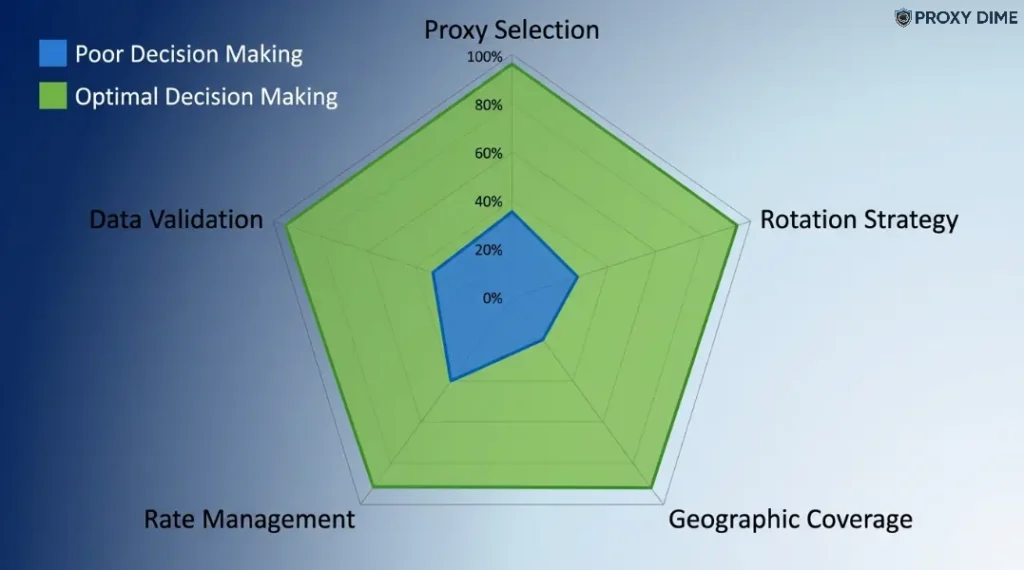
🤝 Five Decisions That Determine Your Price Data Quality
1. Raw Proxies Versus a Dedicated Scraper API
This is the first and most consequential choice for any price monitoring operation. Raw residential proxies give you IPs and leave parsing, retry logic, CAPTCHA handling, and JavaScript rendering entirely to your engineering team.
A dedicated scraper API handles those layers internally and returns structured price data directly. If you have engineering resources and need full control, raw proxies work.
If your goal is price data rather than proxy infrastructure management, an API like Decodo or Oxylabs eliminates weeks of scraper maintenance.
2. Geographic Targeting Depth and Its Impact on Data Accuracy
Amazon and Walmart show different prices to users in different geographic locations. This is not an edge case. It is standard practice on large marketplaces using dynamic pricing algorithms that factor in local demand, fulfilment cost, and competitor density.
Your proxy provider must support ZIP code or city-level targeting to capture geographically accurate price data. Bright Data's ZIP-level Amazon targeting addresses this directly.
General country-level proxies produce average prices that may not match what your customers in specific regions actually see. Choose a provider with postcode-level control for US and EU market monitoring.
3. Rotation Speed and Session Length for Different Retail Targets
Not all retail sites need the same rotation strategy. Amazon requires rotating IPs frequently enough to avoid pattern detection across ASIN requests, but not so rapidly that every request looks like a different user with a cold browser. Most price monitoring engineers settle on rotating every 10 to 50 requests on Amazon.
Simple retailer sites with basic detection tolerate longer sessions before rotation. Aggressive anti-bot environments like Ticketmaster or premium fashion sites need per-request rotation paired with fingerprint management. Match your rotation settings to each target individually rather than applying a single policy across your entire pipeline.
4. JavaScript Rendering Requirements Per Target
Before choosing a proxy provider, audit your target list for JavaScript-rendered pricing. Any site built on React, Vue, Next.js, or Angular likely loads price fields via client-side API calls after initial page load.
Standard proxy connections return the HTML shell and miss the price data entirely. Check your target list using your browser's Network Inspector.
Look for XHR or Fetch requests that fire after page load and carry pricing JSON. If your targets include modern retail sites, ZenRows or the scraper APIs from Decodo, Oxylabs, and Bright Data handle rendering. Standard residential proxies do not.
5. Cost Per Successfully Retrieved Price Point
The right metric for a price monitoring proxy budget is not cost per GB. It is cost per valid price point delivered to your database.
A provider charging $8/GB with a 95% success rate on Amazon costs more per valid result than a provider at $5/GB with an 85% success rate when you account for retries.
Calculate this before committing. Decodo and Oxylabs charge by successful result rather than bandwidth on their scraper APIs, which aligns cost directly with data quality. For raw proxy users, track your actual success rate per target domain and multiply by bandwidth cost to get the real figure.
🎯 Final Thoughts
Reliable proxies for price monitoring come down to one question: do you need raw bandwidth or structured price data delivered directly? Decodo answers the structured data question cleanly with its dedicated Amazon pricing API and 100% delivery success guarantee.
Bright Data adds ZIP-level targeting for teams who need geographically accurate prices rather than national averages. For operations where bandwidth cost is the binding constraint at catalogue scale, Thordata at $0.65/GB changes the economics entirely.
Use free trials on your actual target domains before committing. Success rate varies significantly per retail target, and the only number that matters is how much valid price data arrives in your database.