Your account got flagged. Not because of what you did, but because the IP address you used had been recycled through 40 other users that week. That is the problem with rotating residential proxies for tasks that need a consistent identity. You need an IP that stays the same, gets treated like a real household address, and does not get pulled out from under you mid-session.
ISP proxies (also called static residential proxies) solve exactly that. They combine the trust score of a real ISP-assigned IP with the stability and speed of a datacenter connection.
The global proxy market hit $4.2 billion in 2025, and ISP proxies are the fastest growing segment within it because they fill a gap neither datacenter nor rotating residential can.
I have used ISP proxies across multi-account management, social media automation, e-commerce monitoring, and long-session scraping for over 18 months.
The 12 providers below reflect what performs in real workflows, not what looks good on a features page.
📈 ISP Proxy Market Snapshot 2026
Before picking a provider, it helps to understand what separates the ISP proxy landscape right now.
| Market Factor | Current State (2026) |
|---|---|
| Average ISP proxy cost | $1.30 to $3.50 per IP/month |
| Largest ISP proxy pool | Bright Data at 1.3M+ IPs |
| Typical session duration | Unlimited (static assignment) |
| Primary use cases | Multi-accounting, social media, e-commerce |
| ISP proxy growth rate | Fastest growing proxy segment |
| Common ASN providers | AT&T, Verizon, Orange, Tele2, Cox |
Why ISP Proxies Are the “Sweet Spot” Between Residential and Datacenter IPs
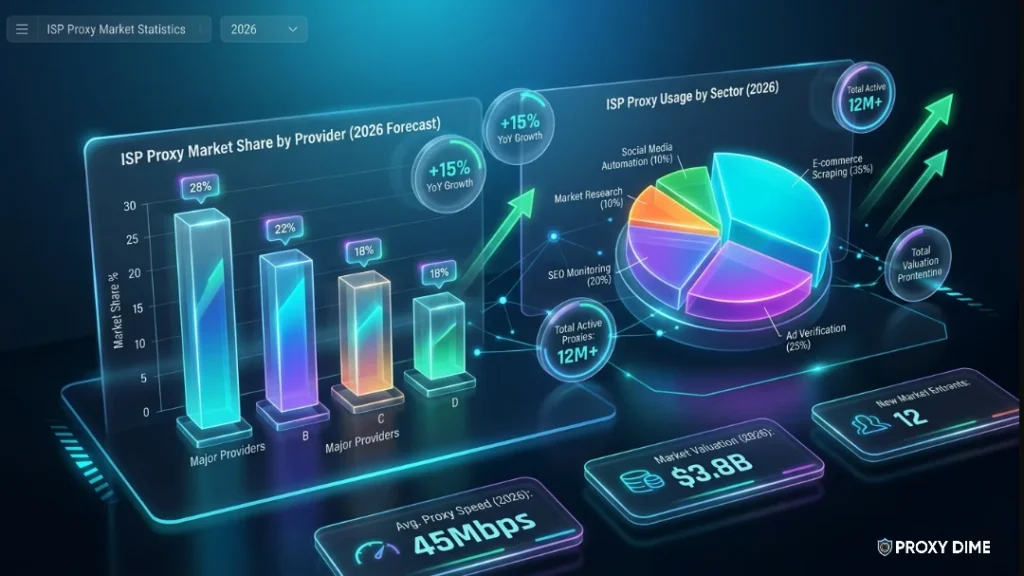
ISP proxies are IP addresses that originate from real Internet Service Providers like AT&T, Verizon, Orange, or Cox, but are hosted on data centre servers rather than household devices.
Think of them as a hybrid. They carry the legitimacy of a residential IP because the address genuinely belongs to an ISP range. But they deliver the speed and stability of a datacenter connection because the infrastructure sits in a server rack, not someone's home router.
This hybrid nature makes ISP proxies the preferred choice for three specific workflows. First, multi-account management where platforms like Instagram, TikTok, or e-commerce marketplaces need each account to maintain a consistent IP identity. Rotating IPs trigger security checks.
A static ISP address does not. Second, long-session scraping where your crawler needs to stay logged in or navigate paginated results without losing session state. Third, ad verification and brand protection where advertisers need to view ads as a real user in a specific location would see them, without the IP changing mid-verification.
The trade-off compared to rotating residential proxies is flexibility. ISP proxies are typically static (one IP assigned to you) rather than rotating. You get fewer unique IPs but far more control over each one. Compared to datacenter proxies, ISP addresses pass trust checks that datacenter subnets fail because websites see a genuine ISP registration behind the address.
Quick Tip: For account management and platforms that track IP consistency, static ISP proxies outperform rotating residential proxies because they maintain the same identity across sessions. Prioritise providers offering premium ASNs from recognisable ISPs like AT&T or Verizon.
High-Performance ISP Proxies for SEO, Automation & Scraping
| Proxy Provider | ISP Proxy Edge | Who Benefits Most |
|---|---|---|
| Decodo | Fastest ISP response time | Multi-account operators |
| Webshare | $0.18/IP yearly pricing | Solo account managers |
| Oxylabs | 100K+ static ISP pool | Enterprise scale teams |
| Bright Data | 1.3M ISP IPs, deepest pool | Compliance-driven businesses |
| IPRoyal | 500K+ IPs, unlimited traffic | Long-term session users |
| NetNut | ISP-native infrastructure | Market research analysts |
| SOAX | Ethical sourcing, ISP bundles | GDPR-sensitive operations |
| NodeMaven | IP quality scoring system | Anti-detect browser users |
| Geonode | $1.50/IP static residential | Budget-conscious scaling |
| Infatica | Backconnect ISP rotation | Automated data pipelines |
| Nimbleway | AI-powered request handling | Protected target scrapers |
| DataImpulse | $1/GB pay-as-you-go ISP | Cost-first bulk collection |
1. Decodo
Decodo built its ISP proxy product around one metric that multi-account operators care about more than anything else. Speed. The average response time sits under 0.2 seconds, which is faster than every other ISP proxy I have benchmarked.
That speed matters when you manage 50+ social media accounts through Multilogin or GoLogin and each profile needs to load its session quickly without triggering timeout flags. The ISP pool draws from premium ASNs including AT&T, Verizon, Orange, and Tele2.
Dedicated and rotating ISP options are both available, and the 99.99% uptime means your static assignments stay live around the clock.
Pricing: ISP proxies from $0.27/IP on high volume plans. Rotating ISP plans priced per GB. Free trial available without credit card.
Pros
Cons
Why Decodo for ISP Proxies: The 0.2 second response time is not just a number. It is the difference between a Multilogin profile loading cleanly and a session timing out before the fingerprint sets. Combined with premium ASN sourcing, Decodo ISP proxies pass platform trust checks that generic static residential addresses fail.
2. Webshare
Webshare prices its static residential (ISP) proxies at $0.30/IP monthly, dropping to $0.18/IP on yearly plans at the 10,000 IP tier. No other provider comes close to that per-IP cost for genuine ISP-assigned static addresses.
The proxies draw from real ISPs like AT&T, Sprint, and Cox Communications, support both HTTP and SOCKS5, and include unlimited bandwidth on every plan. For solo operators managing a handful of accounts or small teams scaling to a few hundred profiles, Webshare offers the most practical entry into ISP proxies without enterprise budgets.
The free tier (available on datacenter plans) also lets you test the dashboard and API before upgrading to static residential.
Pricing: Static residential from $0.30/IP (monthly). $0.225/IP at 10,000 proxies monthly. $0.18/IP at 10,000 proxies yearly. Free datacenter tier available for initial testing.
Pros
Cons
Why Webshare for ISP Proxies: The maths is simple. At $0.18/IP yearly, running 100 static ISP proxies costs $18/month. The same setup on most competitors costs $130 to $180. If your workflow needs consistent static IPs with unlimited bandwidth and you do not require deep geo-targeting, Webshare's pricing cannot be beaten.
3. Oxylabs
Oxylabs expanded its ISP proxy offering in 2026 with a self-service portal that lets you pick country, ASN, and protocol without going through sales.
The pool sits at 100K+ static residential IPs across 17 countries including the US, UK, Germany, France, and Canada. Each IP is shared with a maximum of 3 users, and all plans include unlimited bandwidth with fair usage. What sets Oxylabs apart in the ISP segment is the protocol flexibility.
HTTP, HTTPS, SOCKS5, and even UDP are all supported. For teams running anti-detect browser setups that require SOCKS5 with UDP for WebRTC leak prevention, this is one of the few ISP providers that handles that cleanly.
Pricing: Starter plan at $1.60/IP (10 IPs, $16/month). Advanced at $1.30/IP (100 IPs, $130/month). Enterprise 2,000+ IPs at custom pricing. Use code OXYLABS50 for 50% off your first month.
Pros
Cons
Why Oxylabs for ISP Proxies: The SOCKS5 plus UDP combination is the real differentiator. If you run Multilogin, AdsPower, or GoLogin profiles and need WebRTC to report the correct IP, most ISP proxy providers fail that test. Oxylabs passes it. The 3-user-max sharing model also means your assigned IP is not worn out by dozens of other customers.
4. Bright Data
Bright Data owns the largest ISP proxy pool in the industry at 1.3 million static residential IPs, a number that grew by roughly 200,000 addresses in early 2026 alone. That pool covers 195+ countries, which no other ISP provider matches.
Both shared and dedicated ISP pools are available. Shared ISP proxies start at $1.80/IP for 10 IPs, while dedicated addresses run from $3.50/IP. The pay-per-GB option at $8/GB works for bandwidth-intensive ISP tasks, and the open-source Proxy Manager lets you whitelist IPs, set rotation rules, and monitor bandwidth per target.
For organisations that need ISP proxies in obscure locations or require audit-grade control over their proxy traffic, Bright Data is the only provider that covers every scenario.
Pricing: Shared ISP from $1.80/IP. Dedicated from $3.50/IP. Pay-as-you-go at $8/GB. Free trial with deposit match up to $500.
Pros
Cons
Why Bright Data for ISP Proxies: When your operation requires static ISP proxies in 50+ countries simultaneously, only Bright Data can deliver. The 1.3M pool with ASN and carrier targeting means you can pick an AT&T address in Dallas or an Orange IP in Lyon. The Proxy Manager adds compliance and routing controls that enterprises need for audit trails.
5. IPRoyal
IPRoyal sells ISP proxies as dedicated static residential IPs with a straightforward per-IP model and unlimited traffic on every address. The pool spans 500K+ ethically sourced IPs across 31+ countries, and every IP is yours alone.
No sharing. No pool rotation affecting your address. Pricing works on a duration basis. $1.80/IP for 24 hours, $2.70/IP for 30 days, and rates drop to $2.40/IP on 90 day commitments.
That duration model suits project-based work where you need ISP proxies for a specific campaign window rather than year-round. Use code AFFMAVEN10 for 10% off your first purchase.
Pricing: 24-hour from $1.80/IP. 30-day from $2.70/IP. 60-day from $2.55/IP. 90-day from $2.40/IP. Use code AFFMAVEN10 for 10% off.
Pros
Cons
6. NetNut
NetNut operates its ISP proxies differently from most providers because the network connects directly to ISP partners rather than using peer-to-peer relay. That direct integration means lower latency, more stable sessions, and no dependency on end-user devices staying online.
Their static residential product starts at $3.82/GB and supports persistent sessions that hold indefinitely, not just for 10 or 30 minutes.
For market research firms pulling structured data from e-commerce platforms over hours-long crawling sessions, this ISP-native approach avoids the session drops that peer-sourced ISP proxies suffer from. Use code AFFCOUPON20 for 20% off.
Pricing: Static residential from $3.82/GB. Rotating residential from $1.59/GB on enterprise plans. Use code AFFCOUPON20 for 20% off.
Pros
Cons
7. SOAX
SOAX bundles ISP proxy access into its standard subscription plans alongside residential and mobile proxies. The total pool exceeds 191 million IPs across all types, with ISP proxies available from dedicated per-IP plans starting at 300 IPs minimum.
Every IP in the SOAX network is ethically sourced with verifiable consent processes, which matters for businesses operating under GDPR, CCPA, or similar data regulations. ISP targeting is available by country, city, and specific ISP name.
For compliance-driven organisations that need static ISP addresses with a documented ethical sourcing chain, SOAX provides documentation that most competitors cannot.
Pricing: Bundled plans from $3.60/GB (25 GB starter). Dedicated ISP plans from 300 IPs at custom pricing. Enterprise plans from $0.32/GB.
Pros
Cons
8. NodeMaven
NodeMaven approaches ISP proxies from an angle that most providers ignore. Instead of maximising pool size, they filter for IP quality. Their system runs every IP through fraud score databases and abuse checkers, removing flagged addresses before they reach your rotation.
The result is a 95% clean IP rate, which directly translates to fewer CAPTCHAs, fewer bans, and fewer account flags when running anti-detect browser profiles. Super sticky sessions hold for up to 24 hours, and the IP whitelisting system lets you bind specific IPs to specific ports across up to 1,000 configurations.
For operators running 100+ social media profiles through GoLogin or AdsPower, the cleanliness of the IP matters more than the raw count. Use code AFFMAVEN50 for 50% off.
Pricing: From €6/GB on the 5 GB plan (€30/month). Drops to €3.40/GB at 500 GB. Use code AFFMAVEN50 for 50% off.
Pros
Cons
9. Geonode
Geonode lists static residential (ISP) proxies at approximately $1.50/IP, which positions it among the most affordable dedicated ISP options after Webshare. The ISP proxies include ASN targeting, allowing you to select the specific internet service provider behind your assigned address.
For teams building out dedicated IP pools for e-commerce account management or review monitoring, the per-IP model with ASN control gives the granularity needed to match local ISP fingerprints.
The membership model ($50/month for 100 GB residential bandwidth) can also be combined with ISP products for hybrid workflows.
Pricing: Static ISP from approximately $1.50/IP. Residential membership at $50/month for 100 GB. Pay-as-you-go at $3/GB.
Pros
Cons
10. Infatica
Infatica operates a backconnect proxy network that routes ISP-level traffic through a rotating infrastructure, giving you the trust of ISP addresses with the rotation flexibility of residential proxies. The network covers 100+ countries and supports both HTTP and SOCKS5.
Where Infatica fits the ISP proxy landscape is in automated pipelines that need ISP-grade trust but cannot rely on a single static IP.
Price monitoring bots, competitor tracking scripts, and SEO audit crawlers benefit from ISP rotation because the addresses pass trust checks while avoiding pattern detection from reusing the same IP.
Pricing: Custom plans based on bandwidth requirements. Contact for pricing.
Pros
Cons
11. Nimbleway
Nimbleway adds an AI layer on top of its proxy infrastructure that automatically handles fingerprinting, request retries, and proxy rotation based on the target site's protection level.
For ISP proxy use cases involving heavily protected targets like Amazon, LinkedIn, or Glassdoor, Nimbleway's system detects the anti-bot challenge and adjusts the request pipeline before your scraper even sees the block.
This makes it less of a raw ISP proxy provider and more of an intelligent data access platform. If your engineering team spends more time debugging blocked requests than processing data, Nimbleway shifts that burden to infrastructure.
Pricing: Custom enterprise pricing. Free trial available on request.
Pros
Cons
12. DataImpulse
DataImpulse extends its $1/GB pricing model to ISP-grade traffic, making it the cheapest bandwidth-based ISP proxy option available. The pool of 90M+ IPs includes ISP-sourced addresses, and unused gigabytes roll over to your next billing period.
For teams that measure ISP proxy costs by the gigabyte rather than by the IP (because their workflows consume heavy bandwidth through image scraping, PDF extraction, or media monitoring), DataImpulse keeps the per-GB economics well below every subscription-based competitor. Geo-targeting covers country, state, city, ZIP code, and ASN.
Pricing: Standard ISP-grade traffic from $1/GB. Premium from $5/GB. No subscription. Unused data rolls over.
Pros
Cons
📌Choosing the Right ISP Proxy Provider
1. Session Persistence Requirements
The defining feature of ISP proxies is session stability. If your workflow requires maintaining the same IP across hours or days (account management, logged-in scraping, social media warm-up), choose providers with unlimited session duration like Oxylabs or IPRoyal.
If you need ISP trust with rotation (price monitoring, SERP scraping), Decodo's rotating ISP option or Infatica's backconnect model works better. Match the session type to the workflow, not the other way around.
2. ASN and ISP Source Quality
Not all ISP proxies carry the same trust. An address from AT&T or Verizon carries a higher trust score on US platforms than an IP from a lesser-known regional provider. Decodo and Oxylabs explicitly list their ASN sources.
Bright Data lets you filter by carrier and ASN at the targeting level. Ask about ASN sources before buying. The ISP behind your IP directly impacts whether a platform treats it as a real user.
3. Pool Size vs IP Cleanliness
A bigger pool is not always better for ISP proxies. Bright Data's 1.3M pool offers the most geographic diversity. But NodeMaven's smaller, quality-filtered pool delivers a 95% clean IP rate that reduces bans.
If you operate in a few countries and prioritise account survival, a smaller clean pool outperforms a larger unfiltered one. If you need ISP IPs in 50+ countries, pool size becomes the priority.
4. Pricing Model Fit
ISP proxy pricing splits into two models. Per-IP (Webshare, Oxylabs, IPRoyal, Bright Data) and per-GB (DataImpulse, NetNut, NodeMaven). Per-IP with unlimited bandwidth works for account management where traffic per IP is high but unpredictable.
Per-GB works for scraping where you control the payload size and request volume. Calculate your typical bandwidth per IP per month. If it exceeds 5 GB, per-IP pricing saves money. Below 2 GB, per-GB often costs less.
5. Protocol and Anti-Detect Compatibility
If you use anti-detect browsers, confirm the provider supports SOCKS5. For WebRTC leak prevention, you need SOCKS5 with UDP, which only Oxylabs and SOAX offer among ISP providers on this list.
HTTP(S) proxies work for scraping and API calls but fail WebRTC checks in browser profiles. Always test the specific protocol with your exact anti-detect browser before buying a large block of IPs.
🧠Frequently Asked Questions About ISP Proxies
What are ISP proxies?
ISP proxies are IP addresses issued by real Internet Service Providers (AT&T, Verizon, Orange) but hosted on data centre infrastructure. They combine the trust and legitimacy of a residential IP with the speed and stability of a datacenter connection. Websites treat them as genuine household addresses.
How are ISP proxies different from residential proxies?
Residential proxies route through actual household devices and typically rotate between sessions. ISP proxies are static, assigned to you alone, and hosted on stable servers. Residential IPs change. ISP IPs persist. Choose ISP when session consistency matters and residential when you need IP diversity.
What are ISP proxies best used for?
ISP proxies perform best for multi-account management, social media automation, long-session scraping, ad verification, and e-commerce monitoring. Any workflow that needs a consistent, trusted IP address that does not change between sessions benefits from ISP proxies over rotating alternatives.
How much do ISP proxies cost in 2026?
Per-IP pricing ranges from $0.18/IP (Webshare yearly) to $3.50/IP (Bright Data dedicated). Per-GB models range from $1/GB (DataImpulse) to $8/GB (Bright Data PAYG). Most mid-range ISP providers charge between $1.30 and $2.70 per IP monthly with unlimited bandwidth.
Are ISP proxies better than datacenter proxies?
For targets that check IP legitimacy, yes. ISP proxies pass trust checks that datacenter addresses fail because the IPs are registered to real Internet Service Providers. For unprotected targets where speed and cost are the only factors, datacenter proxies remain cheaper and faster.
Can I use ISP proxies with anti-detect browsers?
Yes. ISP proxies work with Multilogin, GoLogin, AdsPower, and similar anti-detect browsers. For full compatibility including WebRTC leak prevention, use providers offering SOCKS5 with UDP support like Oxylabs or SOAX. HTTP-only ISP proxies work for basic browsing but fail WebRTC fingerprint checks.
Do ISP proxies have unlimited bandwidth?
Most per-IP ISP proxies include unlimited bandwidth (Webshare, IPRoyal, Oxylabs with fair usage). Per-GB providers like DataImpulse and NetNut charge by traffic consumed. Check the billing model before buying. Unlimited bandwidth per IP saves money for traffic-heavy workflows like media scraping.

More Guides On Proxy Dime
🎯Final Thoughts
Decodo sits at the top for raw speed. Sub-0.2 second ISP proxy response times and premium ASN sourcing make it the natural pick for multi-account operators who need every session to load cleanly. Webshare wins on pricing, full stop. At $0.18/IP yearly with unlimited bandwidth, the maths works for anyone scaling static IPs on a budget.
And Bright Data's 1.3M ISP pool remains the only option when you need static residential coverage across dozens of countries. Most providers here offer trials or low-commitment entry plans.
Test with your actual platforms and anti-detect browser before locking into a large IP block. The right ISP proxy provider depends entirely on what you are asking it to do.
👉 Fastest ISP Proxies: Decodo — Sub-0.2s, premium ASNs, free trial
👉 Cheapest ISP Proxies: Webshare — $0.18/IP yearly, unlimited bandwidth
👉 Largest ISP Pool: Bright Data — 1.3M+ ISP IPs, 195+ countries