Your rank tracker showed position 3 for your money keyword on Monday. A manual check from the same city showed position 11. The difference was not a ranking change.
It was bad proxy data feeding your SEO tool inaccurate SERP results. Google now blocks scrapers after as few as 5 to 10 queries per IP per hour, and datacenter proxies achieve only 20 to 40% success rates against its detection systems.
The SERP scraping proxy market has shifted fast. The web scraping industry hit $1.03 billion in 2025 and is projected to reach $1.17 billion in 2026, growing at 18.5% CAGR. More companies pulling search data means tighter anti-bot enforcement from Google, Bing, and Yahoo.
I have rebuilt SERP pipelines after total proxy failures more times than I would like to admit. These seven providers are the ones that consistently returned accurate, location-matched rank data under real production loads.
🌐 The SERP Scraping Problem No One Talks About
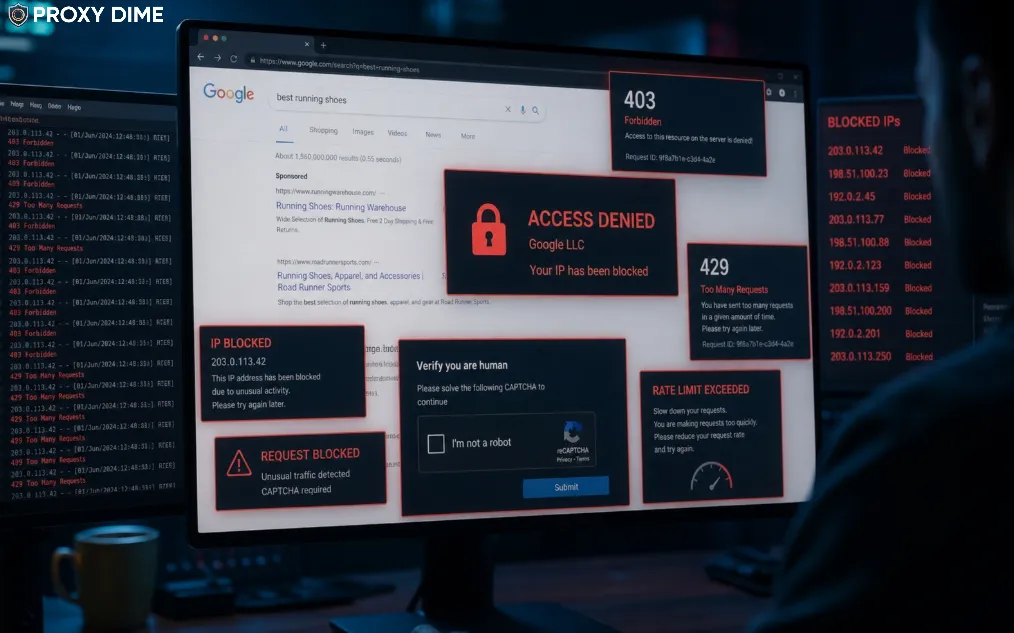
SERP scraping proxies route your automated search queries through real residential or ISP addresses so Google treats each request like a genuine person searching from a specific location. Without them, every rank tracking tool, keyword research pipeline, and competitor monitoring system runs blind.
The problem is not just getting blocked. It is getting wrong data without knowing it. Google serves different results based on IP location, device type, search history, and even time of day.
A proxy from a different city will return different rankings than what your actual target audience sees. That makes geo-targeted residential proxies essential for anyone doing local SEO or multi-market rank tracking.
Residential proxies achieve 85 to 95% success rates on Google, compared to 20 to 40% for datacenter addresses. Google maintains databases of IP ranges from known server farms and flags them immediately. Residential IPs assigned by real ISPs to real households pass those checks naturally.
Quick Tip: For SERP scraping, rotating residential proxies typically outperform datacenter and ISP proxies because Google rate-limits per IP address and rotating spreads queries across thousands of addresses automatically. Prioritise providers offering per-request rotation with city-level geo-targeting for accurate local rank data.
🔍 The State of Google Anti-Bot Detection in 2026
Understanding what your proxy is up against helps explain why some providers succeed and others fail. Here is what Google deployed through 2025 and into 2026.
- IP reputation scoring tracks the history of every address. Past CAPTCHA triggers, query volume, and association with automation tools all contribute to a score that determines whether your next request gets clean results or a verification wall.
- Browser fingerprinting analyses JavaScript execution, WebGL rendering, canvas hashes, and dozens of other signals. Missing or inconsistent fingerprints flag a request as automated even if the IP is clean.
- Behavioural ML models evaluate navigation patterns, click timing, scroll behaviour, and query sequences across sessions. Repetitive patterns that no human would produce trigger soft blocks or degraded results.
- Rate limiting per IP kicks in after as few as 5 to 10 queries per hour from a single address. Sustained high-volume scraping requires a pool large enough to keep each IP well below that threshold.
- reCAPTCHA v3 runs silently in the background, scoring traffic without visible challenges. Low scores result in throttled or filtered SERP responses that look normal but contain incomplete data.
The practical implication is straightforward. SERP scraping in 2026 requires either a massive residential proxy pool with intelligent rotation, or a dedicated SERP API that handles all of this behind the scenes.
Best Proxies for Search Engine Results Page Scraping
| Proxy Provider | SERP-Specific Product | Residential IP Pool |
|---|---|---|
| Decodo | SERP Scraping API | 125M+ |
| Proxy-Seller | Dedicated IPs per location | 220 countries |
| ZenRows | Universal Scraper API | Included in plans |
| Webshare | Rotating + static residential | 80M+ |
| Oxylabs | SERP Scraper API | 175M+ |
| Thordata | SERP API + 120 scrapers | 100M+ |
| Bright Data | SERP API with validation | 72M+ residential |
1. Decodo
Decodo built a purpose-designed SERP Scraping API that removes the entire anti-detection burden from your rank tracking workflow. Instead of configuring proxy rotation, managing headless browsers, and handling retries yourself, you send a query and receive structured JSON or HTML with the actual search results.
Their system routes requests through 125 million residential IPs while handling JavaScript rendering, CAPTCHA solving, and automatic retries behind the scenes. Real-time SERP feature extraction pulls featured snippets, People Also Ask boxes, local packs, and ad placements as structured data.
For SEO agencies running keyword tracking across dozens of client accounts and multiple geographies, this removes weeks of engineering work.
Pricing: SERP Scraping API priced per request. Residential proxies from $2.75/GB at 100GB.
Pros
Cons
Why Decodo for SERP Scraping: The SERP API is the real value here. Instead of building and maintaining a custom scraping stack, you get structured rank data from a single API call. Automated retry logic and SERP feature extraction mean your rank tracker gets complete, parse-ready data every time.
2. Proxy-Seller
Proxy-Seller takes a fundamentally different approach to SERP scraping than the API-first providers. You buy individual geo-targeted IPs and route your own tools through them. That approach gives you complete control over which exact location each query comes from, something that matters enormously for local SEO consultants who need to verify rankings in specific suburbs or metro areas.
Their network covers 220 countries with a good spread of US, UK, and European cities. You can pick individual IPv4 or IPv6 addresses and run Screaming Frog, SERPWoo, or custom Python scrapers through them directly.
For SEO professionals who already have their scraping workflow built and just need clean, dedicated IPs in precise locations, this is the most flexible purchasing model available.
Pricing: Dedicated IPv4 from $0.82/IP per month. Residential from $1.99/500MB.
Pros
Cons
Why Proxy-Seller for SERP Scraping: Local SEO work demands accurate rank data from specific locations. When you need to verify that a dentist in Manchester ranks #3 for “emergency dentist near me” specifically from Manchester IPs, buying a dedicated Manchester proxy for $0.82/month is more cost-effective and accurate than any rotating pool.
3. ZenRows
ZenRows handles SERP scraping as a subset of its broader anti-bot scraping infrastructure, and that broader scope is actually an advantage. The Universal Scraper API bypasses Cloudflare, DataDome, PerimeterX, and Google's own anti-bot systems using a single API endpoint.
When your rank tracking script hits a reCAPTCHA v3 wall or a browser fingerprint challenge, ZenRows resolves it automatically before returning the clean HTML. The Scraping Browser product renders full JavaScript SERP pages in a real browser environment, which captures dynamically loaded elements like People Also Ask expansions and local pack details that raw HTTP requests miss entirely.
Development teams that want to build custom SEO monitoring tools on top of proven anti-bot infrastructure will find ZenRows eliminates the most time-consuming part of the build.
Pricing: Developer plan at $69/month. Startup at $129/month with 50 concurrent requests. Business 500 at $499/month with 150 concurrent requests and $4.50/GB residential bandwidth.
Pros
Cons
Why ZenRows for SERP Scraping: Google is one of the hardest targets on the internet. ZenRows treats it as a “protected” target with dedicated anti-bot handling, which means your success rate on Google SERPs stays high even as detection systems evolve. The $2.08 per 1,000 protected results on Business plans is competitive against building and maintaining your own anti-detection stack.
4. Webshare
Webshare published detailed guidance on SEO tool integration with proxy servers in early 2026, and their own infrastructure reflects that focus. Their blog recommends starting with 1 to 2 concurrent requests per IP and scaling up only once error rates stabilise, which is honest advice that most proxy sellers would never offer.
The 80 million residential IP pool across 195 countries provides the rotating coverage needed for daily SERP checks across multiple markets. Static proxy options are available for consistent session-based rank tracking, where the same IP checks the same keywords daily for trend stability.
Freelance SEO consultants and small agency teams managing under 50 keyword sets will find the free tier (10 proxies with 1GB bandwidth) genuinely useful for testing SERP scraping configurations before scaling.
Pricing: Residential from $3.50/GB at 1GB. Drops to $2.25/GB at 100GB. Free tier available with 10 proxies.
Pros
Cons
5. Oxylabs
Oxylabs runs the largest verified residential proxy pool in the industry at 175 million IPs, and for SERP scraping, pool size is the single most predictive factor of sustained success rates. Google rate-limits at the IP level, so a larger pool means more queries before any single address gets flagged.
Their dedicated SERP Scraper API prices Google results at $0.90 per 1,000 queries on the Starter plan, dropping to $0.80 per 1,000 on Advanced plans. That pay-per-successful-result model means you never pay for failed requests or CAPTCHAs.
The API supports JavaScript rendering for dynamic SERP features and delivers results as structured JSON. Enterprise rank tracking platforms pulling 50,000 or more daily keyword positions across dozens of markets will find the combination of pool depth and API reliability here difficult to outperform.
Pricing: SERP Scraper API from $49/month (Micro, 98K results). Residential proxies from $8/GB. Use OXYLABS50 for 50% off proxy plans.
Pros
Cons
Why Oxylabs for SERP Scraping: At $0.80 to $0.90 per 1,000 Google results with automatic CAPTCHA handling, the economics often beat running your own proxy infrastructure once you factor in the engineering time saved. The 50-request-per-second rate limit means a full 100,000-keyword rank check completes in under an hour.
🚀 Get 50% Off Oxylabs Proxy Plans
Use code OXYLABS50 to get 50% off Oxylabs proxy plans, perfect for SERP scraping, rank tracking, and large-scale Google data extraction.
OXYLABS50
6. Thordata
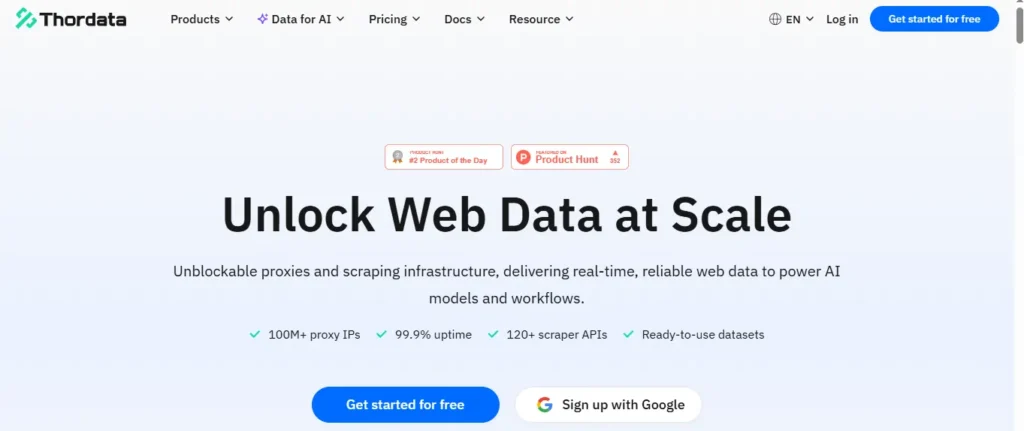
Thordata expanded significantly through 2025 and now offers 100 million residential IPs alongside a dedicated SERP API with 120 prebuilt scraper templates. That SERP API extracts structured data from Google, Bing, and other search engines without requiring you to manage proxies, rotation, or rendering yourself.
What makes this interesting for SERP scraping specifically is the price point. Residential bandwidth starts at $0.65/GB, and the SERP API carries its own competitive per-request pricing. For data-driven SEO startups that need both raw proxy access for custom scrapers and a managed API for quick keyword monitoring, having both under one provider simplifies billing and reduces integration overhead.
The 99.7% uptime guarantee matters when your rank tracker runs automated daily pulls at 4am and there is nobody awake to fix a failed batch.
Pricing: Residential proxies from $0.65/GB. Unlimited residential at $69/day. SERP API priced per request. Free trial available.
Pros
Cons
7. Bright Data
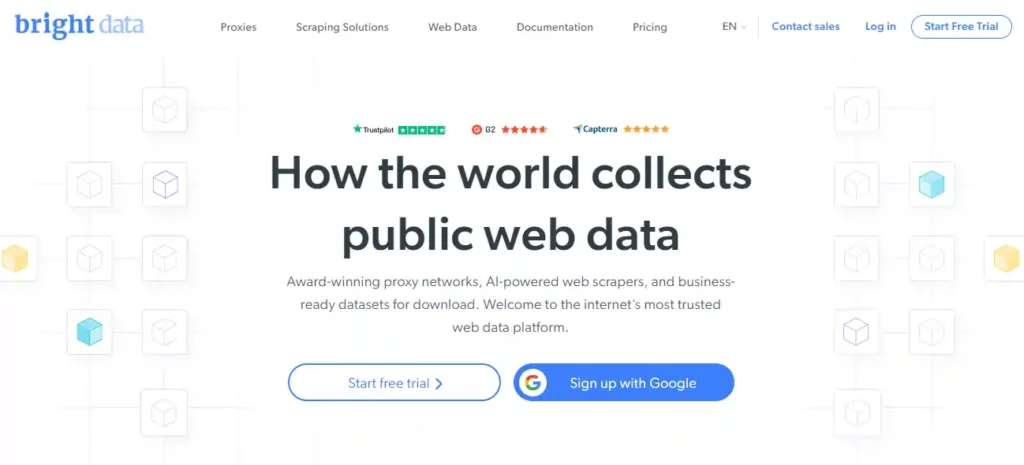
Bright Data operates the most mature SERP API on this list, trusted by over 20,000 customers and used by companies that built their entire SEO data infrastructure on top of it. Their SERP API pricing runs from $1.50 per 1,000 results on pay-as-you-go down to $1.00 per 1,000 on the 2 million result plan.
Every feature you need for production SERP scraping ships included in the price. JavaScript rendering, CAPTCHA solving, IP rotation, browser fingerprinting, desktop and mobile user agents, and unlimited concurrent requests all come standard.
The API delivers data in JSON or HTML with built-in data integrity validations that flag incomplete or inconsistent results before they reach your pipeline. Response time sits under 5 seconds per query. For agencies that need guaranteed accuracy across every search engine and cannot afford to debug failed queries at 2am, the reliability premium here makes financial sense.
Pricing: SERP API at $1.50/1K results (pay-as-you-go), dropping to $1.00/1K at the 2M result plan ($1,999/month).
Pros
Cons
🆚 Raw Proxies vs SERP APIs: Which Approach Fits Your Rank Tracking Setup?
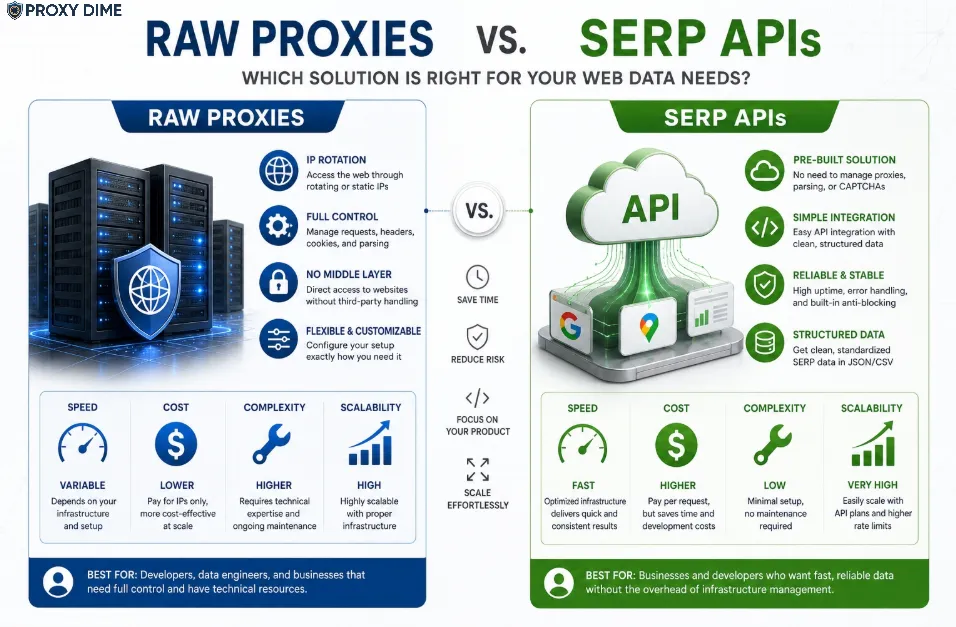
This is the single biggest decision before you pick a provider, and it depends entirely on your existing infrastructure and team size.
When Raw Residential Proxies Make Sense
If you already run Screaming Frog, Scrapebox, or custom Python scrapers with BeautifulSoup or Scrapy, raw residential proxies let you keep full control over your scraping logic. You manage the rotation, the parsing, the retries.
Providers like Webshare, Thordata, and Proxy-Seller fit this path. The cost per GB is lower, and you get flexibility that APIs constrain. The trade-off is engineering time maintaining the anti-detection stack as Google updates its systems.
When a Dedicated SERP API Saves Money
If your team is small or your scraping volume exceeds 50,000 queries daily, the engineering overhead of maintaining custom anti-bot logic often costs more than the API premium. Decodo, Oxylabs, and Bright Data all offer pay-per-successful-result pricing, which means you stop paying for failures.
At scale, the per-result cost of an API (Oxylabs at $0.80/1K, Bright Data at $1.00/1K) often undercuts the true cost of running your own proxy infrastructure once you include developer time, server costs, and retry bandwidth.
The Hybrid Path
Many production SEO teams run both. An API handles the daily bulk rank tracking across 10,000+ keywords, while a separate pool of dedicated proxies runs manual spot-checks and ad hoc SERP research through local tools. Proxy-Seller's per-IP model works well for the spot-check layer alongside an API-based primary pipeline.
Choose your approach first. Then pick the provider.
⚠ Avoiding the 5 Mistakes That Break SERP Scraping Pipelines
Mistake 1: Running Too Many Queries Per IP
Google flags IPs after 5 to 10 queries per hour. If your rotation is not aggressive enough, you burn IPs and get degraded results rather than outright blocks. Per-request rotation is the safest default for bulk keyword tracking.
Mistake 2: Ignoring Geo-Match Accuracy
Rank data from the wrong city is worse than no data. A “US proxy” checking rankings for a business in Austin might return Dallas or Houston results. Use providers with city or ZIP-level targeting for local SEO work.
Mistake 3: Skipping JavaScript Rendering
Featured snippets, People Also Ask, and local packs load through JavaScript. Raw HTTP requests return incomplete SERP pages missing these elements. Use a SERP API with built-in rendering or pair your proxies with a headless browser like Playwright.
Mistake 4: Not Validating Result Completeness
Some proxies return 200 OK responses with partial or empty result sets. If your pipeline does not check for expected elements (10 organic results, PAA box, ad slots), bad data enters your reporting silently. Bright Data's validation layer addresses this.
Mistake 5: Using Datacenter Proxies on Google
Datacenter success rates on Google sit between 20 and 40%. They are cheaper per GB but the failure rate makes them more expensive per successful result. Residential is the only sensible default for sustained Google SERP scraping.
📌 Final Thoughts
For SERP scraping in 2026, the provider choice depends on whether you want an API or raw proxies. Oxylabs delivers the strongest combination of pool size and pay-per-success SERP API pricing at scale. Decodo offers the best structured SERP data output for agencies that need parse-ready results.
Thordata makes daily rank tracking affordable at $0.65/GB for teams running their own scraping infrastructure. All three offer free trials, and testing against your actual target keywords is the only reliable way to benchmark accuracy. Accurate rank data is not something you can afford to get approximately right.