Building a rank tracker used to mean buying a list of datacenter proxies, spinning up a headless browser, and writing regex code to parse HTML. That approach barely survives an hour in 2026.
Google’s anti-bot mechanisms flag automated search queries faster than ever, serving CAPTCHAs and returning modified search results that ruin your data integrity. Maintaining an in-house scraper means you are spending engineering time fighting Cloudflare rather than building your core product.
A SERP API provider solves this completely. You send a search query via API. The provider handles the proxy rotation, JavaScript rendering, and CAPTCHA solving behind the scenes. They parse the raw HTML into clean, structured JSON data, separating organic results from paid ads, local packs, and AI overviews. You only pay for successful requests.
We tested the leading SERP data extractors against speed, localization accuracy, and parsing depth. Here are the eight best SERP API providers for scaling search engine data pipelines.
The Economics of Buying vs Building SERP Scrapers
A SERP API (Search Engine Results Page Application Programming Interface) automates the extraction of data from search engines like Google, Bing, and Baidu. Instead of building a bot that clicks and scrolls, you make a standard HTTP request to an endpoint.
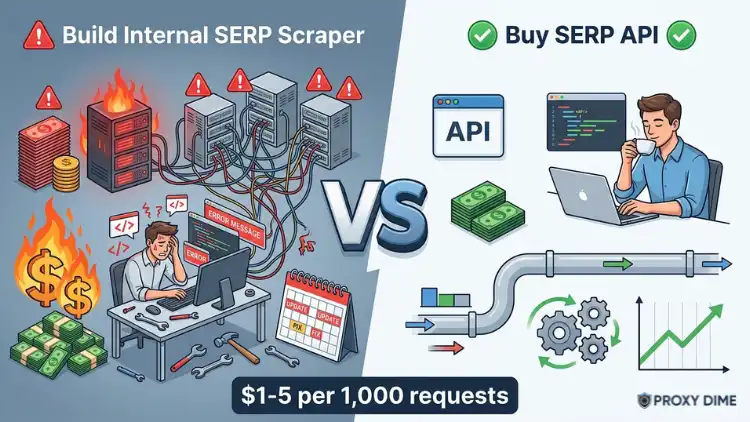
The primary reason development teams migrate to managed SERP APIs is the invisible cost of proxy management. To scrape 100,000 keywords a month, you need rotating residential proxies to avoid subnet bans.
You need to handle dynamic elements like Google's AI Overviews, which require headless browsers to render JavaScript. When Google changes its HTML structure—which happens dozens of times a year—your custom parsing code breaks, and your data feed goes dark until an engineer fixes it.
Modern SERP APIs charge between $1 and $5 per 1,000 requests. At those prices, the math of building an internal infrastructure rarely makes sense unless you are scraping millions of keywords daily. The providers listed below turn a complex, adversarial scraping war into a predictable utility cost.
Prioritise providers offering machine-learning-based parsers that adapt automatically to layout changes without breaking your data pipeline.
Best Search Engine Data Extractors in 2026
| SERP API Provider | Core Competency | Ideal User |
|---|---|---|
| Decodo | 99.8% success rate SLA | Ad monitoring agencies |
| Oxylabs | Deep JSON parsing (44+ points) | Enterprise SEO tools |
| Scraper API | Built-in rendering engine | Developers & startups |
| Bright Data | Unlimited concurrent requests | Bulk data pipelines |
| Webshare | Unmetered raw HTML access | Python Playwright scrapers |
| ZenRows | Next-gen CAPTCHA bypass | Complex domain extraction |
| Thordata | Aggressive volume pricing | High-frequency rank trackers |
| Luna Proxy | Broad global localization | Local SEO researchers |
1. Decodo
Decodo (formerly Smartproxy) operates a SERP scraping API designed for aggressive, high-volume rank tracking and ad verification. Their infrastructure relies on a massive residential proxy pool, allowing them to route queries through genuine mobile and home connections. This enables hyper-localised SERP extraction.
If you need to know exactly which local plumbers are appearing in the Google Map Pack for a user standing in downtown Chicago, Decodo’s location parameters allow city-level targeting. The API supports synchronous and asynchronous requests, returning clean JSON that separates organic links, sponsored ads, and “People Also Ask” boxes. They offer specific endpoints tailored to search engines, meaning the parsing logic is optimized differently for Bing than it is for Google.
Decodo Pros
Decodo Cons
Plans from $19/month, pay only for success
Why Decodo for SERP Data Extraction: The granular pricing model allows you to scale efficiently. If you are scraping basic keywords, the standard proxy tier is incredibly cheap. If you need complex JavaScript rendering, you can toggle it on per request. The flexibility prevents you from overpaying for simple queries while still having the power to bypass tough anti-bot measures when needed.
2. Oxylabs
Oxylabs has built what is arguably the most comprehensive data parsing engine in the SERP API market. When you send a query through the Oxylabs API, you do not just get a list of links.
Their JSON response maps up to 44 distinct data points, including Google AI Overviews, Image Search components, News carousels, and highly specific Google Lens visual matching data. Their unified schema means you can switch your pipeline from scraping Google to scraping Bing by changing a single line of code, without having to rewrite your internal database logic.
The infrastructure is backed by their 175 million IP proxy network, ensuring that large-scale operations do not suffer from IP exhaustion during heavy daily crawls.
Oxylabs Pros
Oxylabs Cons
⚡ Massive 40% Oxylabs SERP API

Get powerful web scraping capabilities with Oxylabs SERP API and enjoy a 40% discount instantly—enter OXYLABS40 at checkout
3. Scraper API
Scraper API popularized the “simple API call” approach to web data extraction. Their Google SERP endpoint is heavily optimized for ease of use. Instead of managing headless browsers, you send an HTTP GET request with your keyword, and Scraper API handles the underlying machine learning models required to bypass Google's anti-scraping mechanisms.
They offer a specialized structured data endpoint that returns remarkably clean JSON, and their JavaScript rendering engine is built-in, meaning you do not have to pay extra per request just to render dynamic content. For startups and developers who need to integrate search data quickly without configuring complex infrastructure, this is the fastest route to production.
Scraper API Pros
Scraper API Cons
5,000 free API credits, built-in JS rendering
4. Bright Data
Bright Data built its SERP API for scale. While other providers enforce rate limits (like 10 to 50 requests per second), Bright Data explicitly offers unlimited concurrent requests. If you have the computing power on your end, their infrastructure will match it.
This makes it the premier choice for enterprise SEO platforms that need to refresh millions of keyword rankings overnight. The API provides real-time data localized worldwide, utilizing their industry-leading proxy network to simulate genuine user behaviour.
You can configure custom headers, manipulate browser fingerprinting, and choose between desktop and mobile user agents to ensure the data you pull exactly matches what a real user would see.
Bright Data Pros
Bright Data Cons
Unlimited concurrent requests, free trial
Why Bright Data for SERP APIs: When an enterprise SEO tool needs to update rank tracking for 500,000 keywords across 20 different countries before the morning reporting cycle runs, concurrency is everything. Bright Data’s removal of rate limits means the only bottleneck is your own server's ability to process the incoming JSON.
5. Webshare
Webshare takes a distinct approach. Rather than selling a pre-packaged JSON API, they provide the high-speed proxy infrastructure required for developers who prefer to build their own extraction logic using Python, Playwright, or Puppeteer.
This is the ideal solution if you require raw HTML data exactly as it appears in the browser, without an intermediary API stripping away unparsed elements. By using Webshare's rotating residential proxies, developers can write custom scripts that navigate Google SERPs, bypassing IP blocks natively.
This method demands more engineering capability, but it offers absolute control over the extraction process and significantly lower data acquisition costs at scale.
Webshare Pros
Webshare Cons
10 free proxies, ideal for custom Python scrapers
6. ZenRows
ZenRows shines when SERP extraction gets difficult. Search engines are deploying increasingly sophisticated anti-bot systems. ZenRows operates a Universal Scraper API that focuses intensely on CAPTCHA bypass and Cloudflare circumvention.
If you are scraping Google properties that aggressively block traditional APIs, ZenRows handles the proxy rotation, header optimization, and headless browser management server-side.
Their auto-parse feature takes the messy, unstructured HTML of complex domains and automatically structures it into JSON without requiring you to write custom CSS selectors. For developers fighting constant blocks on standard scraping tools, ZenRows provides the heavy artillery.
ZenRows Pros
ZenRows Cons
Bypasses anti-bot systems natively
7. Thordata
Thordata provides an aggressive alternative for users who need high-volume data extraction but find enterprise pricing prohibitive. While newer to the market, they leverage a strong underlying proxy infrastructure to offer highly competitive rates for SERP data collection.
They support the core requirements for SEO monitoring: localized results, organic link extraction, and ad data separation.
Thordata is best suited for high-frequency rank trackers and automated monitoring systems where the volume of requests is high, the required data points are relatively standard (titles, URLs, positions), and keeping the monthly operational cost low is the primary objective.
Thordata Pros
Thordata Cons
Aggressive pricing for bulk tracking
8. Luna Proxy

Luna Proxy packages its 175 million IP network into a dedicated SERP tracker API. Because their core competency is global proxy coverage, their API excels at broad international localization.
If you are building a tool that tracks keyword performance simultaneously in the US, Japan, Germany, and Brazil, Luna Proxy ensures the requests originate from those exact regions, bypassing geo-restrictions and delivering highly accurate local search layouts.
They handle the infrastructure entirely, meaning you do not need to route requests through their proxy dashboard; you simply hit the API endpoint with the required country code, and they return the parsed search engine results.
Luna Proxy Pros
Luna Proxy Cons
175 million IPs for global SERP tracking
SERP API Providers Capabilities Compared 2026
| Provider | Native JS Rendering | Unlimited Concurrency | Billing Model |
|---|---|---|---|
| Decodo | Yes (Higher cost) | Tier limits apply | Pay per successful request |
| Oxylabs | Yes | Yes (Enterprise plans) | Tiered subscription |
| Scraper API | Yes | Plan-based limits | Credit system |
| Bright Data | Yes | Yes (No limits) | Tiered + PAYG |
| ZenRows | Yes (Cloud Browser) | 150 Max (Top tier) | Subscription tiers |
How to Choose the Right Search Data API
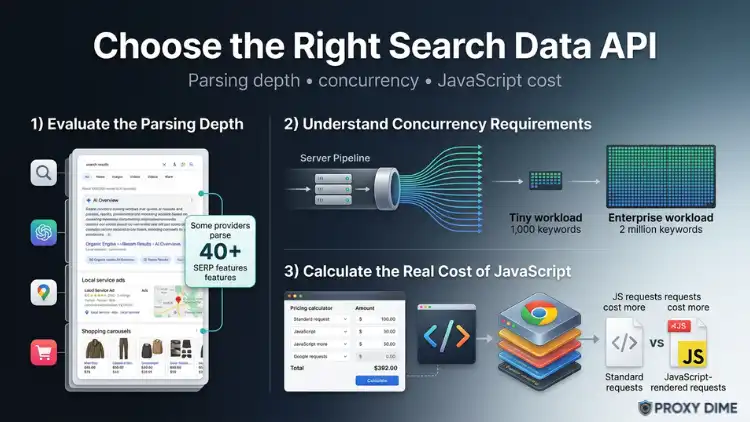
Evaluate the Parsing Depth
If you only need organic rankings (Title, URL, Position), almost any provider will work. However, if your application monitors the volatility of Google’s AI Overviews, Local Service Ads, or Shopping Carousels, you need a provider like Oxylabs that actively parses over 40 distinct SERP features. Building regex to parse AI summaries internally is a maintenance nightmare.
Understand Concurrency Requirements
If you are tracking 1,000 keywords a day, concurrency does not matter. If you are an enterprise SEO platform refreshing 2 million keywords every Monday morning, rate limits will destroy your business model. Bright Data is the clear choice here, as they do not cap concurrent requests, allowing your server to pull data as fast as it can process it.
Calculate the Real Cost of JavaScript
Google increasingly relies on JavaScript to load search components. Some providers charge 2x to 5x more per request if JS rendering is required (e.g., Decodo charges $0.50/1k for standard, but $0.75/1k if JS is needed). Scraper API includes JavaScript rendering natively, which can drastically alter your cost calculations if your targets are dynamic.
Final Thoughts
The decision comes down to volume, data depth, and engineering resources. For absolute reliability and deep feature extraction across massive datasets, Oxylabs and Bright Data remain the enterprise standards.
For startups and developers who need to launch quickly without infrastructure headaches, Scraper API offers the lowest friction to production with native JS rendering. If your use case requires navigating heavily protected domains beyond just search engines, ZenRows provides the necessary anti-bot capabilities.
Stop wasting developer hours fixing broken regex parsers and rotating banned IPs. Use an API, get the JSON, and focus on analyzing the data instead.