You bought 10 GB of residential proxies from a provider you found on Reddit. The scraping jobs ran fine for a week. Then a client asked where those IPs came from.
You had no answer. Were those real devices with opt-in consent? Or was some app silently routing traffic through phones in developing countries without telling their owners?
That question matters more now than ever. Google and major platforms have started fingerprinting traffic not just by IP type but by P2P proxy network behaviour and trust patterns. A residential IP is only as valuable as the peer network behind it.
If the network is built on shady bandwidth-harvesting apps, those IPs get burned fast and carry fraud scores that tank your success rates.
I have run residential proxy setups through consent-based P2P proxy providers for scraping, social media management, and ad verification over the past few years. This guide covers the 7 best P2P proxy providers in 2026 based on peer network quality, ethical sourcing transparency, pool size, pricing, and real performance.
🔎 How P2P Proxy Networks Actually Work
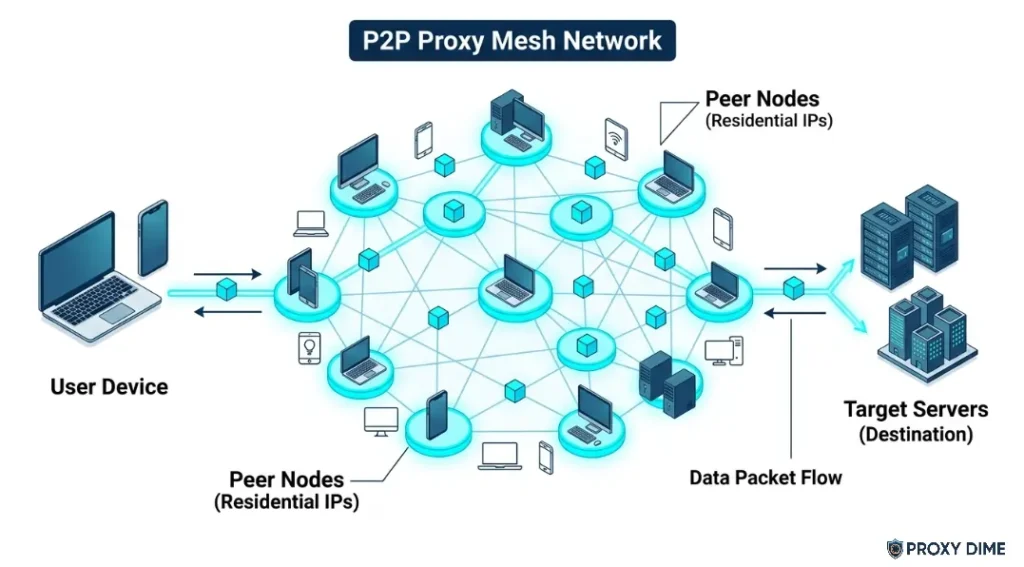
A P2P proxy network routes your internet traffic through real devices owned by people who have agreed to share their bandwidth. The “peers” in P2P are regular internet users. They install an app, consent to share idle bandwidth, and receive compensation (usually free premium features, small payments, or app credits) in return.
When you send a request through a P2P proxy, it travels from the provider's gateway server to one of these peer devices. The peer device forwards your request to the target website. That website sees a genuine residential IP assigned by a real internet service provider, not a datacenter range. The response travels back through the same path.
This is what separates P2P residential proxies from datacenter proxies. Target websites treat peer-sourced IPs with higher trust because the IP address history shows normal browsing behaviour from a real household. That trust translates directly into lower block rates, fewer CAPTCHAs, and better success rates on platforms like Google, Amazon, Instagram, and TikTok.
Not all P2P networks are equal, though. The quality gap between providers comes down to how peers are recruited, what consent mechanisms exist, how the provider handles peer node availability, and how often fresh peers join the pool. Providers with transparent sourcing and active peer recruitment deliver cleaner, more reliable IPs than those relying on buried SDK integrations.
Quick Tip: For P2P proxies, ethically sourced residential pools typically outperform cheaper alternatives with unclear IP origins because consent-based peers maintain healthier IP trust scores. Prioritise providers that publicly document their peer onboarding process.
Trusted P2P Proxy Providers Tested for Real-World Use
| Proxy Provider | P2P Network Edge | Ideal Workflow |
|---|---|---|
| Decodo | Transparent consent-based peers | Budget scraping at scale |
| Webshare | Verified ethical sourcing | Developer proxy testing |
| Thordata | Unlimited bandwidth P2P pool | Continuous data collection |
| Oxylabs | Largest verified peer network | Enterprise data pipelines |
| ZenRows | Anti-bot layer over P2P IPs | Protected site scraping |
| Bright Data | SDK peer ecosystem at 150M+ | Multi-market research |
| Proxy-Seller | Flexible geo-targeted peers | Location-specific tasks |
1. Decodo
Decodo (formerly Smartproxy) powers its residential P2P network through partnerships with app developers who integrate bandwidth-sharing SDKs with explicit user consent. The peer pool spans over 125 million residential IPs across 195+ countries and all 50 US states.
What makes this P2P network particularly useful for scraping is the rotation engine. You can set rotating sessions that assign a new peer IP per request or stick with the same peer device for up to 30 minutes.
The pay-as-you-go model at $12.5/GB means you only spend money when your scraper actually runs. Decodo fits developers and small teams that want a large ethically sourced P2P pool without monthly commitments.
P2P Network Highlights
What You Pay
Residential P2P proxies from $12.5/GB on pay-as-you-go. Subscription plans start at $30/month for datacenter. Residential plans with committed volume start lower per GB. Refund window available for testing.
Pros
Cons
Why Decodo for P2P Proxies
Decodo's consent-based SDK partnerships give you access to 125 million peer IPs without ethical grey areas. The pay-per-GB model keeps costs predictable for burst scraping jobs, and the rotation engine handles both rapid-fire requests and session-dependent workflows.
2. Webshare
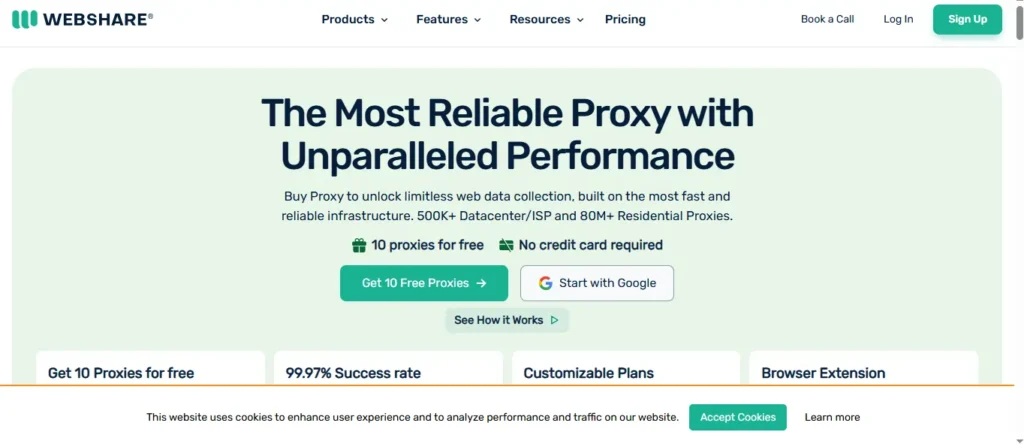
Webshare has built its residential P2P offering on what it calls a fully verified ethical sourcing model. Every residential IP in their network comes from documented sources, and the company publishes its proxy procurement policies openly.
Their peer network covers 50+ countries with over 30 million residential IPs. The free tier gives you 10 proxies and 1 GB of bandwidth per month with no credit card required, which is genuinely useful for testing P2P proxy quality before spending anything.
Webshare charges from $5.20/GB for residential traffic on the entry plan, dropping to $2.99/GB at higher volumes. This provider fits developers and startups that want to verify P2P proxy performance risk-free before scaling.
P2P Network Highlights
What You Pay
Residential P2P proxies from $5.20/GB on the starter plan. Business plans drop to $2.99/GB. Free plan includes 10 shared proxies plus 1 GB bandwidth. Static residential from $0.285/IP on annual plans.sites.
Pros
Cons
Why Webshare for P2P Proxies
The free tier is not a gimmick. You get real residential P2P access to test against your actual targets before any commitment. Pair that with documented ethical sourcing, and Webshare becomes the lowest-risk entry point into P2P proxy usage.
3. Thordata
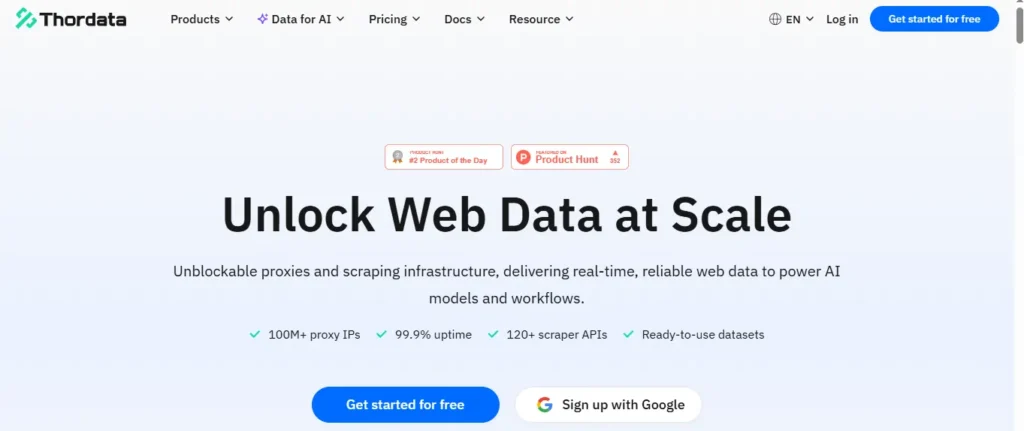
Thordata stands out in the P2P proxy space by offering something most competitors restrict at this price point. Unlimited bandwidth on their residential proxy plans. Their peer network includes over 100 million residential IPs with coverage across 195 countries and city-level targeting.
For continuous data collection workflows where bandwidth consumption is unpredictable, that unlimited model changes the budget calculation entirely. You stop worrying about per-GB costs and focus on the data pipeline itself. Thordata also holds SOC 2, ISO 27001, GDPR, and CCPA certifications, which adds a compliance layer that many P2P providers lack.
The free trial requires no credit card, lowering the barrier to test their peer network quality. Thordata fits teams running always-on scrapers and data feeds that cannot afford bandwidth surprises.
P2P Network Highlights
What You Pay
Residential proxies available from $0.65/GB on metered plans. Unlimited bandwidth plans priced per subscription tier. Free trial with no credit card.
Pros
Cons
Why Thordata for P2P Proxies
When your scraper runs 24/7 and bandwidth consumption varies by 300% week to week, unlimited plans eliminate the single biggest P2P proxy cost variable. The compliance certifications also make Thordata one of the few P2P providers that can pass enterprise vendor reviews.
4. Oxylabs
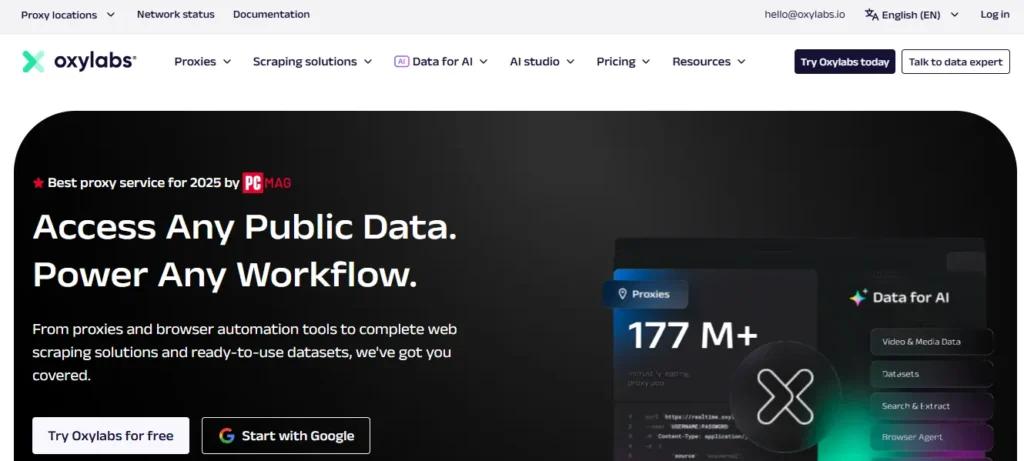
Oxylabs operates the largest verified P2P proxy network in the industry with over 175 million residential IPs sourced through ethical peer partnerships. The sheer size of this peer pool matters for large-scale operations.
When you rotate through 175 million IPs, your request pattern looks organic even at tens of thousands of daily queries against the same target. Their P2P residential proxies support city-level targeting across 195 countries, and sticky sessions hold a single peer IP for up to 24 hours.
Oxylabs also offers a Web Scraper API that layers automatic retry logic and anti-detection on top of the P2P residential pool. The entry price sits at $300/month for residential, making this a premium play. Oxylabs fits enterprise scraping teams and data engineering departments that need the deepest peer pool money can buy.
P2P Network Highlights
What You Pay
Residential P2P proxies start from $300/month (approximately $15/GB at entry). Volume pricing drops significantly on enterprise commitments. Next-Gen residential from $360/month. Mobile P2P from $500/month.
Pros
Cons
Why Oxylabs for P2P Proxies
Pool depth is the single biggest factor in sustained P2P proxy performance. At 175 million peers, Oxylabs gives you a rotation depth where target sites simply cannot pattern-match your traffic. The 24-hour sticky sessions also let you run account management workflows that most P2P providers cap at 30 minutes.
5. ZenRows
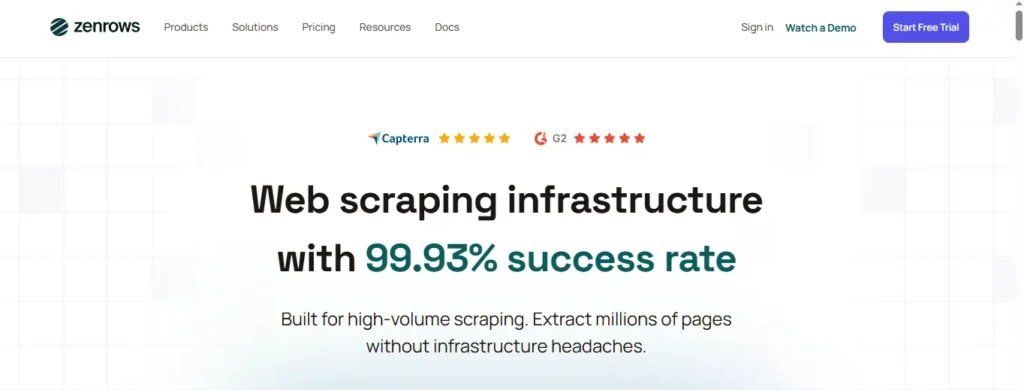
ZenRows wraps P2P residential proxy bandwidth inside a scraping API that handles the hard parts automatically. Instead of configuring proxy rotation, retry logic, and CAPTCHA solving yourself, ZenRows bundles all of it into a single API call.
Their residential proxy access runs through a P2P network, and plans start at $69/month with 12.73 GB of residential bandwidth on the Developer tier. The Universal Scraper handles anti-bot protections including Cloudflare, DataDome, and PerimeterX.
A headless Scraping Browser manages JavaScript-heavy pages through P2P residential IPs without extra infrastructure. ZenRows fits developers and data engineers who need P2P residential IPs but do not want to build the middleware between raw proxies and clean structured data.
P2P Network Highlights
What You Pay
Developer plan from $69/month (12.73 GB residential). Business plan from $299/month (60 GB). Enterprise plans with custom volumes available. 14-day free trial included.
Pros
Cons
Why ZenRows for P2P Proxies
If you are scraping Cloudflare-protected targets, raw P2P residential IPs alone will not get the job done. ZenRows layers anti-bot detection over P2P residential bandwidth in a way that turns a complex scraping stack into a single API endpoint.
6. Bright Data
Bright Data pioneered the P2P proxy model back when it was still called Luminati. Their peer network draws from a proprietary SDK ecosystem where app users consent to share bandwidth in exchange for premium app features.
The result is over 150 million IPs, including 72 million+ residential addresses from real peer devices across 195 countries. No other P2P provider matches this combined scale of residential, mobile, and ISP peer IPs under one roof. Bright Data also operates one of the most thorough KYC and compliance processes in the industry, requiring proxy buyers to verify their identity and intended use case.
That two-sided compliance (both peers and buyers) keeps the network cleaner than providers that skip verification. Bright Data fits agencies and enterprises that need the broadest P2P peer ecosystem with built-in governance.
P2P Network Highlights
What You Pay
Residential P2P proxies from $5.04/GB on pay-as-you-go. Volume discounts at higher commitments. Mobile proxies from $500/month. Free trial with limited credits available.
Pros
Cons
7. Proxy-Seller
Proxy-Seller approaches the P2P proxy market from a different angle than the big residential pool operators. They offer residential proxies sourced through peer partnerships alongside datacenter and ISP options across 220+ locations worldwide.
What makes Proxy-Seller distinctive for P2P use is the per-IP purchasing model. Instead of buying bandwidth by the GB, you can buy individual residential proxy access for specific locations on flexible terms. That works well for users who need P2P residential IPs in a particular city or country without committing to a large bandwidth pool.
Each IP supports unlimited bandwidth and both HTTP and SOCKS5 protocols. Proxy-Seller fits SEO professionals and small operators who need location-specific P2P residential IPs without buying into a full subscription.
P2P Network Highlights
What You Pay
Residential proxies available from approximately $1.39/IP per month for IPv4. IPv6 from $0.16/IP. No subscription or minimum commitment required. Pricing varies by location and rental duration.
Pros
Cons
👀 What Separates a Good P2P Proxy Provider from a Bad One
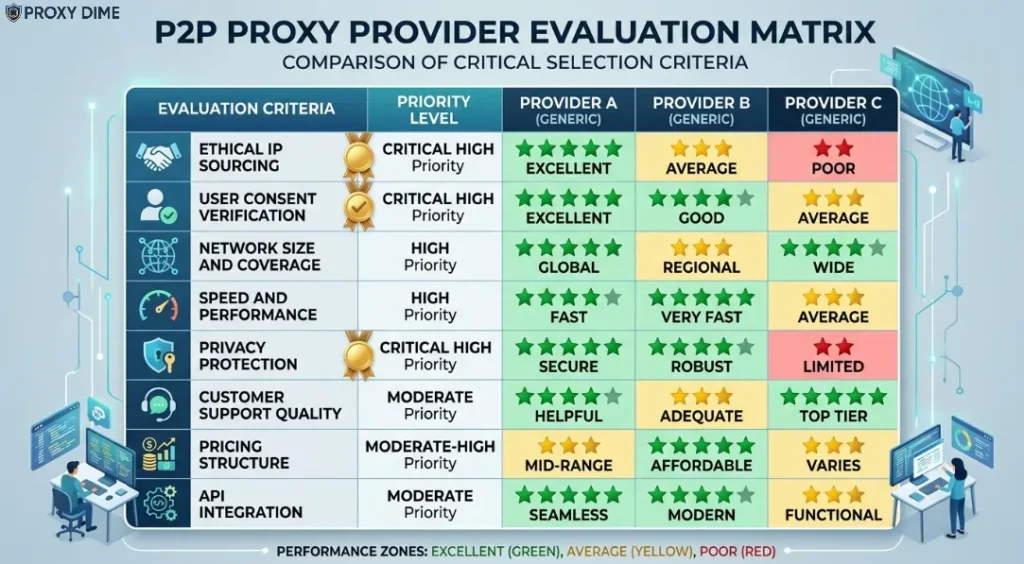
1. Peer Consent and Ethical Sourcing
This is the single most important factor when choosing a P2P proxy provider. Ask one question before anything else. Does the provider publicly explain how peers are recruited and what consent mechanism exists? Providers like Decodo, Webshare, and Bright Data publish their ethical sourcing policies.
If a provider cannot answer where their IPs come from, treat that as a red flag. Ethically sourced peers maintain higher IP trust scores because the underlying devices exhibit normal browsing patterns, not the erratic traffic of a hijacked connection. Choose providers that document their consent framework.
2. Peer Pool Freshness and Size
A P2P network's value depends on how many active peers are online at any given moment and how often new peers join. A pool of 100 million IPs means nothing if only 5% are active during your working hours. Larger providers like Oxylabs and Bright Data maintain higher concurrent peer availability simply because their SDK partnerships reach more app users globally.
Ask about concurrent online peers, not just total pool size. Fresh peer recruitment also matters because older peer IPs accumulate history that can include flags from other proxy buyers. Prioritise providers that actively grow their peer base.
3. Geo-Targeting Accuracy at Peer Level
When a P2P provider offers “city-level targeting,” they are promising that peer devices in that city are actually online and available. Some providers list hundreds of cities but have only a handful of active peers in each.
That leads to slow connections and frequent timeouts as the system searches for an available peer in your requested location. For local SEO scraping or geo-restricted content access, inaccurate targeting wastes both time and bandwidth. Test geo-targeting accuracy during a free trial by requesting peers in specific cities and checking the actual IP geolocation against your request.
4. Session Stability on Peer Devices
Peer devices are real phones and computers that go offline, switch networks, and restart throughout the day. That instability is the core trade-off of P2P proxies. Good providers handle this by maintaining backup routing that seamlessly switches you to another peer when your current one drops.
Bad providers let the connection fail and count the bandwidth anyway. Sticky session duration also varies. Oxylabs offers 24-hour sticky sessions. Decodo caps at 30 minutes. Match the sticky session length to your workflow. Account management needs hours. Rapid scraping needs seconds. Choose accordingly.
5. Cost Structure Per GB vs Per IP vs Unlimited
P2P proxy pricing falls into three models. Per GB (Decodo at $12.5/GB, Bright Data at $5.04/GB). Per IP (Proxy-Seller from $1.39/IP). Unlimited bandwidth (Thordata per subscription). The right model depends on your usage pattern.
If bandwidth consumption is unpredictable, unlimited plans remove budget surprises. If you run controlled scraping jobs with known data volumes, per-GB pricing keeps costs tight. Per-IP works when you need specific locations and low volume. Calculate your expected monthly GB consumption before comparing prices.
🌟 Frequently Asked Questions About P2P Proxy Providers
What is a P2P proxy network?
A P2P (peer-to-peer) proxy network routes your internet traffic through real devices owned by people who have opted in to share their bandwidth. Each peer acts as a mini relay server. Your requests appear to come from a genuine residential IP, making your traffic look organic to target websites. The “peer” element means real people are willingly participating in the network.
How do P2P proxies differ from datacenter proxies?
P2P proxies use IP addresses assigned to real household devices by internet service providers. Datacenter proxies use IPs from commercial server farms. Websites trust P2P residential IPs more because they look like normal internet users. Datacenter IPs get flagged more frequently because their IP ranges are publicly known and associated with automated traffic.
Are P2P proxies ethically sourced?
That depends entirely on the provider. Reputable providers like Decodo, Webshare, Bright Data, and IPRoyal use consent-based models where peers knowingly agree to share bandwidth. Some lower-tier providers embed hidden SDKs in free apps without clear disclosure. Always verify a provider's sourcing policy before purchasing.
How much do P2P proxies cost in 2026?
Pricing ranges widely. Budget options like Webshare start residential access at $5.20/GB. Mid-range providers like Decodo charge $12.5/GB on pay-as-you-go. Premium options like Bright Data start from $5.04/GB. Oxylabs begins at $300/month. Thordata offers unlimited bandwidth plans that remove per-GB pricing entirely.
What is the best proxy type for web scraping?
Rotating P2P residential proxies are the strongest choice for web scraping because they combine high IP trust with automatic rotation. Each request comes from a different genuine residential IP, making it nearly impossible for target sites to identify patterns. For JavaScript-heavy or Cloudflare-protected targets, combining P2P proxies with a scraping API like ZenRows improves success rates further.
Can P2P proxies be detected by websites?
All proxies carry some detection risk. However, P2P residential proxies are significantly harder to detect than datacenter or shared proxies because the IP addresses belong to real ISP customers. Detection usually happens when traffic volume from a single peer IP exceeds normal residential behaviour. Proper rotation settings and bandwidth throttling reduce detection risk to near zero on most platforms.
Can I use free P2P proxies for scraping?
Free proxy lists are almost universally composed of abused, flagged, or abandoned IPs. They carry severe fraud scores and get blocked instantly on any serious target. Webshare's free tier offers a safer starting point with 10 proxies and 1 GB, though those are shared. For production scraping, paid P2P residential proxies are the only realistic option.

More Guides On Proxy Dime
🚀 Final Thoughts
The P2P proxy provider you choose should answer two questions clearly. Where do the peer IPs come from? And can the network sustain your workload? Decodo offers the most accessible entry point with pay-per-GB pricing and a verified consent framework.
Oxylabs delivers the deepest peer pool for enterprise operations that cannot afford IP exhaustion. Thordata makes sense when unpredictable bandwidth needs demand an unlimited model.
Take advantage of the free tiers and trials from Webshare, Thordata, and ZenRows to test peer quality against your actual targets before committing budget.
Start with a small scraping job. Check the success rate. Monitor the geo-accuracy. Then scale. Good P2P proxies should feel like invisible infrastructure. The best sign they are working is that you stop thinking about them entirely.