Your competitor pricing report showed a product at $49.99 across all US markets. The actual price in Houston was $42.99 with a regional promotion. Your report was wrong because the data collection ran from a single IP in Virginia, and the retailer served personalised results based on location, browsing history, and device type.
The market research services industry reached $96.77 billion in 2026, growing at 3.6% CAGR, with projections to hit $116 billion by 2030. That growth is driven by demand for predictive market intelligence, real-time customer feedback, and personalisation analytics. But the raw data powering all of that intelligence is only as accurate as the collection method.
Proxies for market research solve a fundamental data quality problem. Every major ecommerce platform, search engine, and review site serves different content based on the visitor's IP location, device fingerprint, and request history. Without proxies, your market research captures one version of reality. With the right proxy infrastructure, you capture every version, in every market, as every customer segment sees it.
I have built proxy-powered competitive intelligence pipelines that pull pricing, product availability, review sentiment, and search visibility data across 40+ countries simultaneously. This guide covers 9 providers tested against real market research workflows in 2026.
💎The Data Quality Problem Proxies Solve for Researchers
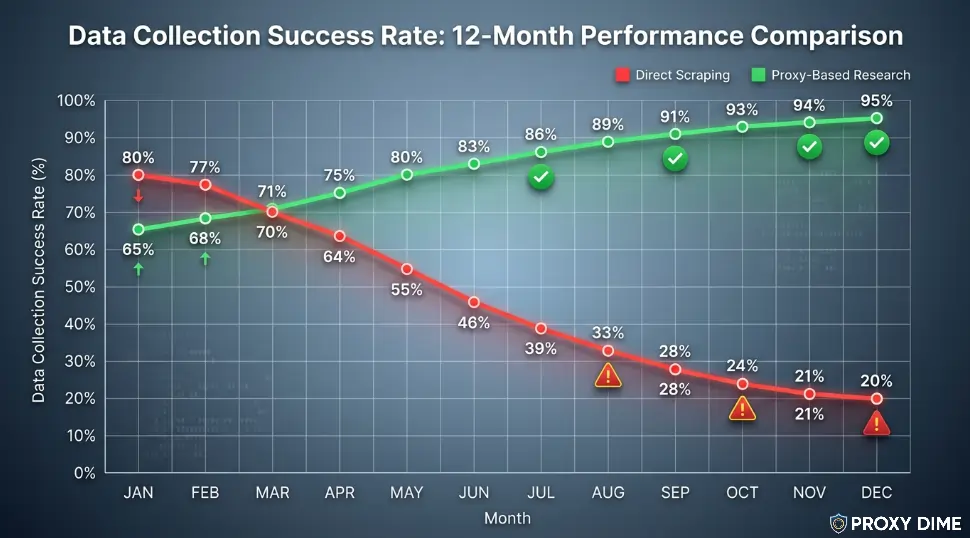
Market research proxies are not just about hiding your IP. They are about seeing the internet the way your research subjects see it. A consumer in Munich sees different Amazon pricing, different Google search results, different social media trending topics, and different ad placements than a consumer in Dallas or Jakarta.
The technical mechanism is straightforward. Your data collection script sends requests through a proxy server located in the target geography. The destination website sees a residential, mobile, or ISP address from that location and serves content exactly as it would to a local consumer. Your script captures that content. Repeat across every market you need to analyse.
Three types of market research depend heavily on proxy infrastructure.
Price monitoring and competitive intelligence. Retailers adjust prices by region, device, logged-in status, and even time of day. Accurate price research requires IPs in each target market to capture the localised price a real shopper would see.
Consumer sentiment and review analysis. Review platforms display different content rankings and filter results based on geography. A proxy in São Paulo shows you the reviews that Brazilian consumers actually read.
Search and visibility research. Google serves different organic results, featured snippets, and AI Mode responses based on searcher location. Accurate SERP research for market positioning requires location-specific proxies.
Residential rotating proxies deliver the best results for market research because they carry genuine ISP trust scores and appear identical to real consumers browsing from that location. Datacenter proxies get blocked on most major ecommerce and review platforms.
Quick Tip: For market research proxies, residential IPs outperform datacenter by a wide margin because Amazon, Google, Walmart, and review sites all assign lower trust scores to datacenter IP ranges. Prioritise providers with city-level or ZIP code targeting, since market conditions change at the metro level, not just the country level.
📈 Market Intelligence Landscape 2026: Key Number
Understanding the scale of the research industry contextualises why proxy infrastructure matters. These are the numbers shaping market research operations right now.
| Metric | 2026 Data | Growth Rate |
|---|---|---|
| Market research services | $96.77 billion | 3.6% CAGR |
| Marketing research and analysis | $87.6 billion | 3.7% CAGR |
| Global ad spend (total) | $1 trillion+ | 9.2% YoY |
| Digital share of ad spend | 68.7% | Rising |
| Projected research market 2030 | $116.02 billion | 4.6% CAGR |
The growth drivers listed in the 2026 market report are telling. Predictive market intelligence, automation in research execution, real-time customer feedback systems, and personalisation analytics are all listed as primary growth catalysts. Every single one of those requires large-scale, geo-specific web data collection. That is exactly what proxy infrastructure enables.
💪 Technical Parameter Comparison 2026
| Provider | Geographic Depth | Success Rate |
|---|---|---|
| Oxylabs | ZIP, coordinates, ASN | 99.82% |
| Decodo | ZIP, ASN, city | 99.86% |
| Bright Data | ZIP, carrier, city | 99.9%+ |
| Thordata | City, ASN, ISP | 99.9% |
| NodeMaven | City, ISP (1,400+ cities) | 99.54% |
| IPRoyal | City level | Mid-tier |
| Webshare | Country, state | 99.97% uptime |
| ZenRows | Country level | Anti-bot optimised |
| Proxy-Seller | 220+ locations | Dedicated IPs |
1. Oxylabs
Oxylabs provides the most complete data collection stack available for market research operations. Beyond their 177 million+ residential IPs across 195 countries with city, ZIP code, and coordinate-level targeting, they offer a Web Scraper API with dedicated parsers for Amazon, Walmart, eBay, Target, and Google.
The SERP Scraper API now includes a Google AI Mode scraper for collecting AI Overview responses across markets. Their AI Studio enables building custom market research data pipelines that combine web scraping with automated analysis. What makes Oxylabs particularly strong for competitive intelligence is the layered product approach. Use residential proxies for raw data flexibility.
Use Scraper APIs for structured output from Amazon or Google without maintaining parsers. Use pre-built Datasets for instant access to historical market data. The scheduled scraping feature automates recurring collection jobs with delivery to Amazon S3, Google Cloud Storage, or compatible cloud storage.
Oxylabs fits enterprise market research teams and consultancies that need a complete intelligence platform rather than just proxy connections.
Research Capabilities
Investment
Residential from $4/GB pay-as-you-go. Web Scraper API from $49/month (17,500 results). Enterprise pricing with committed volume discounts. Use code OXYLABS50 for 50% off residential.
Pros
Cons
Why Oxylabs for Market Research: The layered stack matters. A pricing analyst can use the eCommerce Scraper API for structured Amazon data, while the same team's SEO analyst uses the SERP Scraper API for search visibility research, and the strategy lead accesses pre-built Datasets for historical trend context. One vendor, three abstraction levels, zero scraper maintenance.
2. Decodo
Decodo positioned itself as the proxy of choice for ecommerce market research by building an eCommerce Scraping API with pre-built templates for Amazon, Walmart, eBay, Etsy, AliExpress, SHEIN, Target, Wayfair, and Idealo.
The API handles anti-bot bypass, JavaScript rendering, and CAPTCHA solving automatically. You send a product URL. You receive structured pricing, availability, review, and product specification data back in JSON, HTML, Markdown, or table format.
The underlying infrastructure of 125 million+ residential, mobile, datacenter, and ISP proxies across 195+ locations powers the collection. The Reddit scraping community considers Decodo “the industry standard for connectivity” when building custom scrapers.
What researchers particularly value is the pay-per-successful-result pricing on Scraper APIs, which means failed requests (blocked pages, timeouts) do not count toward your bill. A 99.86% success rate means fewer failures in the first place. Decodo fits pricing intelligence teams, ecommerce analysts, and market research agencies that collect product and pricing data from multiple online retailers.
Research Capabilities
Investment
Residential from $1.5/GB on larger plans. eCommerce Scraper API from $49/month. 100 MB free trial plus 14-day money-back guarantee.
Pros
Cons
Why Decodo for Market Research: The eCommerce Scraper API with pay-per-success pricing changes the economics of large-scale price monitoring. When you track 50,000 products across Amazon, Walmart, and Target daily, paying only for successful data returns instead of total bandwidth consumed reduces waste significantly. The 100+ pre-built templates eliminate the fragile scraper maintenance that breaks research schedules.
3. Bright Data
Bright Data operates what is arguably the broadest data collection ecosystem in the industry, with 150 million+ residential IPs, 1.6 million+ ISP IPs, 7 million+ mobile IPs, a Web Scraper API, a Web Unblocker, and a Dataset Marketplace offering pre-collected, structured data from Amazon, LinkedIn, Zillow, Glassdoor, and dozens of other platforms.
For market research consultancies, the Dataset Marketplace is particularly valuable because it provides historical, cleaned, and parsed data without running a single proxy request. Need six months of Amazon pricing history across 200,000 ASINs? Buy the dataset instead of building the infrastructure to collect it.
The Web Unblocker uses AI-driven fingerprinting and adaptive browser emulation to access the most protected research targets, including sites that block even residential proxies. Bright Data fits consultancies, large research agencies, and enterprise intelligence teams that need both raw collection capability and ready-made data products.
Research Capabilities
Investment
Residential from $5.04/GB pay-as-you-go. Datasets priced per volume. Web Unblocker from pay-per-success model. Free trial with credits available.
Pros
Cons
Why Bright Data for Market Research: The Dataset Marketplace is the differentiator for time-sensitive projects. When a client needs competitive intelligence by Friday and you do not have six weeks to build a scraper, buying a pre-collected Amazon or Google Shopping dataset and layering your own analysis on top is the practical move. Raw proxy access fills the gaps for custom targets the Marketplace does not cover.
4. Thordata
Thordata addresses the cost structure that makes continuous market monitoring prohibitively expensive at most providers. Their unlimited bandwidth residential plans mean tracking 100,000 product prices daily, or running weekly competitive analyses across 30 markets, does not generate a variable cost line item that grows with research scope.
The 100 million+ residential IPs cover 190+ countries with city, ASN, and ISP-level targeting. SOC 2 and ISO 27001 certifications meet the compliance requirements that enterprise clients demand from their research data suppliers.
For longitudinal market research (tracking how pricing, availability, and competitive positioning shift over 6 to 24 month periods), the fixed-cost bandwidth model provides budget certainty that per-GB pricing cannot match.
The no-credit-card free trial lets research teams validate data quality against their actual targets before procurement approval. Thordata fits market research operations running continuous, long-term data collection where bandwidth consumption would be the primary cost driver at other providers.
Research Capabilities
Investment
Metered residential from $0.65/GB. Unlimited bandwidth plans per subscription tier. Free trial without credit card required.
Pros
Cons
Why Thordata for Market Research: Market research that tracks trends over months or years consumes enormous bandwidth. A longitudinal pricing study monitoring 50,000 SKUs daily across 20 markets might use 500+ GB per month at a per-GB provider. At Oxylabs' $4/GB, that is $2,000/month in bandwidth alone. Thordata's unlimited model converts that variable into a predictable fixed cost.
5. NodeMaven
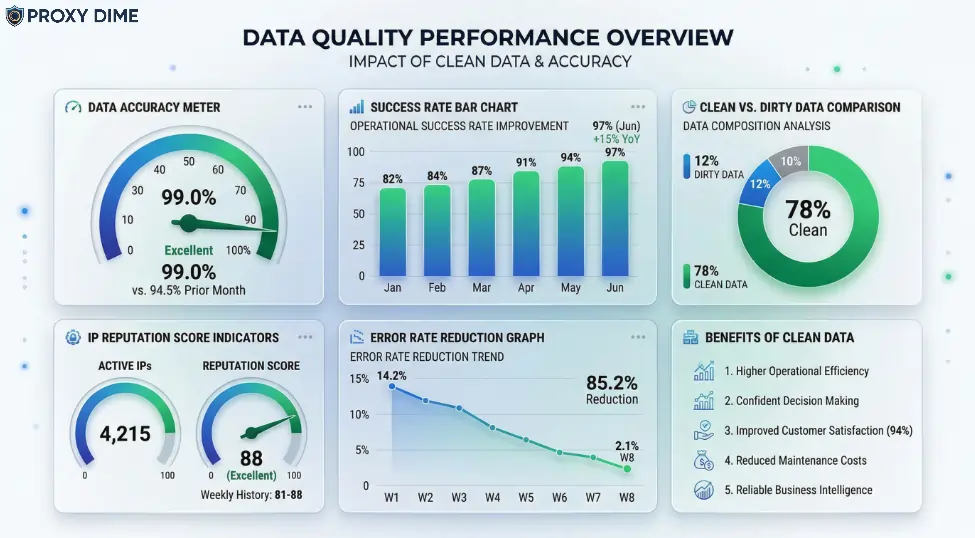
NodeMaven separates itself from larger providers through an IP Quality Filter that pre-screens every proxy for cleanliness before assignment. For market research, IP quality directly affects data accuracy. A “dirty” IP (previously flagged for automated activity) will receive different content from an ecommerce site than a clean residential address would.
The pool of 30 million+ residential IPs and 295,000+ mobile IPs covers 150+ countries and 1,400+ cities, with a 99.54% average success rate and sub-0.8 second response times. Sticky sessions hold for up to 24 hours, which is essential for research workflows that require maintaining a browsing session while navigating multi-page product catalogues or paginated search results.
The trial costs just €3.99 for 1 GB of bandwidth with full access to all features, which is enough to validate data quality against several hundred research targets. NodeMaven fits market research teams prioritising data accuracy over raw pool size, where the cleanliness of each IP matters more than having 100 million addresses to rotate through.
Research Capabilities
Investment
Residential from €2.22/GB on 500 GB plans. Entry at €6/GB for 5 GB. Trial at €3.99 for 1 GB. Use code AFFMAVEN50 for 50% off.
Pros
Cons
Why NodeMaven for Market Research: Data quality starts at the IP level. If the proxy you use has been flagged by Amazon or Google for automated activity, you receive different content than a clean residential user would see. NodeMaven's IP Quality Filter addresses this at the source, which matters for research where accuracy is the entire point.
6. IPRoyal
IPRoyal built a bandwidth model that fits the irregular rhythm of market research projects perfectly. Purchased residential bandwidth never expires, regardless of how long between uses. A research agency that runs intensive competitive analysis for three weeks, then pauses for a month during report writing, then fires up again for the next project does not lose prepaid data during quiet periods.
The residential pool covers 190+ countries with city-level targeting and supports both rotating and sticky sessions. For longer-term research, static residential (ISP) proxies maintain a consistent identity that prevents ecommerce sites from flagging you as a new visitor on every request, which matters when monitoring the same set of product pages over weeks or months.
Community testing places IPRoyal in the reliable mid-tier for success rates and response times. IPRoyal fits research agencies and freelance analysts with project-based workflows where monthly subscriptions create waste between engagements.
Research Capabilities
Investment
Residential from $1.75/GB with non-expiring traffic. Static residential priced separately. Use code AFFMAVEN10 for 10% off.
Pros
Cons
7. Webshare
Webshare's free plan with 10 proxies and 1 GB of monthly bandwidth lets market research startups and solo analysts build and test collection pipelines at zero cost. That might sound trivial, but for a freelance researcher validating whether proxy-powered data collection is feasible for their business model, it removes the entry barrier entirely.
The paid residential pool reaches 80 million+ IPs across 195 countries with a 99.97% uptime guarantee. ISP proxies from Comcast and AT&T carry high trust scores on US ecommerce platforms, which translates into cleaner data returns on price monitoring and availability checks.
The API supports integration with Python (requests, Scrapy, Selenium), Node.js, and most research automation frameworks. Webshare fits research startups prototyping data collection systems and budget-conscious analysts who need reliable residential access without premium pricing.
Research Capabilities
Investment
Residential from $3.50/month ($1.75/GB). ISP from $6/month. Free plan always available.
Pros
Cons
8. ZenRows
ZenRows solves a specific market research headache. Collecting data from heavily protected websites that block even residential proxies through Cloudflare, DataDome, PerimeterX, and similar systems. When your research requires data from a competitor's website that runs aggressive anti-bot protection, a standard residential IP may not be enough.
ZenRows wraps residential proxy access inside an anti-bot bypass engine that handles JavaScript challenges, TLS fingerprinting, and browser emulation automatically. The system supports up to 400 concurrent requests for parallel multi-target research.
The 14-day free trial with 1,000 requests provides enough capacity to test against actual protected research targets. ZenRows fits market research teams that specifically struggle with collecting data from well-protected competitor websites, SaaS platforms, or gated marketplaces.
Research Capabilities
Investment
Developer from $69/month (12.73 GB). Business from $299/month (60 GB). 14-day free trial included.
Pros
Cons
9. Proxy-Seller
Proxy-Seller offers dedicated individual IPs across 220+ locations on flexible rental terms from a single day to 12 months. For market research, the per-IP dedicated model matters in a specific scenario.
When you need to monitor a fixed set of competitor sites from consistent geographic locations over weeks or months, a dedicated IP builds a browsing history that the target site recognises as a returning visitor rather than a new automated request.
Buy 15 dedicated IPs in your 15 target markets. Each IP accumulates session history and cookies that make subsequent requests look like returning customers checking prices. This approach works particularly well for B2B pricing research where sites display different rates based on visitor behaviour patterns.
Each IP includes unlimited bandwidth and supports HTTP and SOCKS5. Proxy-Seller fits research teams running fixed-geography, long-term competitive monitoring where consistent visitor identity improves data accuracy.
Research Capabilities
Investment
Datacenter IPv4 from $1.39/IP per month. ISP IPs priced per location. Daily rental available.
Pros
Cons
🔥 Five Research Workflow Patterns and Which Provider Fits Each
Rather than a generic buyer's guide, here are five real market research workflows I have run, with the provider that performs best for each.
Pattern 1: Daily Ecommerce Price Intelligence
You track 10,000 to 100,000 SKUs across Amazon, Walmart, Target, and regional retailers. Prices update daily. The scraper runs every morning and feeds a dashboard.
Decodo's eCommerce Scraper API handles this with pre-built parsers and pay-per-success pricing. Oxylabs' Web Scraper API is the premium alternative with Amazon, Walmart, and eBay-specific endpoints. Both eliminate the fragile custom scrapers that break every time a site updates its layout.
Pattern 2: Quarterly Competitive Landscape Reports
A consultancy collects competitor data across pricing, product positioning, review sentiment, and search visibility every quarter. Heavy collection for 2 to 3 weeks. Quiet for 2 to 3 months.
IPRoyal's non-expiring bandwidth prevents waste between projects. NodeMaven's traffic rollover serves the same purpose with higher IP quality. Avoid monthly subscription models that charge during quiet periods.
Pattern 3: Longitudinal Trend Tracking
You monitor market conditions continuously for 6 to 24 months. Pricing shifts, product availability changes, seasonal patterns, and emerging competitor activity.
Thordata's unlimited bandwidth model turns this from a variable cost nightmare into a fixed monthly expense. At scale (500+ GB monthly), the savings versus per-GB providers can reach 60 to 80%.
Pattern 4: Protected Source Intelligence
Your research targets include SaaS platforms, gated B2B marketplaces, or heavily protected competitor sites that block standard residential proxies.
ZenRows' anti-bot bypass handles Cloudflare, DataDome, and PerimeterX automatically. Bright Data's Web Unblocker is the enterprise alternative with AI-driven fingerprinting.
Pattern 5: Localised Consumer Research
You need to see exactly what consumers in specific cities experience. Local search results, regional promotions, location-specific product availability.
Oxylabs' coordinate-level targeting pins collection to exact latitude/longitude. NodeMaven's 1,400+ city selection covers more metro areas per country than most competitors. Avoid providers with country-only targeting for this workflow.

More Guides On Proxy Dime
🎯 Final Thoughts
The right proxy for market research depends on your collection volume, target complexity, and project structure. Oxylabs delivers the most complete stack with raw proxies, scraper APIs, and pre-built datasets under one roof.
Decodo offers the best ecommerce-specific value with pay-per-success pricing and 100+ pre-built templates. Thordata makes continuous, large-scale monitoring financially viable with unlimited bandwidth.
Start with Decodo's free trial for ecommerce research or NodeMaven's €3.99 trial to test IP quality against your targets. Validate the data before committing to a monthly plan.
The accuracy of the proxy determines the accuracy of the research, and the accuracy of the research determines the quality of every business decision that follows. Get the foundation right first.