Your competitor just undercut your pricing by 12%. You found out two weeks late because you were manually checking their website from one IP address. By the time you adjusted, they had already captured your top accounts. This is what running a small business without proper proxy infrastructure looks like in 2026.
The global proxy server market hit $1.13 billion this year, with SME adoption growing as the fastest segment according to industry forecasts. Small businesses now use proxies for everything from competitor price monitoring and ad verification to local SEO tracking and brand protection across multiple markets.
But most proxy providers for small business price their plans for enterprises spending $500 plus monthly, leaving five person teams and solo founders overpaying for capacity they never use.
I have set up proxy stacks for e-commerce shops monitoring 3 competitors, marketing agencies verifying client ad placements across 6 countries, and local service businesses tracking Google rankings in 15 cities. The providers below are the ones that actually work at SMB budgets and workflows.
What Small Businesses Actually Use Proxies For?
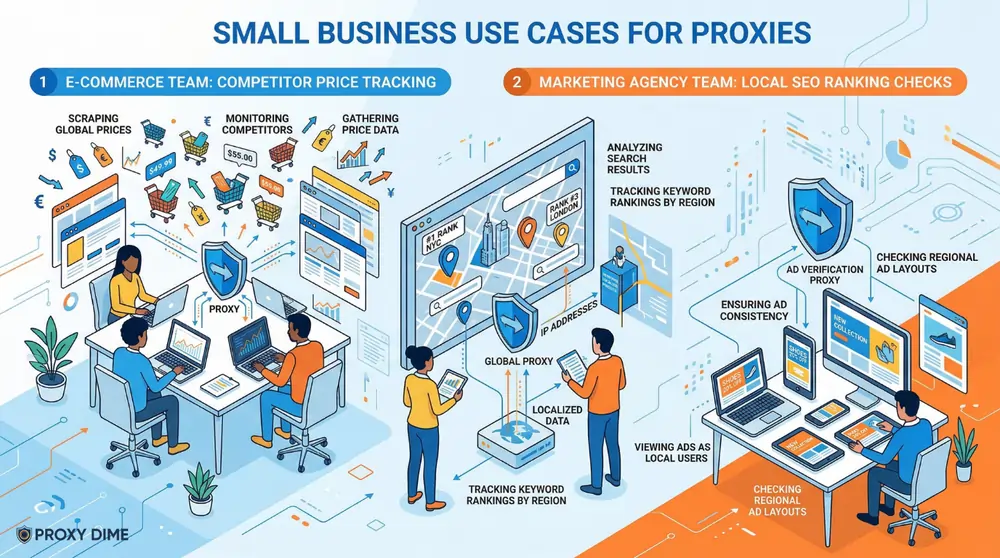
A proxy provider for small business routes your internet traffic through intermediary servers, letting your team collect data, verify ads, monitor competitors, and manage accounts from different locations without exposing your real IP or triggering blocks.
This is not enterprise tooling repurposed for smaller budgets. Small businesses have distinct proxy needs. A five person e-commerce team needs to track 500 competitor product prices daily across Amazon, Walmart, and direct competitor sites. A local marketing agency needs to check Google rankings from 20 specific cities for 8 client accounts. A DTC brand needs to verify that their Facebook and Google Ads display correctly in each target market.
Without proxies, these tasks either fail (rate limited, blocked, shown wrong geo results) or require manual effort that eats hours your small team does not have. The proxy market has responded. Providers now offer plans starting under $15 per month with pay-as-you-go options that fit irregular small business workflows.
Residential proxies work best for most SMB tasks because they carry real ISP trust scores that platforms accept. Datacenter proxies cost less and suit non-sensitive targets like public directories or open data sources. ISP proxies split the difference with residential trust at datacenter stability.
10 Proxy Providers for Small Business Budgets 2026
| Proxy Provider | SMB Advantage | Ideal User |
|---|---|---|
| Decodo | Lowest PAYG entry point | Solo founders |
| Webshare | Free forever starter plan | Bootstrapped startups |
| Bright Data | Full stack proxy suite | Growing data teams |
| Oxylabs | Highest data accuracy | E-commerce operators |
| Thordata | $13/mo starter plan | Budget developers |
| ZenRows | Scrape without engineers | Non-technical owners |
| Proxy-Seller | Dedicated IPs per market | Local service businesses |
| IPRoyal | Traffic never expires | Seasonal businesses |
| Geonode | $1/GB residential | Price sensitive scrapers |
| NodeMaven | Clean residential IPs | Agency account managers |
1. Decodo

Decodo earned its reputation as the go-to proxy for smaller enterprises and first-time users, and CNET specifically called it “the best proxy server for smaller businesses” in their 2025 review. The reasoning is straightforward. Residential proxies at $3.50 per GB on pay-as-you-go means a small e-commerce team can monitor 200 competitor product pages for under $5 in bandwidth.
The 125 million plus IP pool covers 195 countries with city-level targeting, so a local bakery chain tracking Google Maps rankings across 12 cities gets accurate local results without technical gymnastics. Decodo also bundles a browser extension that turns proxy configuration into a two-click process.
No API knowledge needed. For a marketing agency checking client ad placements in different countries, the extension alone saves hours of setup time that a small team cannot afford to waste.
Decodo Pros
Decodo Cons
Free residential trial, PAYG from $3.50/GB
2. Webshare
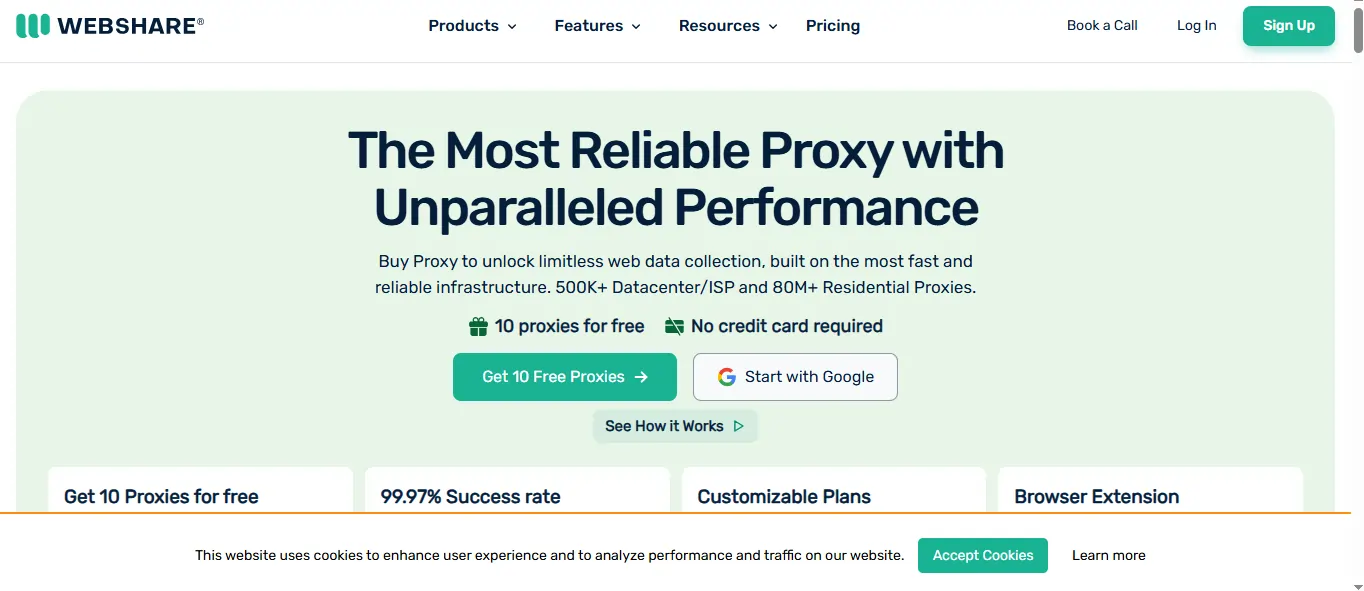
Webshare is the only provider on this list where a small business can start using proxies today and pay absolutely nothing. The free plan includes 10 proxies with 1 GB of monthly bandwidth and requires no credit card. That is enough for a solo founder to test competitor monitoring scripts or verify local ad placements before spending a penny.
The paid tiers scale gently. Datacenter proxies start at $0.029 per IP, and ISP proxies at $6 per month for 20 addresses. CNET rated Webshare as the best budget proxy server overall, noting that its IP pool and performance exceed expectations given the low pricing.
For small businesses running market research, the proxy use case guides on their site walk through competitor analysis, pricing intelligence, and ad verification workflows step by step.
Webshare Pros
Webshare Cons
Start free, upgrade when ready
3. Bright Data
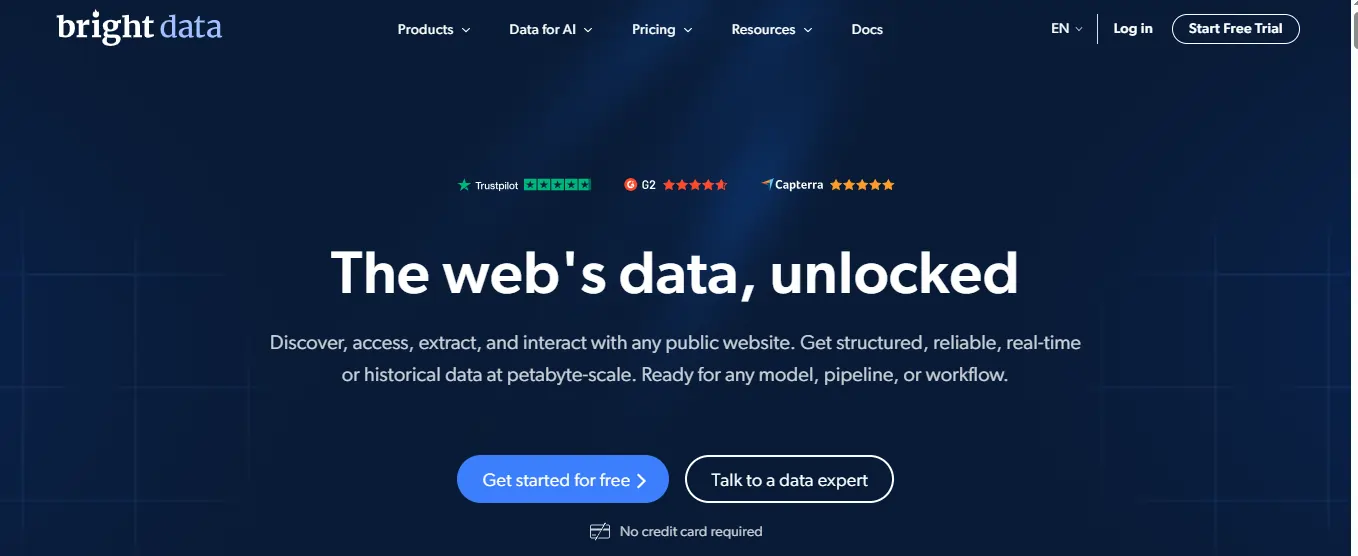
Bright Data is the largest proxy infrastructure available, and while it is often associated with enterprise deployments, the 2026 pricing structure includes genuine SMB entry points. New accounts get residential proxies at $4 per GB on pay-as-you-go, and datacenter bandwidth starts at just $0.60 per GB. The real value for a growing small business is the range of tools under one roof.
Web Scraper APIs for e-commerce price monitoring, SERP APIs for SEO tracking, and a full Proxy Manager for custom workflows all sit inside the same dashboard.
A small team that starts with competitor price scraping can expand into ad verification and SEO monitoring without switching providers or migrating data. The 150 million plus IP pool means no small business will ever hit capacity limits, even as the company grows.
Bright Data Pros
Bright Data Cons
Free trial with deposit match up to $500
4. Oxylabs
Oxylabs positions itself as the provider for businesses that cannot afford inaccurate data. The 99.82% success rate and 175 million plus IP pool produce the highest data reliability on this list. For a small e-commerce business where a missed competitor price change costs real revenue, that accuracy gap between 95% and 99.82% translates directly into money.
Their residential PAYG starts at $9 per GB with a 1 GB minimum top-up, which keeps the entry accessible for smaller operations. ISP proxies begin at $1.60 per IP for 10 addresses, a reasonable starting point for local monitoring tasks. Where Oxylabs really serves small business is through Scraper APIs that handle JavaScript rendering, CAPTCHA solving, and data parsing without requiring engineering staff.
Oxylabs Pros
Oxylabs Cons
💲 Get 40% Off Oxylabs Proxies Now!

Slash 40% off premium proxies and web scraping tools with code OXYLABS40. Boost your data projects with reliable, high-speed access—perfect for businesses scaling fast.
5. Thordata

Thordata built its pricing for the exact budget reality most small businesses live in. The Basic plan starts at $13 per month, which is cheaper than most SaaS subscriptions small teams already carry. Residential proxies on pay-as-you-go sit at $1.80 per GB, and the rate drops to $0.65 per GB at modest volume thresholds.
A DTC brand monitoring competitor prices on 10 rival websites can run a weekly scrape for under $3 in bandwidth. The 60 million plus IP pool covers 195 countries with ASN filtering, which means a local business can select IPs from the exact internet service provider their customers use.
New accounts can request a 1 GB residential trial at no cost, and the introductory offer of 5 GB for $4 ($0.80/GB) removes financial risk almost entirely.
Thordata Pros
Thordata Cons
Free 1 GB residential trial on request
6. ZenRows
ZenRows solves a specific small business problem. You need data from competitor websites, but you do not have a developer on staff to build and maintain scrapers. The Universal Scraper API handles anti-bot bypass, JavaScript rendering, CAPTCHA solving, and data extraction in a single API call.
A marketing agency owner can pull competitor pricing from Cloudflare-protected e-commerce sites without writing a line of custom anti-detection code. Plans start at $49 per month for the Developer tier with 250,000 API credits, and the documentation includes sample code for Python, Node.js, and direct HTTP requests.
The AI Web Unblocker intelligently manages access challenges, making it particularly effective for small businesses scraping protected platforms like Amazon, LinkedIn, or major retailer sites.
ZenRows Pros
ZenRows Cons
Free trial included
7. Proxy-Seller
Proxy-Seller provides dedicated IPs that small businesses can assign to specific markets or client accounts without sharing with anyone. For a local service business (plumber, dentist, law firm) that needs to verify their Google Business Profile listings from specific cities, a dedicated IP in each target city produces consistent, reliable results.
The 220 plus country coverage is the widest on this list, and ISP proxies start at just $3 per month for a single address. A small agency managing local SEO for 5 clients in different cities can set up 5 dedicated ISP proxies for $15 per month total. Automatic IP replacement when quality degrades means the team never needs to troubleshoot connection issues manually.
Proxy-Seller Pros
Proxy-Seller Cons
Dedicated ISP proxies from $3/month
8. IPRoyal
IPRoyal offers something particularly useful for seasonal small businesses. Their residential proxy traffic never expires. Buy 5 GB today, use 2 GB this month for holiday season competitor research, and the remaining 3 GB sits in your account for the next campaign.
The 34 million plus IP pool covers 195 countries with a 4.6 Trustpilot rating from over 3,000 reviews. Integration works with 650 plus tools and platforms, so connecting to existing business software is rarely an issue. For startups and smaller data teams, IPRoyal fills the gap between free tier limitations and enterprise commitments with genuine pay-as-you-go flexibility.
IPRoyal Pros
IPRoyal Cons
🔥 Get 10% Off IPRoyal Proxies Now!

Grab instant 10% savings on premium proxies with code AFFMAVEN10. Boost your web scraping, SEO, or browsing speed today—reliable residential IPs at unbeatable prices!
9. Geonode
Geonode targets price-sensitive small businesses with residential proxies at $1 per GB on their Starter plan and datacenter at $0.50 per GB. For a small team running daily competitor price checks across a handful of websites, that rate keeps monthly proxy costs in single digits.
The dashboard includes bulk endpoint generation for batch operations, granular geographic targeting for location-specific data, and port configuration for multi-app environments. All of this runs through an enterprise-ready management system that feels overkill for a solo operation but proves its worth the moment the team grows to three or four people managing different monitoring tasks.
Geonode Pros
Geonode Cons
Residential proxies from $1/GB
10. NodeMaven
NodeMaven provides clean, ethically sourced residential proxies with advanced geo-targeting that suits small agencies managing multiple client accounts. The ISP-based filtering lets you select proxies from specific internet providers, which keeps local SEO checks and ad verification accurate to the neighbourhood level.
Static and rotating residential options are both available, and the 24/7 support means a small team running into a configuration issue at midnight does not have to wait until business hours. Flexible pricing caters to both solo operators and growing businesses without forcing enterprise tier commitments.
NodeMaven Pros
NodeMaven Cons
🚀 NodeMaven 50% Flash Sale – Use AFFMAVEN50

Score an exclusive 50% discount on NodeMaven services with code AFFMAVEN50. Enjoy seamless Node.js development, blazing speeds, and expert support.
The SMB Proxy Market in 2026 (What Changed)
The proxy market is not what it was even two years ago. The global proxy server service sector reached $1.13 billion in 2026 and is forecast to hit $2.04 billion by 2035 at a 6.5% compound annual growth rate. The SME segment is growing faster than enterprise adoption, driven by cloud-based proxy deployment that eliminates the infrastructure costs small businesses historically could not absorb.
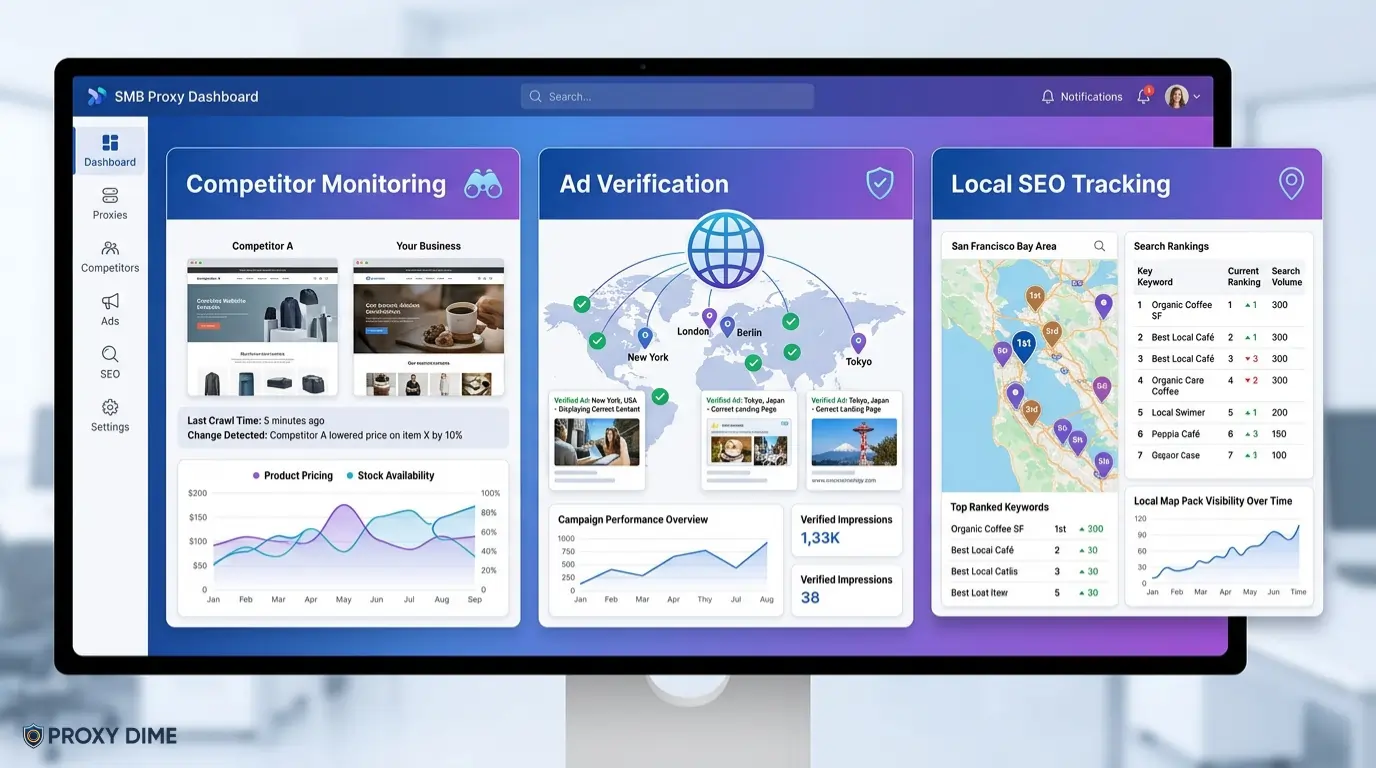
Three shifts matter for small businesses specifically. First, pay-as-you-go models are now standard rather than exceptions. Decodo, Thordata, IPRoyal, and Bright Data all offer genuine PAYG without minimum contracts.
Second, scraping APIs (from ZenRows, Bright Data, and Oxylabs) have turned data collection from an engineering project into an API call, removing the developer bottleneck that kept small teams from using proxies at all. Third, ISP proxies have dropped to $1.60 to $3 per IP monthly, creating a new price tier between datacenter (cheap but often blocked) and residential (trusted but expensive per GB).
The practical result is that a five person business can now run competitor monitoring, ad verification, and local SEO tracking for under $50 per month in total proxy costs. That was not realistic in 2023.
💲 Proxy Budgeting for a 5 to 10 Person Team
Monthly Cost Reality
Small business proxy budgets fall into three tiers based on actual tested usage patterns.
Under $20 per month covers basic competitor price monitoring (10 to 20 sites, weekly checks) using Thordata at $13/month or Webshare's free tier plus a minimal ISP upgrade. This tier works for local service businesses tracking 3 to 5 competitors in one market.
$20 to $75 per month handles regular competitor monitoring, local SEO rank tracking across multiple cities, and basic ad verification. Decodo PAYG at $3.50/GB or Geonode at $1/GB keep costs predictable at this volume. Most e-commerce small businesses sit in this range.
$75 to $200 per month supports daily multi-market monitoring, systematic ad verification across platforms, and regular SERP data collection. Bright Data's full suite or Oxylabs ISP plus Scraper API combinations fit teams that treat data collection as a core business function.
Avoiding Overcommitment
The biggest mistake small businesses make is buying annual enterprise plans to save per-GB costs and then using 30% of the capacity. Start with PAYG. Track actual usage for 60 days. Then evaluate whether a plan saves money against your real consumption numbers.
Answers to Small Business Proxy Questions
What is a proxy provider for a small business?
A proxy provider for small business supplies intermediary servers that route internet traffic through different IP addresses, enabling competitor monitoring, ad verification, local SEO tracking, and market research without blocks or geo-restrictions.
These providers offer plans starting under $15 monthly to match SMB budgets rather than enterprise spending levels.
How do small businesses use proxies day to day?
Small businesses connect proxies to scraping tools, browser extensions, or APIs that automate data collection tasks.
A typical workflow involves routing requests through residential or ISP proxies to collect competitor pricing, verify ad placements across markets, or check local search rankings from different cities.
The proxy handles IP rotation and geo-targeting while the business focuses on the data.
Which proxy type works best for small business?
ISP proxies offer the best balance for most small business tasks. They carry residential trust scores (so platforms do not block them) while maintaining the speed and stability of datacenter infrastructure.
For businesses scraping non-protected public data sources, datacenter proxies at $0.029 to $0.60 per GB cost less and perform reliably.
How much should a small business budget for proxies?
Most small businesses spend between $15 and $75 per month on proxies. Light monitoring with 5 to 10 competitors costs under $20 using Thordata or Webshare.
Regular multi-market competitor tracking and ad verification runs $50 to $100. Budget $1 to $9 per GB for residential and $0.029 to $1.60 per IP for datacenter or ISP depending on provider.
Are proxies legal for small business competitor monitoring?
Yes. Using proxies to collect publicly available data from competitor websites is legal in most jurisdictions. Price monitoring, ad verification, and SERP tracking are standard business intelligence practices. Always respect website terms of service and applicable data protection regulations in your market.
Can a small business use free proxies for monitoring?
Free proxy services lack the reliability, speed, and IP quality that business operations require. Webshare's free tier with 10 proxies is the exception, offering a genuine starting point for basic tasks.
For anything beyond initial testing, even a $13 monthly plan from Thordata outperforms free alternatives by a wide margin in uptime, success rates, and data accuracy.
Do I need technical knowledge to set up business proxies?
Not necessarily. Decodo's browser extension requires zero technical skill. ZenRows handles everything through a single API call.
Webshare's self-service dashboard guides new users through configuration. Technical knowledge helps with custom integrations, but most small business proxy tasks can run through pre-built tools and browser extensions.
Final Thoughts
Decodo gives small businesses the smoothest entry at $3.50/GB PAYG with tools built for non-technical teams. Thordata wins on pure budget with $13/month plans and $0.65/GB at volume. Webshare removes all risk with its free forever tier.
Start free with Webshare or grab Thordata's 1 GB trial to test against your actual targets. The right proxy provider is the one that costs less than the business intelligence it produces. For most small businesses, that bar is surprisingly low.