Your product catalogue runs 12,000 SKUs. A competitor just undercut 800 of them overnight. You know this because a customer told you, not because your data told you. That is the gap proxies for e-commerce fill.
Global e-commerce sales hit an estimated $6.88 trillion in 2026, a 7.2% jump from last year, with 2.86 billion people buying online across more than 40 major marketplaces.
Every one of those marketplaces guards its product data behind Akamai Bot Manager, Datadome, PerimeterX, and Cloudflare. Standard HTTP requests from your office IP get blocked within minutes.
I have spent the past several years building and maintaining scraping infrastructure for e-commerce brands, resellers, and retail analytics companies.
The difference between losing margin silently and catching competitor moves in real time comes down to how your proxy infrastructure handles marketplace anti-bot systems.
Harvard Business Review found that unauthorised retailers violate MAP policies 50% of the time. Without reliable proxy access to marketplace listings, you simply cannot enforce pricing agreements or respond to competitive shifts.
These 7 providers handle the specific technical demands of e-commerce data extraction in 2026.
🌐 The E-Commerce Data Landscape in Numbers
Before picking a proxy, understanding the scale of the challenge matters. Here is what the e-commerce data environment looks like right now.
| Metric | 2026 Figure | Source |
|---|---|---|
| Global e-commerce sales | $6.88 trillion | Shopify/DemandSage |
| Share of total retail | 21.1% | Shopify |
| Digital buyers worldwide | 2.86 billion | Flowlu |
| MAP violation rate (unauthorised sellers) | 50% | Harvard Business Review |
| Fastest growing region | Latin America (12.2% YoY) | Shopify |
| Bright Data ecommerce scrapers available | 286+ pre-built | Bright Data |
| Oxylabs marketplace targets | 50+ platforms | Oxylabs |
These numbers explain why e-commerce proxies are not optional for any business competing on product data.
When half of your unauthorised resellers violate advertised pricing and billions of shoppers are comparing products across dozens of platforms, automated data collection is the only way to keep pace.
🔏 How E-Commerce Proxies Protect Your Revenue
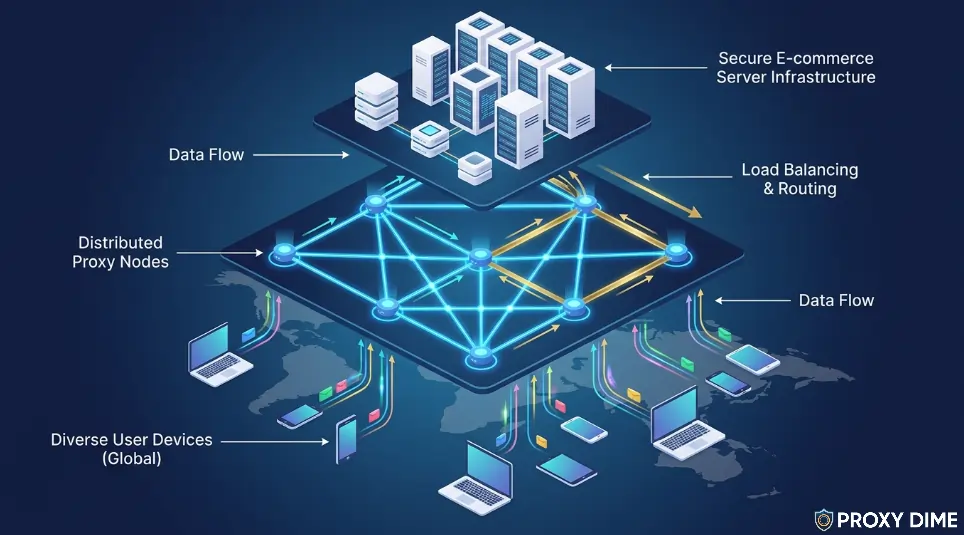
E-commerce proxies route your scraping, monitoring, and research traffic through IP addresses that marketplaces treat as regular shopper visits. The mechanism works at the network layer. Your scraping tool sends an HTTP or HTTPS request to Amazon, Walmart, eBay, Shopify, or any retail site.
Instead of your server IP appearing in the request headers, the proxy server's IP appears. The marketplace evaluates that IP against its trust database and decides whether to serve real product data or block the connection.
Why does this matter specifically for e-commerce work? Three core scenarios depend on proxy quality.
Rotating residential proxies perform best for e-commerce scraping because marketplace anti-bot systems assign consumer trust scores based on IP origin.
ISP proxies work well for sustained monitoring of a single domain where the same IP needs to persist across sessions. Datacenter proxies handle lightweight targets with basic protection at a fraction of the bandwidth cost.
Quick Tip: For e-commerce proxies, rotating residential IPs outperform datacenter IPs on Amazon, Walmart, and eBay because these marketplaces actively maintain blocklists of known hosting provider IP ranges. Prioritise providers with dedicated ecommerce scraper APIs that return structured product data, saving your team from building and maintaining custom HTML parsers.
🏆 E-Commerce Proxy Capabilities Compared
| Provider | Ecommerce Scraper API | Residential Pool Size |
|---|---|---|
| Decodo | 50+ targets, JSON output | 125M+ |
| Webshare | Raw proxies only | 80M+ |
| Oxylabs | 50+ targets, AI parser | 177M+ |
| ZenRows | Amazon and Walmart APIs | 55M+ |
| Thordata | Raw proxies only | 100M+ |
| Bright Data | 286 scrapers, datasets | 150M+ |
| Proxy-Seller | Raw proxies only | 20M+ |
1. Decodo
Decodo built an eCommerce Scraping API that sits between a raw proxy and a full data product. Send a request targeting Amazon, Walmart, Target, Best Buy, or any of 50+ supported retail platforms and receive back structured fields.
Not raw HTML. Parsed JSON with product titles, current pricing, discount flags, stock status, review counts, seller names, and shipping details already extracted. The API rides on top of 125 million residential, ISP, mobile, and datacenter proxies, with built-in fingerprint management and CAPTCHA handling.
You pay only for successfully delivered results. For an e-commerce team tracking 10,000 competitor SKUs daily, removing the parsing layer from the pipeline cuts engineering maintenance in half. Over 100 pre-built scraping templates cover the most common retail targets.
E-Commerce Capabilities
💰 Pricing: eCommerce Scraper API from $50/month. Residential proxy bandwidth from $4/GB. Free trial available.
Pros
Cons
Why Decodo for E-Commerce: The adaptive request power model is what makes Decodo stand out for e-commerce work. Scraping a static product page on a small retailer costs a fraction of what a heavily protected Amazon listing costs. You configure that per request. For businesses scraping across dozens of retail targets with wildly different bot protection levels, this granular cost control makes the economics work at scale.
2. Webshare
Webshare positions itself as the entry point for e-commerce teams building scraping operations on a lean budget. The free tier provides 10 private proxies and 1GB of bandwidth with no expiry and no credit card.
That is enough to validate your scraping logic against Amazon product pages, test your data pipeline, and confirm your parser handles variant pricing before spending a cent. But the real e-commerce value lives in the paid tiers.
Rotating residential proxies at $3.50/GB across an 80 million IP pool handle marketplace extraction at scale. Static ISP proxies at $6/month for 20 IPs suit persistent sessions where you need the same trusted address logging into seller dashboards or marketplace accounts.
Webshare specifically markets its ecommerce proxy capabilities for Amazon scraping, pricing intelligence, and catalogue data collection.
E-Commerce Capabilities
💰 Pricing: Free with 10 proxies and 1GB. Residential from $3.50/GB. ISP proxies from $6/month for 20 IPs. Datacenter from $2.99/month for 100 IPs.
Pros
Cons
Why Webshare for E-Commerce: Starting a scraping operation is risky. You do not know which targets will block you, how much bandwidth each target consumes, or whether your parser handles edge cases until you test with live traffic. Webshare removes the financial risk from that testing phase entirely. Build your e-commerce scraper on the free tier, prove it works, then scale with $3.50/GB residential bandwidth.
3. Oxylabs
Oxylabs covers more named e-commerce targets than any provider I have tested. The E-Commerce Scraper API comes with pre-configured parsers for Amazon, Walmart, Best Buy, Target, eBay, Etsy, Lowe's, Flipkart, Lazada, Mercado Libre, and dozens more.
That list matters because each marketplace has unique page structures, anti-bot systems, and data layouts. A parser built for Amazon product pages breaks on Walmart search results. Oxylabs maintains those parsers centrally, so when Walmart changes its HTML structure at 2am, your data pipeline does not break.
The OxyCopilot feature uses AI to generate parsing code from natural language prompts. Tell it what data fields you want from a URL, and it writes the extraction logic. For enterprise e-commerce intelligence teams pulling structured data from 50+ global marketplaces simultaneously, this breadth of coverage eliminates months of custom development.
E-Commerce Capabilities
💰 Pricing: E-Commerce Scraper API from $49/month. Residential proxies from $8/GB. Use code OXYLABS50 for 50% off.
Pros
Cons
Why Oxylabs for E-Commerce: The self-healing parser is the feature that matters most for sustained e-commerce scraping. Amazon and Walmart change their HTML structure regularly. When your parser breaks at 2am, your morning pricing report is empty. Oxylabs maintains those parsers centrally and patches them before your next scheduled job runs. That operational reliability is worth the premium for teams where data gaps cost real money.
Save 50% on Oxylabs Residential Proxies & Scraper API
Use OXYLABS50 to get 50% off Oxylabs. Access 177M+ residential proxies, adaptive parsers, and automated scheduling for reliable e-commerce data collection.

Use Code 🎁
OXYLABS50
4. ZenRows
ZenRows recently launched purpose-built Scraper APIs for Amazon and Walmart alongside its Universal Scraper API. These are not generic proxy endpoints. They return structured product data models directly. Send an Amazon ASIN or Walmart product URL, and you get back parsed JSON with price, ratings, review counts, seller information, and availability.
No custom parser needed. For teams that have struggled with Amazon's rotating HTML structures and Walmart's increasingly hostile bot detection, these dedicated APIs handle the anti-bot bypass, JavaScript rendering, and data extraction in a single call.
The Universal API covers everything else. Any retail site with standard or aggressive protection becomes accessible through a single endpoint with automatic fingerprint rotation, residential proxy backing, and configurable rendering. ZenRows processes requests through 55 million residential IPs with geo-targeting support.
E-Commerce Capabilities
💰 Pricing: Developer plan at $69/month with 250K basic results. Higher tiers from $149/month. Free 14-day trial.
Pros
Cons
Why ZenRows for E-Commerce: The dedicated Amazon and Walmart Scraper APIs change the economics of marketplace data extraction. Instead of building and maintaining parsers that break when Amazon shifts HTML structures, you call a purpose-built endpoint that handles extraction, anti-bot bypass, and proxy rotation behind a single API call. For US-focused e-commerce brands, this covers the two targets that matter most.
5. Thordata
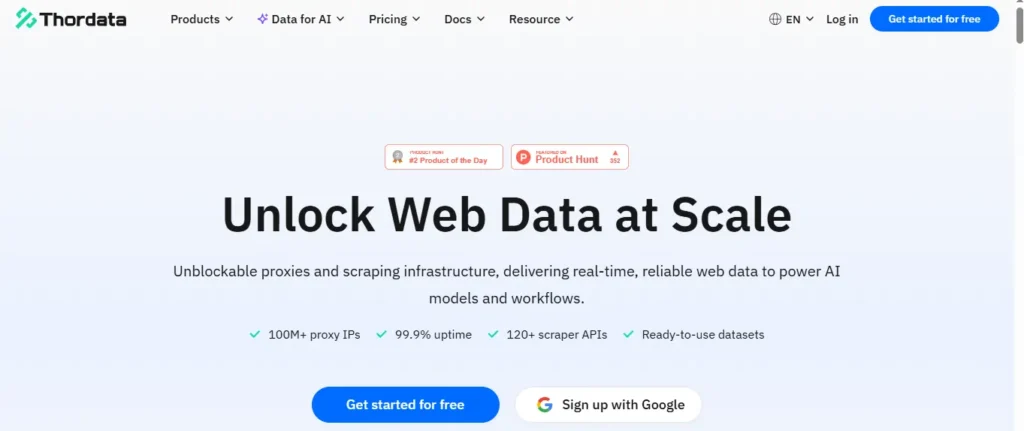
Thordata makes high-volume e-commerce scraping viable at a per-GB price that larger providers cannot match. At $0.65/GB for residential bandwidth, crawling 200,000 product pages daily across Amazon, Walmart, eBay, and regional platforms costs a fraction of what the same volume costs on an $8/GB network.
The platform specifically targets e-commerce marketing as a core use case. Their documentation covers Amazon, Walmart, Google Shopping, eBay, and Target scraping workflows directly. The 100 million residential IP pool across 190+ countries handles the IP diversity needed for multi-marketplace crawls, with automatic rotation configurable from 1 to 90 minute intervals.
An unlimited residential plan at $69 per day absorbs unpredictable bandwidth spikes during holiday monitoring sprints or flash sale competitive sweeps. A 99.9% uptime guarantee and simple API integration keep scraping jobs running without interruption.
E-Commerce Capabilities
💰 Pricing: Residential from $0.65/GB. Unlimited residential at $69/day. Datacenter from $0.75/IP. Mobile from $2.20/GB. Free trial available.
Pros
Cons
Get 40% Off Thordata for Marketplace Data Collection
Use AFFMAVEN for 40% off Thordata and make high-volume marketplace scraping more affordable with flexible rotation and global IP coverage.
Use Code 🎁
AFFMAVEN
6. Bright Data
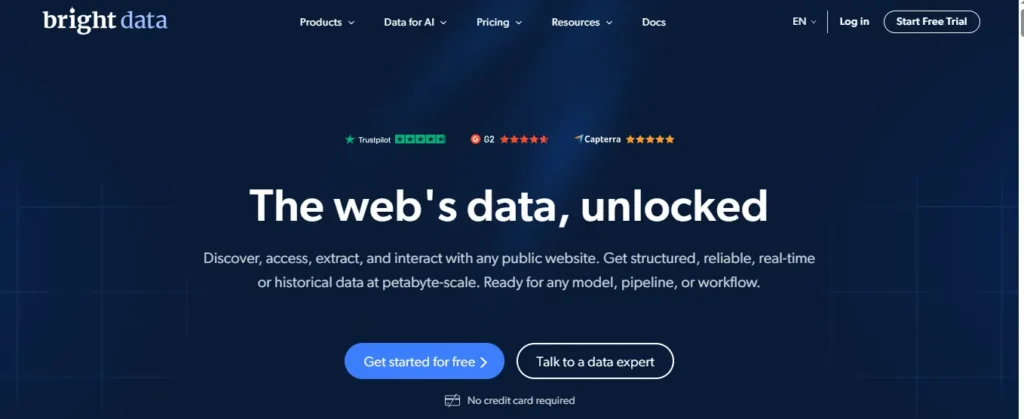
Bright Data offers 286 pre-built ecommerce scrapers spanning more marketplace targets than any competing provider.
These cover Amazon (all regional domains), Walmart, eBay, Etsy, Shopify stores, AliExpress, Flipkart, Rakuten, Zalando, and dozens of niche retail platforms.
Each scraper returns structured product data. No parsing required. The platform also offers pre-collected ecommerce datasets for teams that do not want to run scrapers at all.
Need historical Amazon pricing for 5 million ASINs across the US, UK, and Germany? The dataset API delivers that without a single scrape request.
Independent benchmarks by Scrape.do in 2026 tested 11 major scraping APIs and measured Bright Data at a 98.44% average success rate, the highest across all providers tested.
The 150 million residential IP pool across 195 countries handles the scale. ZIP-level targeting for US marketplaces captures localised pricing variations that national-level proxies miss entirely.
E-Commerce Capabilities
💰 Pricing: Residential from $5.04/GB. Scraper API plans by request volume. Pre-built datasets priced separately. Free trial available. No credit card required.
Pros
Cons
Why Bright Data for E-Commerce: The 286 pre-built scrapers with a 98.44% independently verified success rate represent a data pipeline, not a proxy product. For enterprise e-commerce intelligence operations that need reliable structured data from global marketplaces daily, Bright Data removes the infrastructure burden entirely. The pre-collected dataset option goes one step further by eliminating scraping from the equation completely.
7. Proxy-Seller
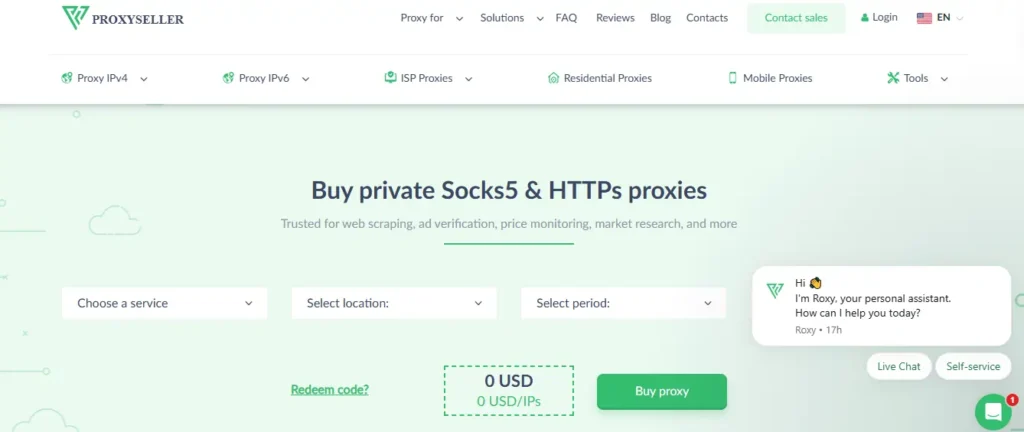
Proxy-Seller addresses the multi-region e-commerce challenge that platforms like Shopify, Amazon, and Zalando create through geographically restricted catalogue access. An Amazon listing in Germany shows different pricing, availability, and seller information than the same product on Amazon Japan.
Monitoring e-commerce data across 15 markets requires exit nodes in each country that look like genuine local shoppers.
Proxy-Seller offers residential, ISP, and datacenter proxies across 220+ countries with carrier-level ISP selection. That means you can choose a specific Vodafone exit node in Germany or a BT residential IP in the UK, matching the ISP fingerprint that regional marketplaces expect from local traffic.
IPv6 proxy support adds an additional layer for markets where IPv6 traffic carries lower bot-suspicion scores. The instant activation model delivers proxies within minutes, which matters during time-sensitive competitive monitoring sprints.
E-Commerce Capabilities
💰 Pricing: Residential from $4/GB. ISP proxies from $3/month per IP. Dedicated datacenter IPv4 from $18/month. No free trial.
Pros
Cons
Save 15% on Proxy-Seller for Global Pricing & Stock Monitoring
Get 15% off Proxy-Seller and collect localized pricing, stock, and seller data with country-specific proxy coverage.

Use Code 🎁
AFFMAVEN
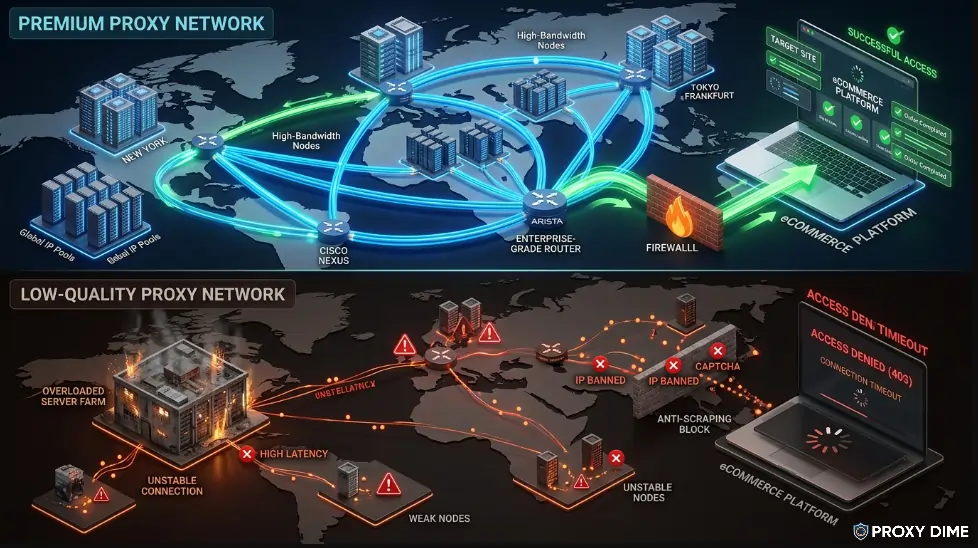
👀 What Separates a Good E-Commerce Proxy From a Bad One
1. Structured Data Output vs Raw Bandwidth
The most consequential decision in e-commerce proxy selection is whether you need raw IP rotation or parsed product data delivered as JSON. Providers like Decodo, Oxylabs, ZenRows, and Bright Data offer ecommerce scraper APIs that handle HTML fetching, anti-bot bypass, JavaScript rendering, and data parsing internally.
Raw proxy providers like Webshare, Thordata, and Proxy-Seller give you IP addresses and leave the engineering to you. If your team lacks dedicated scraping engineers, a scraper API saves months of development. Choose structured APIs for time-sensitive deployments and raw proxies when you need full pipeline control.
2. Marketplace Target Breadth
Amazon is not the only marketplace that matters. Fashion brands monitor Zalando and ASOS. Electronics companies track Best Buy, Newegg, and Flipkart. Latin American operations watch Mercado Libre.
Your proxy provider must either offer pre-built parsers for your specific targets or deliver raw bandwidth reliable enough to build custom scrapers against those platforms. Count your target list before choosing. A provider with 50 pre-built marketplace parsers saves you from maintaining 50 custom extraction scripts.
3. Anti-Bot Bypass Sophistication
Amazon uses Akamai Bot Manager. Walmart deploys PerimeterX. Shopify stores vary between Cloudflare and DataDome. Each system analyses different signals including TLS fingerprints, JavaScript challenge responses, mouse movement patterns, and request timing.
Your proxy provider must handle these defences at the IP layer (through residential rotation) or at the application layer (through fingerprint management and rendering engines). Ask specifically which anti-bot systems the provider bypasses before committing.
4. Localised Data Accuracy
A product priced at $34.99 in New York may show $38.50 in rural Montana. Amazon, Walmart, and regional marketplaces use dynamic pricing algorithms that factor in location, demand density, and fulfilment logistics.
If your e-commerce intelligence depends on accurate local pricing, you need proxies with ZIP code or city-level geo-targeting. Country-level targeting gives you national averages, which may not reflect what your actual customers see. Prioritise providers offering postcode-level control for US and EU market monitoring.
5. Cost Per Successful Data Point
Raw bandwidth cost per GB tells you nothing without success rate context. A provider charging $0.65/GB with a 70% success rate on Amazon costs more per valid product record than a provider charging $4/GB with a 98% success rate because of the retries, wasted bandwidth, and incomplete data.
Always calculate cost per successfully retrieved product record, not cost per GB. Scraper APIs that charge only for successful results (like Decodo and Bright Data) align your costs directly with data quality.

More Guides On Proxy Dime
📌 Final Thoughts
The right proxies for e-commerce depend on a simple question. Do you want parsed product data or raw IP rotation? Bright Data leads with 286 pre-built scrapers and a 98.44% success rate for teams that want structured data without infrastructure headaches.
Decodo offers the most flexible per-request cost model for operations scraping targets with varied protection levels.Thordata at $0.65/GB makes raw bandwidth viable for teams with engineering resources to build their own parsers. Test with free trials on your actual marketplace targets before committing.
Success rates vary dramatically between Amazon and a niche Shopify store, and the only metric that matters is how many clean product records land in your database each day.