Your scraper stalls at 3 a.m. Success rate sliding, blocks climbing, last month's invoice still open in another tab. One provider bills by the gigabyte, the other sells proxy ports for pocket change. What are you actually paying for?
That gap is why Oxylabs vs Webshare keeps surfacing in team chats. One built its name on enterprise scale and ethically sourced pools. The other grew by making proxies cheap enough to test on a weekend project. Both work, for different workloads.
PROXY DIME's Take: Cost per gigabyte gets quoted everywhere, but it quietly hides retries. A proxy that fails a quarter of the time stops being cheap somewhere around attempt three. That math shifts depending on what you're scraping.
Oxylabs vs Webshare in 60 Seconds: What Each Network Is Optimised For
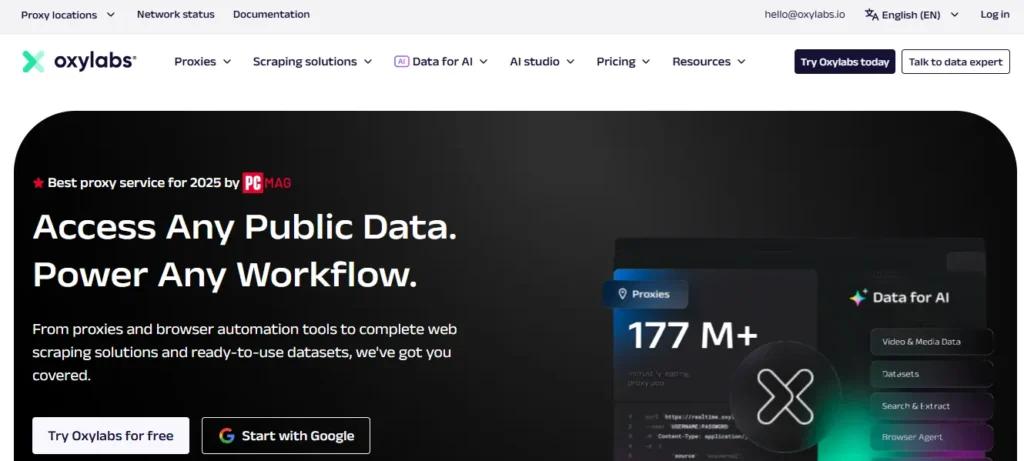
Oxylabs is a full web data platform. Proxies are the entry point, but the catalogue extends into scraper APIs, unblocking tools, headless browsers, and prebuilt datasets.
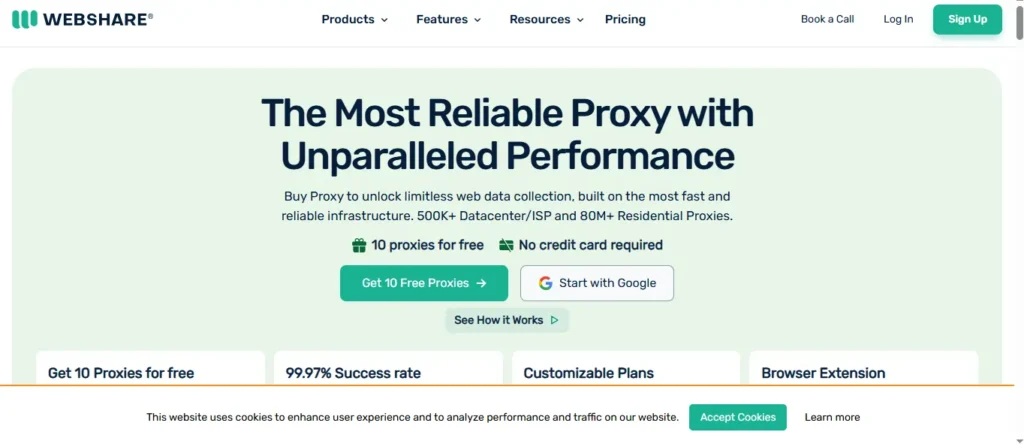
Webshare is a self-serve proxy vendor. You pick a plan, get credentials, and connect. There is no sales call and no onboarding sequence.
| Oxylabs | Webshare | |
|---|---|---|
| Residential IP pool | 175M+ ethically sourced. | 80M+. |
| Datacenter IPs | 2M+. | 400K+. |
| Country coverage | 188+. | 195. |
| Entry residential price | $2.5/GB. | From $3.50/mo (per-GB rate: [VERIFY CURRENT INFORMATION]). |
| Entry datacenter price | $0.7/IP, 5 free IPs. | $0.0299/proxy, 10 free proxies. |
| Mobile proxies | Yes, 20M+ IPs, $3.5/GB. | Not offered. |
| Stated performance | 99%+ public data retrieval success. | 99.7% success rate, 99.97% proxy server uptime. |
| Scale signals | 15,000+ clients. | 64,773 customers, 650B+ monthly requests. |
The Billing Model Is the Real Split in Oxylabs vs Webshare
The two providers do not price in the same unit, which is why headline numbers rarely line up. Oxylabs bills rotating traffic by the gigabyte and static products by the IP. Webshare bills almost everything by the proxy port, with volume discounts stacked on top.
Oxylabs Pricing: Entry Points Across the Full Product Range
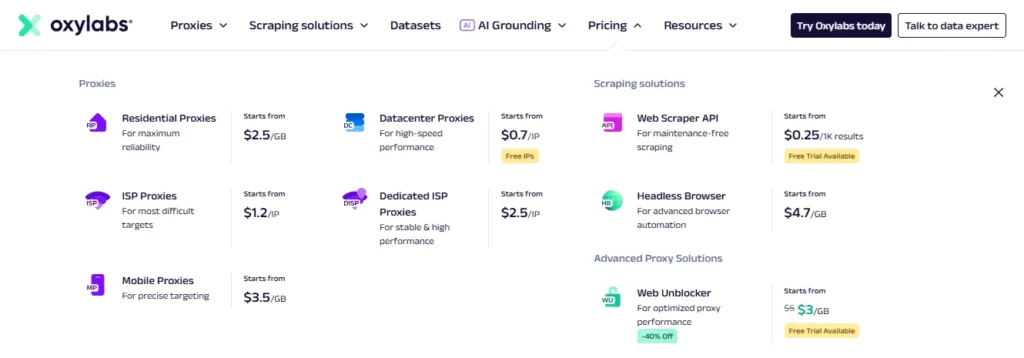
| Product | Starts from | Notes |
|---|---|---|
| Residential Proxies | $2.5/GB | For maximum reliability. |
| Datacenter Proxies | $0.7/IP | Free IPs available. |
| ISP Proxies | $1.2/IP | For most difficult targets. |
| Dedicated ISP Proxies | $2.5/IP | For stable, high performance. |
| Mobile Proxies | $3.5/GB | For precise targeting. |
| Web Scraper API | $0.25/1K results | Free trial available. |
| Headless Browser | $4.7/GB | For advanced browser automation. |
| Web Unblocker | $3/GB | Currently 40% off from $5. Free trial available. |
Two things stand out here. Rotating residential and mobile are metered by data, so your bill moves with payload size rather than session count. Everything static is per IP, which makes ISP and dedicated ISP the more predictable line items for long-running sessions.
The scraping products are priced on a different axis entirely. Web Scraper API charges per 1,000 results, so you are buying parsed output rather than bandwidth.
Oxylabs Coupon Code: Get 50% Off Proxy Plans With OXYLABS50
Use Oxylabs coupon code OXYLABS50 to get 50% off eligible proxy and scraping plans, including residential, datacenter, ISP, mobile proxies, and Oxylabs scraping tools.

Use Code 🎁
Webshare Static Residential (ISP) Pricing: $0.30 Per Proxy Before Discounts
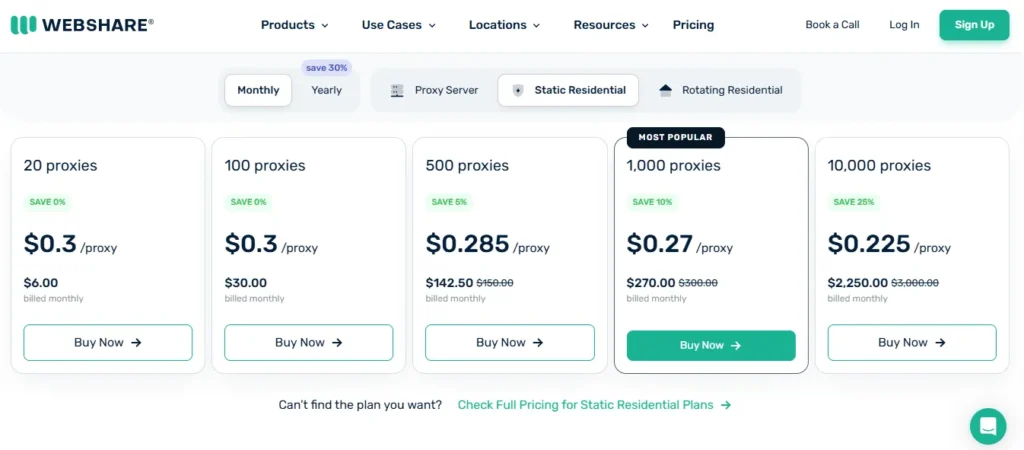
| Plan size | Price per proxy | Billed monthly | Discount |
|---|---|---|---|
| 20 proxies | $0.30 | $6.00 | None. |
| 100 proxies | $0.30 | $30.00 | None. |
| 500 proxies | $0.285 | $142.50 (from $150.00) | 5%. |
| 1,000 proxies | $0.27 | $270.00 (from $300.00) | 10%. |
| 10,000 proxies | $0.225 | $2,250.00 (from $3,000.00) | 25%. |
Yearly billing takes a further 30% off. Discounts do not begin until 500 proxies, so the 20 and 100 tiers cost the same per unit.
The Comparison That Actually Matters: ISP Proxies Head to Head
Static residential is the one place where Oxylabs vs Webshare can be compared cleanly, because both charge per IP.
On sticker price, Webshare is roughly four times cheaper at entry, and more than five times cheaper at volume. That gap is the whole argument.
Whether it holds depends on what happens when those IPs meet your target, since a cheaper IP that gets blocked is not cheaper in practice.
For rotating residential traffic, the units diverge again. Oxylabs meters at $2.5/GB, while Webshare sells rotating residential as a plan starting at $3.50/month.
Confirm the current per-GB or bandwidth terms on Webshare's rotating tier before modelling costs against Oxylabs.
Oxylabs vs Webshare IP Pool Depth: 175M+ Ethically Sourced vs 80M+ Across 195 Countries
Oxylabs lists 175M+ residential IPs, 20M+ mobile IPs, and 2M+ datacenter IPs across 188+ countries. Webshare lists 80M+ IPs across 195 countries, with 400K+ datacenter IPs and 99.97% uptime on its proxy server product.
Raw pool size matters less than most buyers assume. What it buys you is dilution: a larger pool means an individual IP hits a given target less often, which reduces the chance of that IP being flagged.
On heavily defended sites, that dilution is worth real money. On an unprotected API or a small e-commerce catalogue, it is capacity you are paying for and not using.
Where Geo-Targeting Granularity Differs
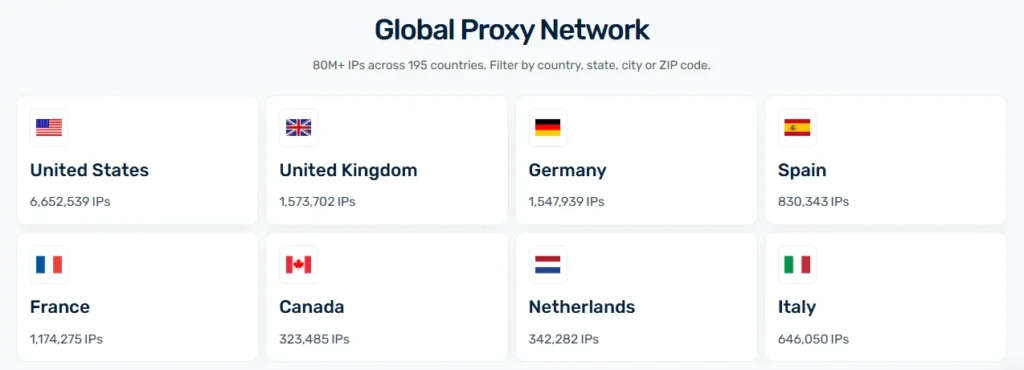
Both offer country-level targeting. Webshare publishes per-country IP counts openly, including 6.65M in the US, 1.57M in the UK, 1.55M in Germany, and 1.17M in France, and supports city-level filtering on rotating residential. Its proxy server product is more limited, covering 50+ countries.
Oxylabs covers 188+ countries and added new proxy locations across its self-service products in August 2026. If your targeting needs are narrow and specific, check current availability for your exact cities on both sides before committing.
Proxy Type Coverage in Oxylabs vs Webshare: Residential, ISP, Datacenter, Mobile
Webshare sells three product lines: proxy servers (datacenter), static residential (ISP), and rotating residential.
Each is available shared, private (1 to 2 users), or dedicated. Private proxy servers run $0.741/IP at 25 IPs, dedicated $1.33/IP at 20 IPs. Static residential private is $0.926/IP, dedicated $2.10/IP.
Oxylabs covers the same three categories and adds mobile proxies, which Webshare does not sell at all. If your work involves app traffic, mobile-first targets, or carrier-level IP signals, that alone settles the Oxylabs vs Webshare question.
Oxylabs vs Webshare Free Access Compared: Trial Credits vs 10 Permanent Free Proxies
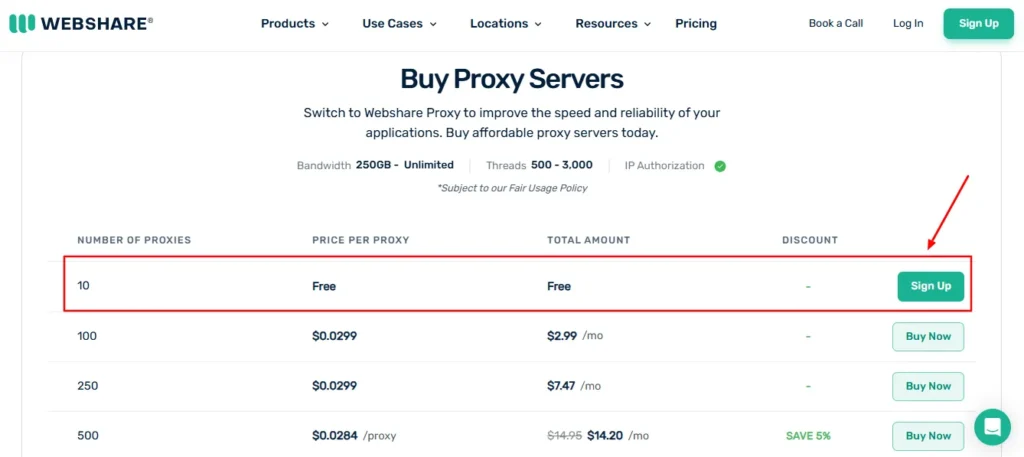
Webshare's offer is the more unusual one. Ten proxies, permanently free, no credit card required. That is not a trial window, it is a standing free tier you can leave running.
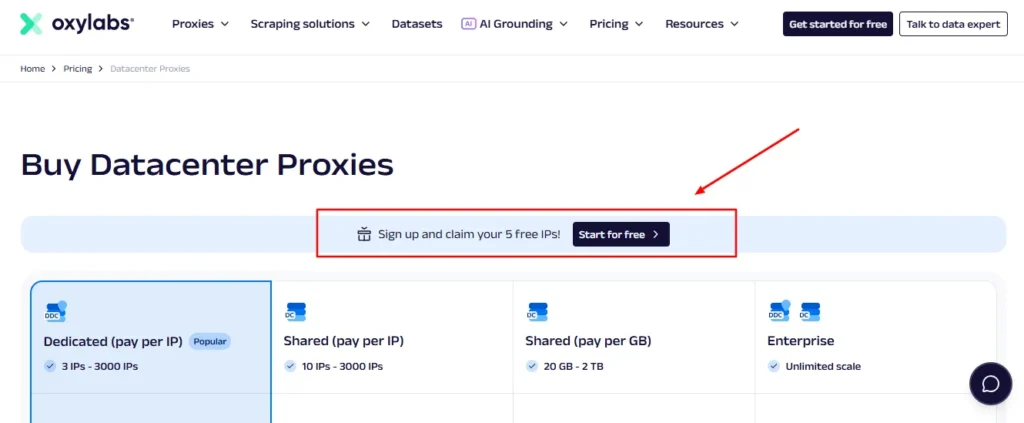
Oxylabs offers 5 free datacenter IPs and free trials on Web Scraper API and Web Unblocker. Terms and duration change, so confirm current conditions before planning around them.
For evaluation purposes these are not equivalent. Webshare's free proxies let you validate a scraper end to end at zero cost, indefinitely. Oxylabs' trials are better for testing whether its unblocking layer clears a target that raw proxies cannot.
Success Rate and Uptime in Oxylabs vs Webshare: 99%+ Retrieval vs 99.97% Proxy Uptime
Both publish strong numbers. Oxylabs states 99%+ public data retrieval success and average response time under 1 second, with 0.25s on datacenter. Webshare states a 99.7% success rate and 99.97% uptime on proxy servers.
Why Uptime and Success Rate Are Not the Same Metric
Uptime measures whether the proxy is reachable. Success rate measures whether your request came back with usable data from the target.
A proxy can be up 99.97% of the time and still fail on a defended site because the target blocked it, not because the proxy broke.
This is the single most misread pair of numbers in proxy comparisons. When a vendor quotes uptime, ask what its success rate looks like against your specific targets.
Vendor-published figures are self-reported and measured on their own conditions, so treat them as directional rather than as a benchmark you can compare like for like.
Beyond Raw Proxies: Where Oxylabs vs Webshare Stops Being a Fair Fight
Scraper APIs, Web Unblocker, and Headless Browser on the Oxylabs Side
Oxylabs structures its catalogue in layers: proxies for connection, Web Scraper API and Fast Search API for scraping, Web Unblocker and Headless Browser for access, and custom datasets for finished data.
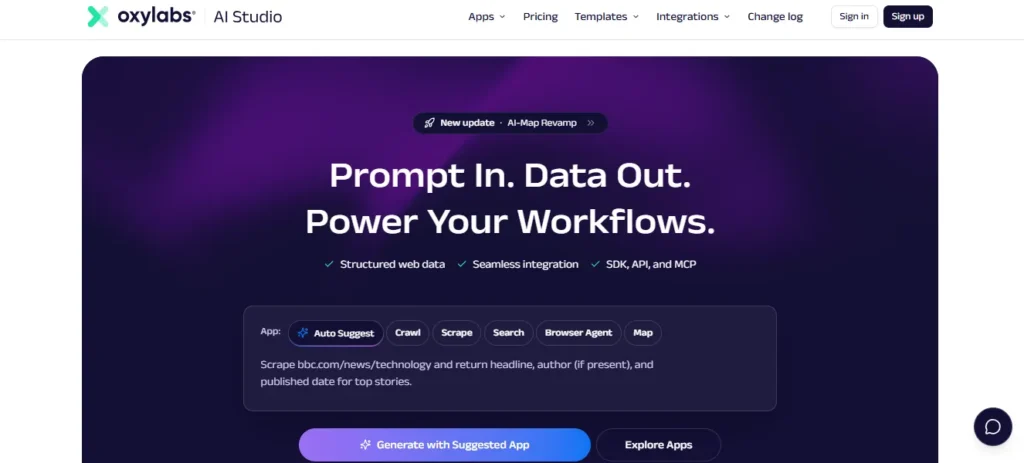
It also ships AI Studio tools (AI-Scraper, AI-Crawler, Browser Agent, AI-Search, AI-Map) and integrations with 30+ tools including LangChain, n8n, Zapier, and Crawl4AI.
That matters when the hard part of your job is not connecting, it is getting past the defence. Buying an unblocking layer is different from buying IPs.
Webshare's Deliberate Choice to Stay a Proxy Vendor
Webshare sells proxies, a Chrome extension, an API, and a dashboard. No scraper API, no managed unblocking, no datasets. That is not an oversight, it is the product decision that keeps the pricing where it is.
If you already have a working scraper with your own retry logic, header rotation, and parsing, the extra layers are cost you would not use.
Cost Per Successful Request: The Oxylabs vs Webshare Math Nobody Runs
Sticker price is per gigabyte or per port. What you actually care about is cost per successful response.
Run the arithmetic on your own logs rather than trusting a headline rate. The structure looks like this:
Effective cost = (spend on the plan) ÷ (requests that returned usable data).
Two things distort it. First, failed requests still consume bandwidth on metered plans, so a low success rate inflates per-GB billing invisibly. Second, engineering time spent maintaining retry and unblocking logic is a real cost that never appears on either invoice.
A cheap port that needs three attempts on a defended target can end up more expensive than a premium gigabyte that lands first time.
The reverse is equally true on undefended targets, where paying for unblocking you do not need is pure waste. The only way to know which side you are on is to test both against your actual URLs.
Oxylabs vs Webshare by Use Case: Which Workloads Belong on Which Network
Oxylabs generally fits better when:
Webshare generally fits better when:
Oxylabs vs Webshare FAQs
Is Webshare cheaper than Oxylabs?
On entry pricing, yes. Webshare's proxy server plans start at $2.99/month for 100 proxies, and 10 proxies are permanently free. Oxylabs residential starts at $2.5/GB with datacenter at $0.7/IP. Whether it is cheaper for your workload depends on your success rate, since failed requests still cost you.
Does Webshare offer mobile proxies?
No. Webshare's lineup covers proxy servers, static residential, and rotating residential. Oxylabs offers mobile proxies with a stated 20M+ IPs from real devices at $3.5/GB.
Does Oxylabs have a free trial?
Oxylabs lists 5 free datacenter IPs and free trials on Web Scraper API and Web Unblocker. Confirm current terms before relying on them.
Which has more IPs, Oxylabs or Webshare?
Oxylabs publishes 175M+ residential IPs, 20M+ mobile, and 2M+ datacenter. Webshare publishes 80M+ IPs across 195 countries with 400K+ datacenter IPs. Oxylabs has the larger residential pool; Webshare lists slightly broader country coverage.
Can I use Webshare for scraping protected sites?
It is possible, but Webshare provides proxies rather than managed unblocking. You handle retries, headers, and anti-bot handling yourself. Oxylabs sells Web Unblocker and Web Scraper API for that layer.
Do either offer SOCKS5?
Both do. Webshare supports HTTP and SOCKS5 endpoints, and Oxylabs lists SOCKS5 proxies among its products.
PROXY DIME Verdict
These are not competitors so much as answers to different questions.
Webshare wins on cost of entry and cost at volume, and its permanent free tier makes it the cheapest realistic way to validate a scraping idea. If your targets do not fight back hard, paying more is difficult to justify.
Oxylabs wins where difficulty is the problem rather than price. The 175M+ residential pool, mobile proxies, and the unblocking and scraper layers exist to solve failures that more IPs alone will not fix. That capability is priced accordingly.
The useful move is to run both against your real target list, with your real request pattern, and compare cost per successful response rather than cost per gigabyte. Start with Webshare's 10 free proxies and the free Oxylabs datacenter IPs. Your logs will settle it faster than any comparison table.