Managing thousands of individual proxy addresses manually wastes engineering hours and creates fragile data pipelines. Hardcoding lists into your scraping script leads to instant blocks when those specific addresses burn out.
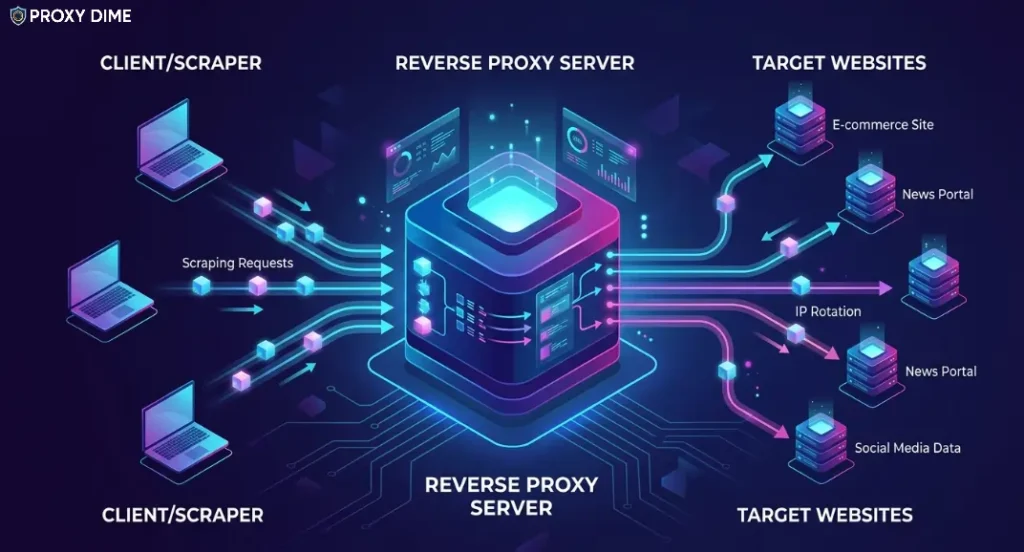
A reverse proxy gateway solves this entirely. You send every request to a single endpoint node. The provider handles the IP address rotation and load balancing under the hood automatically.
I have built enterprise data pipelines relying entirely on backconnect gateways to harvest millions of retail pages daily. This architecture prevents your local machine from juggling connection states and lets the provider infrastructure do the heavy lifting.
A solid gateway swaps your digital footprint without requiring constant script changes. Here is the benchmark data on the best reverse proxy providers available this year.
❓ What Are Reverse Proxy Providers and Why Do They Matter?
A reverse proxy sits between your local machine and the target website. Standard forward proxies require you to manage the exact IP address making the connection.
A reverse proxy setup gives you a single entry node. You send your web request to this gateway address. The provider infrastructure evaluates your request and assigns a fresh IP address from their pool automatically.
This backconnect method matters deeply for web scraping and data harvesting. Target servers block IP addresses that make too many automated requests.
Rotating gateways swap your digital footprint on every single connection without requiring code alterations. You just point your scraper at one address and let the provider handle the rotation logic entirely.
Quick Tip: For reverse proxy setups, backconnect residential networks typically outperform static lists because they offer dynamic IP rotation automatically. Prioritise providers offering sticky session control for complex workflows.
Best Reverse Proxy Providers Compared: Features, Pricing & Performance
| Proxy Provider | Primary Strength | Ideal User |
|---|---|---|
| Oxylabs | Enterprise scalability | Large data teams |
| Bright Data | Granular targeting | Advanced developers |
| ZenRows | Bypassing protections | Scraping engineers |
| Decodo | Consistent uptime | Automation specialists |
| Webshare | Affordable routing | Independent developers |
| Thordata | Clean address pools | Retail scrapers |
| Proxy Seller | Custom protocols | Social media managers |
| NodeMaven | Session stickiness | Account creators |
| IPRoyal | Metered billing | Startup founders |
1. Oxylabs
Oxylabs runs a massive reverse proxy infrastructure built for serious data harvesting. You connect to their main gateway and their system routes your traffic through millions of residential addresses.
This works well for complex search engine scraping where target servers block repetitive patterns quickly. You can hold a sticky session for up to 24 hours through their backconnect node. This stability matters immensely when scraping secure portals or completing long tasks.
Pricing starts from $8/GB for standard residential traffic. Free trial available with corporate email verification.
Why Oxylabs for reverse proxy routing: Their backconnect gateway handles JavaScript rendering and IP rotation perfectly. This removes the burden of managing proxy lists locally while maintaining enterprise level success rates on difficult domains.
2. Bright Data
Bright Data offers incredibly granular control over your reverse proxy gateway connections. You can configure exact routing rules through their Proxy Manager tool locally. This software acts as a middleman to route your traffic through their global network based on custom logic.
Data engineers use this to route heavy traffic through cheap datacenter nodes while sending sensitive requests through premium residential endpoints. It does the job perfectly for complex scraping operations.
Pricing starts from $8.40/GB for metered residential traffic. Free trial available for registered businesses.
Why Bright Data for reverse proxy routing: The local Proxy Manager allows you to dictate exactly how the remote gateway behaves. You can cascade requests from cheap datacenter nodes to premium residential addresses automatically to save massive amounts of bandwidth budget.
3. ZenRows
ZenRows operates as a reverse proxy API specifically designed to bypass web protections. You send a single API request and their gateway handles all the browser fingerprinting and IP rotation automatically. This removes the need to build custom headers or manage headless browsers locally.
Developers harvesting data from heavily protected retail sites find this approach highly efficient. The success rate on complex targets makes it a solid option for web scraping engineers.
Pricing starts from $49 per month for API credits. Free trial available with generous initial request limits.
Why ZenRows for reverse proxy routing: Traditional reverse proxies still require you to manage browser headers and fingerprinting locally. ZenRows handles the proxy rotation and the browser fingerprinting at the gateway level simultaneously.
4. Decodo
Decodo provides a very straightforward backconnect proxy solution. You get access to a single gateway endpoint that rotates your IP address automatically on every connection. This works brilliantly for retail automation where you need fresh digital footprints instantly.
Their entry node responds quickly and rarely drops connections during high traffic events. Automation specialists appreciate how simple it is to plug their gateway address directly into custom software.
Pricing starts from $7/GB for standard residential plans. Free trial available through customer support request.
Why Decodo for reverse proxy routing: Their gateway focuses purely on speed and simplicity. You plug one single address into your automation tool and their backend handles the entire rotation sequence without noticeable latency drops.
5. Webshare
Webshare excels at providing affordable rotating proxies through a simple reverse gateway. You can point your application at their backbone server and receive a new datacenter or residential address instantly. Their automated dashboard makes it easy to configure your exact backconnect endpoint without talking to sales representatives.
Independent developers running continuous data pipelines find their pricing structure highly appealing. It remains a reliable service for those needing basic IP rotation without enterprise costs.
Pricing starts from $7 per month for basic rotating packages. Free trial available with limited permanent bandwidth.
6. Thordata
Thordata offers a clean network of backconnect nodes built for data extraction. You connect to their main server and their routing algorithm selects unblocked addresses for your specific target. This specialized approach ensures higher success rates when scraping product details or pricing changes.
The gateway handles the session sticky time precisely based on your port selection. Users tracking inventory across global storefronts will find this service highly dependable.
Pricing starts from $6/GB for standard traffic. Free trial available upon specific request.
7. Proxy Seller
Proxy Seller provides robust reverse proxy gateways with excellent protocol support. You can connect to their entry nodes using secure protocols easily while the backend handles rotation. This flexibility works well for social media automation where specific connection types matter.
Their infrastructure routes traffic efficiently across specific regions to maintain account safety. It is a solid choice for teams managing multiple automated accounts through single entry nodes.
Pricing starts from $3 per specific port depending on location. Free trial available occasionally during promotions.
8. NodeMaven
NodeMaven delivers highly stable backconnect connections perfect for account management. Their reverse proxy system ensures you keep the exact same IP address for an extended period. You point your browser at their gateway and their system evaluates addresses before assigning one to you.
This quality control prevents sudden session drops during important tasks. It performs consistently well for anyone needing reliable session retention.
Pricing starts from $8/GB depending on volume. Free trial available for testing purposes.
9. IPRoyal
IPRoyal provides a very accessible entry point for reverse proxy networking. Their backconnect residential gateway routes traffic through a globally distributed pool of real user devices. This creates highly organic traffic patterns that target servers rarely flag as suspicious.
Startup founders building their first data pipelines appreciate the simple pricing model where traffic never expires. It remains a very practical option for developers needing genuine residential rotation.
Pricing starts from $7/GB with no expiration dates. Free trial available occasionally.
✨ Reverse Proxy Providers Feature Comparison 2026
| Proxy Provider | Proxy Types Available | Total IP Pool Size |
|---|---|---|
| Oxylabs | Residential and Datacenter | 100 Million |
| Bright Data | All Major Types | 72 Million |
| ZenRows | Scraping API Gateway | Variable Pool |
| Decodo | Blended Network | 40 Million |
| NodeMaven | Filtered Residential | 5 Million |
| Webshare | Datacenter and Residential | 30 Million |
| Thordata | Retail Focused | Variable Pool |
| IPRoyal | Authentic Residential | 32 Million |
| Proxy Seller | Custom Protocol Mix | Variable Pool |
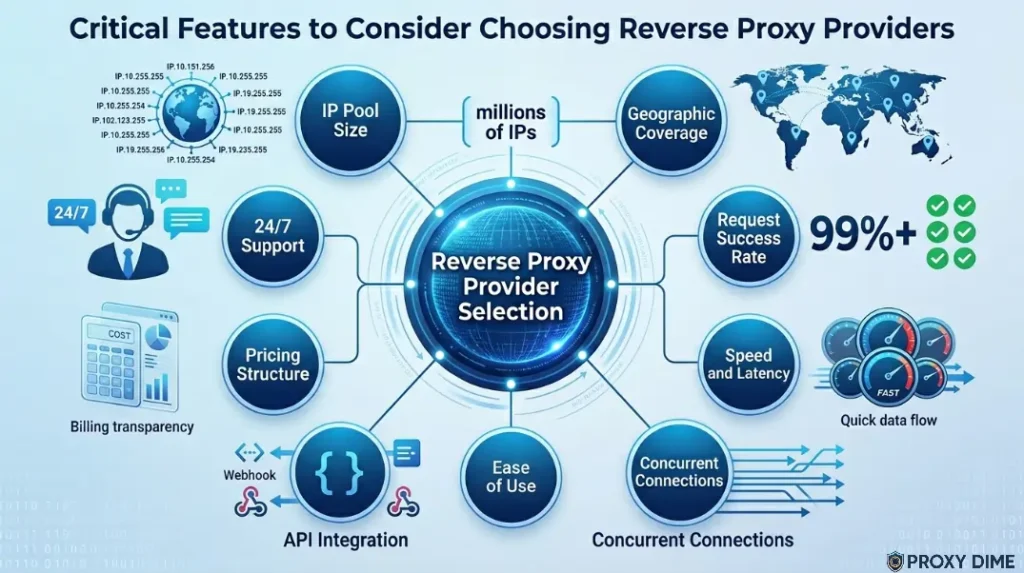
✅ How to Choose the Right Reverse Proxy Providers
1. Proxy Type Selection
The type of network behind the gateway dictates your success rate entirely. Backconnect residential networks win for heavy web scraping because target servers see legitimate user traffic. Datacenter gateways offer better speed but suffer from much higher block rates. Choose residential backconnect nodes when scraping heavily protected platforms.
2. Geographic Coverage
Your gateway must route traffic through locations relevant to your specific target. Local search engine tracking requires specific city gateway targeting to pull accurate results. Retail automation requires gateways physically close to the target servers to reduce latency. Verify the provider offers specific entry nodes for your required regions before purchasing.
3. Speed and Response Time
Adding a reverse proxy node introduces an extra network hop inevitably. This inherent latency impacts urgent operations significantly. Enterprise providers mitigate this by using fast internal routing before hitting the final IP address. Test the gateway response time thoroughly if your workflow depends on absolute speed.
4. Rotation and Session Control
Your automation software needs exact control over when the gateway assigns a new IP. Scraping search engines requires immediate rotation on every single request. Filling out complex forms requires a sticky session that holds the same IP for several minutes. Ensure your provider offers flexible port configurations for precise session retention.
5. Pricing and Value
High volume data pipelines consume bandwidth rapidly through backconnect nodes. Paying per gigabyte gets extremely expensive when downloading heavy page assets or images. API based gateways often charge per successful request instead of total bandwidth used. Calculate your estimated request volume accurately to decide between bandwidth pricing and request pricing.
⚡Frequently Asked Questions About Reverse Proxy Providers
What are reverse proxy providers?
A reverse proxy provider gives you a single entry node that routes your traffic through a larger network of IP addresses automatically. You connect to one gateway address and their infrastructure handles the complex rotation logic. This prevents you from managing massive proxy lists manually.
How do reverse proxy providers work?
You configure your software to send web requests to the provider gateway port. The provider server receives your request and selects an available IP address from their internal pool. It forwards your request through that selected address and returns the target server response to you seamlessly.
What type of proxy is best for web scraping?
Backconnect residential proxies perform best for complex web scraping operations. The rotating gateway swaps your IP address constantly while using authentic residential addresses. This combination prevents target servers from tracking your request patterns and blocking your automated connection.
How much do reverse proxy providers cost?
Quality backconnect residential traffic usually costs between $5 and $15 per gigabyte depending on your volume commitments. Datacenter gateway traffic costs significantly less per month. Some specialized scraping API gateways charge around $50 per month for a set number of successful requests.
Are reverse proxy providers legal to use?
Using a reverse proxy gateway remains legal in most jurisdictions globally. The legality depends entirely on how you use the routed traffic and what specific data you extract. You must ensure your automated activities comply with target website terms and regional data protection laws.
How do I stop reverse proxies from blocking requests?
Target servers block proxy requests when they detect unusual browser fingerprints or missing headers. Using an advanced reverse proxy gateway like ZenRows solves this by handling the header configuration and JavaScript execution automatically. You can also improve success rates by using clean residential IP pools.
Can I use free proxies for data pipelines?
Free proxy lists fail completely for serious data pipelines. They drop connections constantly and lack the automated rotation a backconnect gateway provides. Target servers block these public addresses almost instantly making them utterly useless for automated tasks.

More Guides On Proxy Dime
🙌 Final Thoughts
Managing thousands of individual proxy addresses manually creates unnecessary bottlenecks for data pipelines. A reliable reverse proxy gateway solves this by handling the rotation logic at the network level. Oxylabs offers the most robust enterprise infrastructure for massive concurrent scraping tasks.
Bright Data provides unmatched control over local routing rules for advanced developers. ZenRows works perfectly if you want to bypass web protections entirely through a simple API request.
Test these platforms using their trials to see how their gateways handle your specific targets. Take time to evaluate the session control settings before committing to a large monthly plan.