Your self-hosted proxy setup crashed again at 3 AM. The VPS ran out of memory, half the IP list burned through overnight, and your morning scrape returned nothing but 403 errors.
Sound familiar? According to Proxyway's 2026 benchmark, teams using managed cloud-based proxy providers reduced infrastructure downtime by over 80% compared to self-maintained servers.
I have migrated three separate enterprise scraping stacks from self-hosted setups to fully managed cloud proxy platforms over the past two years. The difference in operational overhead is not subtle. It is transformational.
This guide breaks down the 7 best cloud-based proxy providers worth your budget this year. Each one was evaluated on uptime reliability, API maturity, dashboard tooling, elastic scaling, and real cost per successful request. Here is the shortlist before the deep reviews.
⚙️ Why Cloud-Based Proxies Beat Self-Hosted Setups
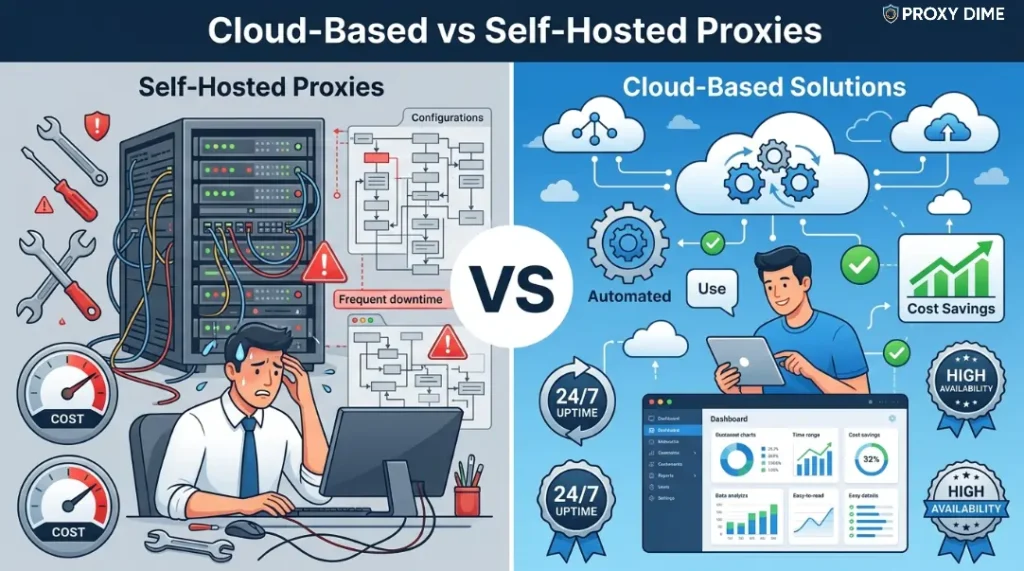
A cloud-based proxy is a fully managed proxy service hosted on the provider's own infrastructure rather than your local servers or rented VPS machines.
You connect through an API endpoint or a web dashboard. The provider handles all the backend work. That means IP rotation, geographic targeting, health monitoring, scaling, and security patches happen without you touching a terminal.
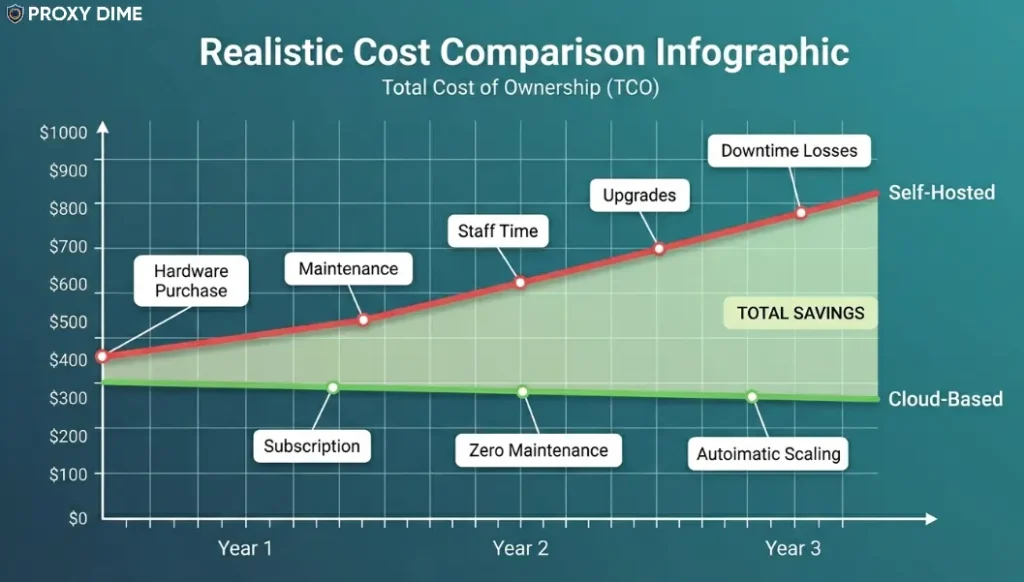
This matters because self-managed proxy servers create a maintenance trap. You spend engineering hours replacing burned IPs, patching software vulnerabilities, and scaling hardware when traffic spikes. A cloud proxy eliminates that entire burden. You pay for traffic or requests. The provider worries about everything else.
For web scraping, market research, ad verification, and multi-account management, cloud proxies provide instant access to millions of IPs across hundreds of regions through a single dashboard. The infrastructure scales elastically.
Need 10x more bandwidth for a product launch monitoring sprint? You adjust a slider or upgrade a plan. No server provisioning required.
Quick Tip: For cloud-based proxy setups, rotating residential IPs typically outperform datacenter addresses because target sites see genuine household traffic patterns. Prioritise providers offering real-time usage analytics and API-driven management tools.
☁️ Cloud-Based Proxy Specs Side-by-Side 2026
| Proxy Provider | Cloud Advantage | Built For |
|---|---|---|
| Bright Data | Full stack SaaS platform | Enterprise data teams |
| Decodo | Fast cloud onboarding | Mid-market scrapers |
| Oxylabs | Massive elastic pool | High volume pipelines |
| Webshare | Self-serve cloud dashboard | Solo developers |
| ZenRows | API-first scraping cloud | Anti-bot engineers |
| Thordata | Low cost cloud traffic | Budget-conscious teams |
| Proxy-Seller | Multi-protocol cloud nodes | Account managers |
1. Bright Data
Bright Data operates what is arguably the most complete cloud proxy platform available today. Their infrastructure spans over 150 million IP addresses across residential, datacenter, ISP, and mobile networks.
What separates them from other cloud-based proxy providers is the Proxy Manager. This free open source tool runs locally but connects to their entire cloud network. It lets you build waterfall routing rules that cascade requests from cheap datacenter IPs to premium residential addresses automatically.
Data engineering teams running multi-target scraping operations across dozens of protected domains will find this level of cloud orchestration genuinely useful.
What stands out
Where it falls short
Pricing starts from $5/GB on committed enterprise plans and $8.40/GB on metered residential traffic.
Why Bright Data for cloud-based proxies: The Proxy Manager paired with their super proxy load balancers creates a true SaaS proxy orchestration layer. You define rules locally. Their cloud executes them globally. No other provider offers this depth of managed cloud routing control.
2. Decodo
Decodo (formerly Smartproxy) makes cloud proxy access remarkably straightforward. Their platform hosts over 115 million proxies spanning residential, static ISP, mobile, and datacenter networks across 195 countries. The cloud dashboard generates your proxy credentials in seconds.
No sales calls. No lengthy verification. You pick your plan, grab your endpoint, and start routing traffic. Response times sit below 0.2 seconds on their static ISP nodes, which is faster than most cloud alternatives.
Growth teams and mid-market scraping operations that need reliable cloud infrastructure without enterprise procurement headaches will appreciate how quickly this platform gets you operational.
What stands out
Where it falls short
Pricing starts from approximately $3/GB for residential cloud traffic. Free trial available through the dashboard.
Why Decodo for cloud-based proxies: Speed of deployment sets Decodo apart. Their cloud infrastructure delivers sub-0.2-second response times on ISP nodes while the Site Unblocker handles anti-bot challenges at the cloud layer. Perfect for teams that want managed performance without configuring anything locally.
3. Oxylabs
Oxylabs controls the single largest verified proxy pool on the planet. Over 100 million residential addresses, 2 million datacenter IPs, and 20 million mobile endpoints feed into their cloud infrastructure.
For teams running massive parallel scraping jobs, this pool depth means IP exhaustion is essentially a non-issue even at millions of daily requests. Their Web Scraper API offloads JavaScript rendering to the cloud entirely, removing the need to maintain headless browser instances on your own servers.
I tested their cloud residential pool against a batch of 15 Cloudflare-protected retail sites and saw consistent success rates above 95% across a full week. Enterprise operations needing predictable cloud performance at serious scale will find Oxylabs delivers.
What stands out
Where it falls short
Pricing starts from $4/GB on committed residential plans and $8/GB on pay-as-you-go.
Why Oxylabs for cloud-based proxies: Pool depth is everything when your cloud pipeline needs to sustain millions of daily requests. No other provider matches 100M+ residential IPs combined with cloud-hosted rendering and enterprise-grade session control. The economics improve dramatically at committed volumes.
Oxylabs Discount Code: 40% Off Proxy Services
Unlock a 40% discount with coupon code OXYLABS40. Mention Oxylabs when redeeming the offer and access a powerful global proxy network with residential, datacenter, and mobile IP options.

Use Code 🎁
OXYLABS40
4. Webshare
Webshare strips cloud proxy access down to the essentials and prices it aggressively. Their platform offers datacenter and rotating residential IPs through a clean self-service dashboard that requires zero interaction with a sales team.
You can start with 10 completely free datacenter proxies and scale up to 60,000 without ever making a phone call. Rotating residential bandwidth currently sits at $1.40/GB with an ongoing promotional discount.
The API handles account management, proxy generation, and usage monitoring programmatically. Solo developers and small teams building their first cloud scraping infrastructure will find Webshare's pricing hard to beat.sites.
What stands out
Where it falls short
Pricing starts from $2.99/month for 100 datacenter proxies and $1.40/GB for rotating residential traffic.sites.
Why Webshare for cloud-based proxies: The permanent free tier and self-serve dashboard make this the lowest friction cloud proxy entry point available. For developers prototyping scrapers or running moderate volumes, the per-GB economics beat most providers by a wide margin.
5. ZenRows
ZenRows takes a fundamentally different approach to cloud-based proxies. Instead of giving you raw IP endpoints, their platform wraps proxy rotation, browser fingerprinting, CAPTCHA solving, and JavaScript rendering into a single API call. You send a URL.
Their cloud infrastructure handles the rest. This means no headless browser management, no header rotation scripts, and no proxy list maintenance on your end. The platform defeats protections from Cloudflare, DataDome, and Akamai at the cloud level before returning clean HTML or JSON.
Scraping engineers who spend more time fighting anti-bot systems than actually processing data will find this approach saves enormous development hours.
What stands out
Where it falls short
Pricing starts from $69/month on the Developer plan with 250K basic cloud API results.
Why ZenRows for cloud-based proxies: Traditional cloud proxy providers give you IPs. ZenRows gives you successful responses. Their cloud layer handles every anti-bot challenge before your code even sees the data. The engineering hours you save on bypass logic alone can justify the premium.
6. Thordata
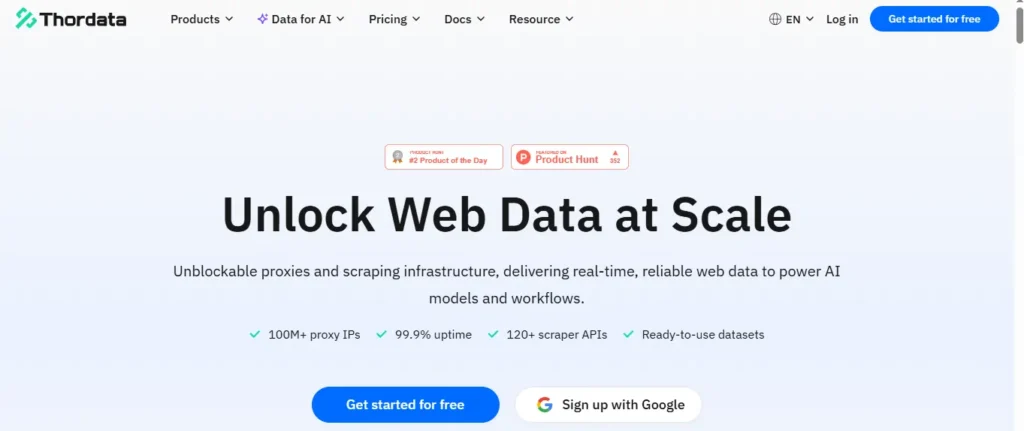
Thordata delivers cloud proxy traffic at prices that undercut nearly every competitor on this list. Their residential pool spans 60 million IPs across 195 countries, and the pay-as-you-go model starts at just $0.65/GB with no minimum contract.
That pricing drops further at volume. At 500 GB, you are paying $0.49/GB. At 2 TB, it drops to $0.40/GB. New users can request a 1 GB free trial to test their cloud infrastructure before committing anything.
The platform also offers an unlimited residential tier at $69 per day for teams running high bandwidth operations. E-commerce monitoring teams and price intelligence operations that consume serious bandwidth will find Thordata's cloud economics genuinely appealing.
What stands out
Where it falls short
Pricing starts from $0.65/GB for residential cloud traffic. 1 GB free trial available on request.
Save 40% on Thordata Residential Proxies
Apply code AFFMAVEN and mention Thordata to receive a 40% discount. Thordata is a strong choice for e-commerce monitoring, price intelligence, and high-bandwidth scraping without long-term contracts.
Use Code 🎁
AFFMAVEN
7. Proxy-Seller
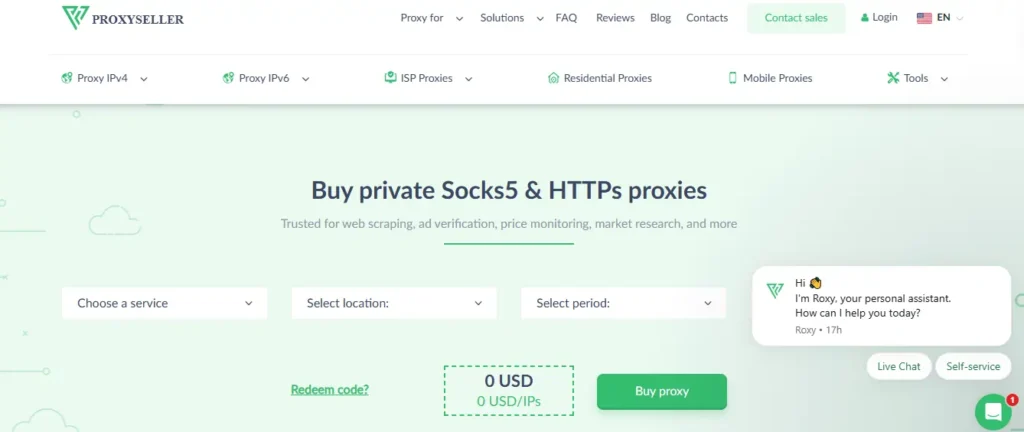
Proxy-Seller provides cloud proxy access across a broad mix of protocols and IP types spanning 220 countries and regions. Their network supports IPv4, IPv6, ISP, mobile, and residential connections through a managed cloud dashboard.
What makes them practical for multi-account management workflows is the per-IP rental model. You can lease dedicated IPv4 cloud proxies starting from $0.70 per IP with flexible rental periods from one week to a full year.
Mobile cloud proxies start at $40/month for teams managing social media accounts across different geographic profiles. The platform rotates residential traffic by time interval or URL pattern, giving you precise cloud session control.
What stands out
Where it falls short
Pricing starts from $0.70/IP for dedicated IPv4 and $0.70/GB for residential traffic at volume.
Claim 15% Off Proxy-Seller Cloud IPs
Use AFFINCO and mention Proxy-Seller to unlock 15% off. Benefit from broad geographic coverage, IPv4 and IPv6 support, mobile connections, and customizable residential proxy rotation.

Use Code 🎁
AFFINCO
✅ Picking the Right Cloud-Based Proxy Provider
1. Cloud Infrastructure Maturity
Not every provider claiming “cloud” actually runs elastic, redundant infrastructure. Look for those offering real-time dashboards, uptime SLAs, and automatic failover.
Bright Data and Oxylabs publish uptime guarantees above 99.9%. Smaller providers may host on shared servers that buckle during peak hours. Ask about infrastructure redundancy before signing an annual plan.
2. API and Developer Tooling
Your cloud proxy is only as useful as its integration points. Teams building automated pipelines need well documented APIs for proxy generation, credential rotation, and usage monitoring.
ZenRows and Webshare both offer strong API-first experiences. Bright Data's Proxy Manager adds a local control layer. If your workflow depends on programmatic access, test the API documentation quality during the trial period.
3. Geographic Reach from the Cloud
Where the provider routes your traffic determines what data you can access. Local SEO monitoring requires city-level cloud nodes.
E-commerce price scraping across 30 countries needs broad coverage. Oxylabs and Proxy-Seller both cover 195+ regions from their cloud networks. Verify your required locations are available before committing budget.
4. Elastic Scaling Capability
The whole point of a cloud-based proxy is removing hardware bottlenecks. Your provider should let you scale from 10 GB to 1 TB of monthly traffic without provisioning new servers or renegotiating contracts.
Thordata's pay-as-you-go model and Webshare's tiered plans both support gradual scaling. Enterprise teams should confirm concurrency limits and whether extra bandwidth is available on demand.
5. True Cost at Your Usage Level
Cloud proxy pricing varies dramatically at different volume tiers. Thordata charges $0.65/GB at entry level but drops to $0.40/GB at 2 TB.
Bright Data starts at $8.40/GB on pay-as-you-go but falls to $5/GB on enterprise commitments. Calculate your estimated monthly bandwidth realistically. Then compare the per-GB rate at that specific tier rather than the advertised starting price.
✨ Common Questions About Cloud-Based Proxy Providers
What are cloud-based proxy providers?
Cloud-based proxy providers are services that host and manage proxy infrastructure entirely on remote servers. You access their IP pools through APIs or web dashboards without maintaining any local proxy hardware. They handle rotation, scaling, security patches, and uptime monitoring on your behalf.
How do cloud-based proxies actually work?
Your application sends requests to the provider's cloud endpoint. Their servers select an available IP address, route your request through it, and return the response to you. All IP management, geographic targeting, and rotation happen at the cloud layer automatically.
What proxy type works best in a cloud setup?
Rotating residential proxies deliver the highest success rates for cloud scraping workflows because they mimic genuine user traffic. ISP proxies offer a strong middle ground when you need faster speeds with residential-level trust. Datacenter proxies work for volume-heavy jobs against less protected targets.
How much do cloud-based proxy services cost?
Prices range widely. Thordata starts at $0.65/GB for residential cloud traffic. Webshare offers datacenter plans from $2.99/month. Bright Data's residential pay-as-you-go begins at $8.40/GB. Enterprise committed plans reduce costs significantly at higher volumes.
Are cloud-based proxy providers legal?
Using cloud-based proxy services is legal in most jurisdictions. Legality depends entirely on what you do with the routed traffic. Ensure your data collection activities comply with target website terms of service and applicable data protection regulations in your region.
Can I replace my VPS proxy setup with a cloud provider?
Yes. A managed cloud proxy provider handles the IP pool, rotation logic, and server maintenance that a VPS setup requires you to manage manually. The trade-off is per-GB cost versus fixed VPS rental. For teams spending more time maintaining proxies than using them, the migration pays for itself quickly.
Do free cloud proxies work for serious projects?
Webshare offers 10 free datacenter proxies permanently, which work for prototyping. Beyond that, free proxy lists lack the reliability, speed, and rotation needed for production workflows. The risk of IP bans and data leaks makes free options unsuitable for anything beyond basic testing.

More Guides On Proxy Dime
📌 Final Thoughts
Bright Data delivers the deepest cloud orchestration toolkit for teams that need full control over proxy routing logic. Oxylabs provides the largest pool for operations where IP exhaustion is the primary concern.
Thordata offers remarkably low per-GB pricing for bandwidth-heavy cloud scraping on a budget. Most of these providers offer trials. Use them. Run your actual workload against two or three platforms before committing monthly spend.
The right cloud proxy provider is the one that fits your specific traffic volume and technical workflow. Not necessarily the one with the biggest feature list.