Your scraper hits a Cloudflare wall before a single line of page content loads. It is not your IP. It is not your headers. It is the TLS handshake — the invisible part of every HTTPS connection that modern bot detection systems now read like a fingerprint.
Over 60% of web traffic is encrypted HTTPS today. That means the quality of your HTTPS proxy infrastructure now determines whether your requests reach a server or die at the gate. A proxy that supports HTTP but fumbles the CONNECT tunnel on port 443 is useless for scraping anything built in the last three years.developer.
I have set up and stress-tested HTTPS proxy pipelines across e-commerce price monitors, financial data feeds, SaaS competitor tracking and ad verification workflows. The nine providers below are the ones I reach for when the target is protected, the data matters and failure is not an option.
❓ What HTTPS Proxies Actually Do for Your Scraping Setup
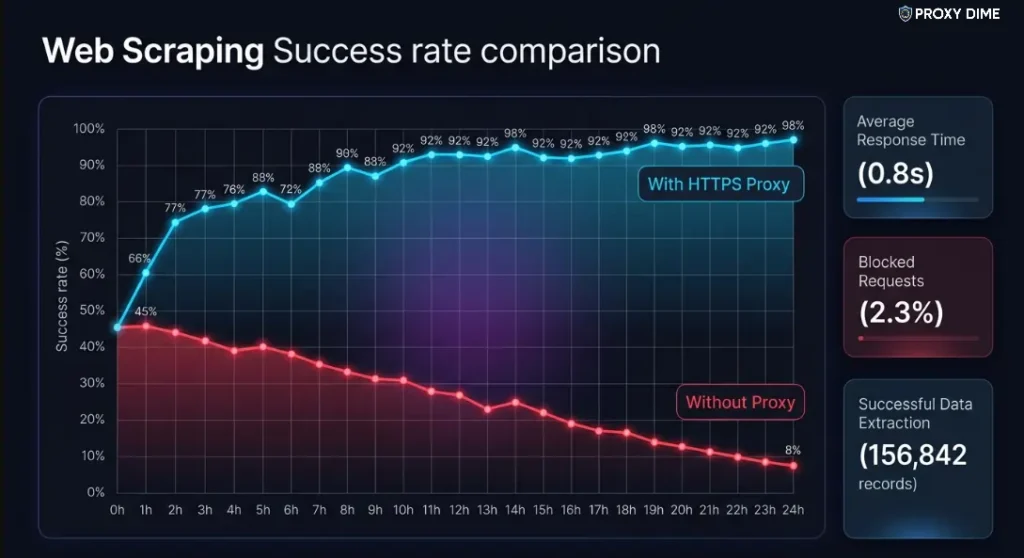
HTTPS proxies are not simply HTTP proxies with a padlock on them. They do three separate things that plain HTTP proxies cannot handle properly.
First, they support the HTTP CONNECT method, which asks the proxy to establish a raw TCP tunnel directly to port 443 on the target server. Once that tunnel is open, the full TLS handshake happens between your client and the target, not between your client and the proxy. The proxy forwards encrypted bytes without reading them.
Second, better HTTPS proxy providers go a step further by managing TLS fingerprinting. Every TLS client sends a ClientHello packet containing cipher suites, extension order and supported versions. Security tools like Cloudflare read that pattern (often described as a JA3 hash) and compare it against known bot libraries.
Proxies that only route traffic do nothing about this. Providers with dedicated anti-bot layers — Bright Data, Decodo, Oxylabs, ZenRows — normalise that fingerprint so your requests look like a real Chrome session rather than Python's requests library.
Third, strong HTTPS proxy infrastructure supports TLS 1.3 and correct cipher suite ordering, which matters on modern HSTS-enforced targets that reject older protocol versions outright.
Quick Tip: For HTTPS scraping on Cloudflare-protected or finance targets, residential HTTPS proxies with TLS fingerprint management outperform plain rotating proxies because JA3 detection happens before your IP is even evaluated. Prioritise providers that offer a Web Unblocker or Site Unblocker layer on top of their HTTPS proxy infrastructure.
💎Best HTTPS Proxy Providers 2026 Reviewed
| Provider | TLS Bypass Capability | HTTPS Protocol Support | Starting Price |
|---|---|---|---|
| Bright Data | Managed JA3 rotation | HTTP, HTTPS, SOCKS5 | $5.88/GB residential |
| Decodo | Site Unblocker, TLS normalisation | HTTP, HTTPS, SOCKS5 | $2/GB residential |
| Oxylabs | Web Unblocker, AI routing | HTTP, HTTPS, SOCKS5 | $4/GB residential |
| Webshare | Standard HTTPS tunnelling | HTTP, HTTPS, SOCKS5 | $2.99/month |
| Thordata | Anti-bot scraping API add-on | HTTP, HTTPS | $0.65/GB residential |
| ZenRows | Full TLS fingerprint bypass | HTTP, HTTPS | $49/month API |
| Proxy-Seller | Dedicated HTTPS tunnel IPs | HTTP, HTTPS | $10/IP dedicated |
| IPRoyal | Standard HTTPS, non-expiry traffic | HTTP, HTTPS, SOCKS5 | Pay-as-you-go |
| NetNut | HTTPS and SOCKS5 pipelines | HTTP, HTTPS, SOCKS5 | $3.82/GB residential |
1. Bright Data — Enterprise HTTPS With Full TLS Stack Control
Bright Data treats HTTPS proxy infrastructure as a managed service rather than a raw IP product. The 150 million+ IP network spans residential, ISP, mobile and datacenter types, all with HTTP, HTTPS and SOCKS5 protocol support including UDP on SOCKS5.
The Proxy Manager tool gives teams fine control over TLS version negotiation, certificate validation behaviour and session resumption, which makes a real difference when your pipeline hits targets that enforce strict TLS 1.3 or HSTS policies.
Documented 99.99% uptime and ISO/IEC 27001 certification make this the practical choice when enterprise procurement or security audits are part of the picture.
Key Features:
Pricing: Residential HTTPS from $5.88/GB. Pay-as-you-go with free trial credit available on sign-up.
Pros
Cons
Why Bright Data for HTTPS Proxies
When your HTTPS scraping target uses DataDome, PerimeterX or Cloudflare Bot Management and your data team needs auditable infrastructure, Bright Data is the provider that holds up. The Proxy Manager's TLS configuration options are not available anywhere else on this list. Add the 150M+ residential pool and you have a setup that does not need replacing six months later.
2. Decodo — Best Value HTTPS With Anti-Detection Built In
Decodo combines a 125 million+ IP residential pool with a dedicated HTTPS anti-detection layer at a price point that makes it accessible well below the enterprise tier. Residential HTTPS proxies start at $2/GB.
The Site Unblocker adds managed TLS fingerprint normalisation on top of standard HTTPS proxy support, which handles Cloudflare's increasingly aggressive bot detection without requiring your team to build custom TLS impersonation logic in curl or Python.
Response times sit below 0.5 seconds with a 99.99% measured uptime across the proxy network. For growing SaaS teams and data agencies that need HTTPS scraping to work reliably on hard targets without enterprise price tags, Decodo is where I start every project.
Key Features:
Pricing: HTTPS residential from $2/GB. Site Unblocker from $0.95 per 1,000 requests. 14-day money-back guarantee.
Pros
Cons
Why Decodo for HTTPS Proxies
The combination of a residential HTTPS pool at $2/GB and a Site Unblocker that handles TLS fingerprinting automatically makes Decodo the most practical choice for teams running Scrapy or Playwright pipelines against Cloudflare-protected e-commerce and SaaS targets. You do not need to build TLS impersonation yourself and you do not need to pay Bright Data prices to get results.
3. Oxylabs — AI-Routed HTTPS With 100M+ Residential Pool
Oxylabs approaches HTTPS proxy reliability through AI-driven request routing rather than static IP assignment. The Web Unblocker layer analyses the TLS fingerprint profile of each target and routes requests through residential IPs whose handshake signatures match known good browser patterns for that site specifically.
Residential HTTPS proxies cover 195 countries with city and coordinate-level targeting, and the pool runs to 100 million addresses with a 99%+ documented success rate on encrypted targets. Pricing sits at $4/GB for residential on standard plans, with the three coupons in your stack bringing that down substantially.
For teams running large-scale HTTPS price intelligence or SERP monitoring, the AI routing removes a category of block that manual proxy setups cannot solve..
Key Features:
Pricing: Residential HTTPS from $4/GB. Static HTTPS from $1.20/IP. Use OXYLABS50 for 50% off, OXYLABS40 for 40% off, or OXY30PREMIUM for 30% off premium plans.
Pros
Cons
Why Oxylabs for HTTPS Proxies
The AI routing layer in Oxylabs' Web Unblocker solves TLS fingerprinting challenges automatically, without your engineering team writing cipher suite randomisation code. Combined with the widest choice of proxy types all supporting HTTPS, it is a well-rounded platform for teams whose HTTPS scraping targets span multiple verticals with different anti-bot stacks.
4. Webshare — Clean HTTPS Proxy Entry Point for Developers
Webshare keeps the HTTPS proxy offering deliberately accessible. HTTP, HTTPS and SOCKS5 are all supported across shared and dedicated proxy tiers, and the developer API is genuinely well-documented compared to the clunkier enterprise platforms.
For a developer who wants to start an HTTPS scraping project with a small budget, test a few hundred proxy addresses and scale only when the use case proves out, Webshare removes the friction of contracts and sales calls.
The free tier, which requires no credit card, is rare in the HTTPS proxy space and useful for proof of concept work. Starting paid plans begin at $2.99/month. That said, if your HTTPS targets use advanced TLS fingerprint analysis, Webshare does not offer a managed bypass layer.
Key Features:
Pricing: Free tier available without card. Paid plans from $2.99/month.
Pros
Cons
5. Thordata — High Volume HTTPS at Aggressive Pricing
Thordata has built a reputation in the scraping community for pricing that undercuts larger brands without sacrificing the basics that HTTPS scraping pipelines need. Residential HTTPS proxies start at $0.65/GB with PAYG billing.
The pool covers 60 million IPs across 195 countries and the documented success rate sits at 99.7%. An unlimited residential plan at $69/day removes per-GB anxiety for teams running burst HTTPS scraping sessions.
The scraping API add-on handles anti-bot bypass on HTTPS targets for teams who want more than raw proxy access. What Thordata lacks relative to Oxylabs or Bright Data is depth of TLS configuration options, but for straightforward high-volume HTTPS residential scraping, the economics are hard to ignore.
Key Features:
Pricing: Residential HTTPS from $0.65/GB. Unlimited plan $69/day. Static ISP from $1.50/IP.
Pros
Cons
6. ZenRows — Developer API Purpose-Built for HTTPS Anti-Bot Targets
ZenRows solves a specific HTTPS problem that raw proxy providers cannot address. When a target site uses Cloudflare, DataDome or Akamai to inspect TLS handshakes and block non-browser requests, adding a residential proxy is not always enough.
ZenRows wraps the entire HTTPS request lifecycle — JA3 fingerprint matching, cipher suite rotation, header normalisation, JavaScript rendering — into a single API call. You send a URL. ZenRows handles the TLS negotiation transparently.
For Python and Node.js data engineers who want to collect data from HTTPS-protected sites without building a custom TLS impersonation stack, this approach saves days of engineering time. The residential proxy pool covers 55M+ IPs in 190+ countries.
Key Features:
Pricing: Starter from $49/month (250,000 API credits). Residential HTTPS proxy from $2.80/GB. 1,000 free API calls to test HTTPS targets.
Pros
Cons
7. Proxy-Seller — Dedicated HTTPS IPs With Exclusive Tunnel Control
Proxy-Seller takes a different angle on HTTPS proxy infrastructure. Instead of shared rotating pools, you rent dedicated IPs in residential or ISP ranges that are exclusively yours for the billing period.
Each IP handles HTTPS via a clean CONNECT tunnel with no shared pool history contaminating your TLS sessions. For payment intelligence analysts, compliance teams and operators running HTTPS bots on high-value targets where another user's blocked IP would contaminate the whole subnet, this dedicated approach is worth the premium.
IPv4 and IPv6 are both available. Manual IP refresh is on-demand when you need a clean HTTPS endpoint without terminating the subscription.
Key Features:
Pricing: Dedicated HTTPS residential from $10/IP. Rotating residential from $0.70/GB.
Pros
Cons
8. IPRoyal — Non-Expiring HTTPS Traffic for Irregular Scraping Work
IPRoyal does something most HTTPS proxy providers do not. Residential bandwidth does not expire. You buy it and use it whenever you need it. For SEO agencies running monthly HTTPS rank checks, compliance teams doing quarterly ad verification or developers with irregular HTTPS scraping schedules, that removes the frustrating waste of paying for GB you did not consume before the billing cycle reset.
HTTP, HTTPS and SOCKS5 are all supported across the 34 million+ residential IP pool in 195 countries. The G2 review page shows consistent praise for clean HTTPS integration with custom Python monitoring scripts, which aligns with what I have seen from teams using it for periodic HTTPS audit workflows.
Key Features:
Pricing: Pay-as-you-go residential HTTPS. Non-expiring traffic model. Use code AFFMAVEN10 for 10% off.
Pros
Cons
9. NetNut — HTTPS Pipeline Stability for Always-On Data Feeds
NetNut builds its HTTPS proxy network around connection stability for long-running data pipelines rather than raw pool size. HTTP, HTTPS and SOCKS5 are all supported with a 3G/4G/5G/LTE and residential combined network across 100+ countries.
The architecture reduces the mid-session HTTPS tunnel drop rate that plagues cheaper providers during overnight scraping runs. Pricing starts at $3.82/GB for residential HTTPS access.
For data engineering teams running automated HTTPS feeds — price monitors, financial APIs, structured product data pipelines — that reduced drop rate translates directly into fewer broken records and less re-scraping overhead. Use code AFFCOUPON20 for 20% off.
Key Features:
Pricing: Residential HTTPS from $3.82/GB. Use code AFFCOUPON20 for 20% off.
Pros
Cons
✨ HTTPS Proxy Feature Comparison 2026
| Provider | HTTPS Protocol Options | IP Pool Size |
|---|---|---|
| Bright Data | HTTP, HTTPS, SOCKS5 + UDP | 150M+ proxy |
| Decodo | HTTP, HTTPS, SOCKS5 | 125M+ |
| Oxylabs | HTTP, HTTPS, SOCKS5 | 100M+ |
| Webshare | HTTP, HTTPS, SOCKS5 | Variable tiers |
| Thordata | HTTP, HTTPS | 60M+ |
| ZenRows | HTTPS API managed | 55M+ |
| Proxy-Seller | HTTP, HTTPS | Dedicated IPs |
| IPRoyal | HTTP, HTTPS, SOCKS5 | 34M+ |
| NetNut | HTTP, HTTPS, SOCKS5 | 100+ countries |
⚡ How to Choose the Right HTTPS Proxy: 5 Real Decisions
Does Your Target Inspect TLS Handshakes?
This is the first and most important question. If your HTTPS target uses Cloudflare Bot Management, DataDome or PerimeterX, raw residential HTTPS proxies are not enough. You need a provider with active JA3 fingerprint rotation. That means Bright Data, Decodo, Oxylabs or ZenRows. If the target is a standard e-commerce or SaaS site with basic bot detection, Thordata or IPRoyal handle the job at lower cost.
Choose providers with a Web Unblocker or scraping API layer if your HTTPS targets score above medium on bot detection complexity.
Protocol Stack Depth
HTTPS via HTTP CONNECT is the baseline. SOCKS5 with UDP support becomes relevant when your HTTPS scraping pipeline also handles non-web protocols, streaming endpoints or WebSocket connections. Bright Data is the only provider on this list that explicitly supports SOCKS5 with UDP, which matters for broader pipeline architectures beyond standard HTTPS web scraping.
Choose Bright Data or NetNut when your pipeline mixes HTTPS with other protocol types.
Session Behaviour on HTTPS Targets
Some HTTPS targets maintain server-side session state after the TLS handshake. A login portal, a cookie-dependent dashboard or a multi-step HTTPS checkout flow needs sticky sessions that keep the same IP alive long enough to complete the sequence. Rotating on every HTTPS request destroys those sessions. Decodo holds sticky HTTPS sessions up to 24 hours. Oxylabs caps at 30 minutes on static and longer on ISP.
Choose Decodo for the longest sticky HTTPS sessions available at a competitive price point.
Cost Model Against Your HTTPS Scraping Pattern
Per-GB HTTPS billing (Thordata, Decodo, Oxylabs) suits high-frequency scraping where you consume bandwidth steadily. Per-IP HTTPS billing with unlimited bandwidth (Oxylabs static, Webshare) suits setups where you run many concurrent HTTPS sessions with moderate individual request volumes. Non-expiring traffic (IPRoyal) suits periodic audit-style HTTPS work. ZenRows credit billing suits unpredictable HTTPS workloads where you pay only for successful responses.
Match the billing model to your actual HTTPS consumption pattern before committing to a plan.
HTTPS Compliance and Security Documentation
If your HTTPS scraping pipeline handles personal data, sits within a regulated industry or requires a security review, you need more than proxy access. You need GDPR and CCPA alignment, KYC contributor verification and ideally ISO/IEC 27001 certification. Bright Data and Oxylabs have the strongest documented compliance postures. Decodo covers GDPR. Thordata and IPRoyal are lighter on formal compliance documentation.
Choose Bright Data or Oxylabs when compliance documentation is a procurement requirement.
🤝 Frequently Asked Questions About HTTPS Proxies
What are HTTPS proxies?
HTTPS proxies are proxy servers that support encrypted HTTPS connections using the HTTP CONNECT tunnelling method. The proxy opens a raw TCP tunnel to the target server, allowing the full TLS handshake to happen end-to-end between your client and the destination. They are used for secure, anonymous web scraping and access to HTTPS-only targets.developer.
How do HTTPS proxies work technically?
Your client sends a CONNECT request to the proxy, specifying the target hostname and port 443. The proxy opens a TCP connection to that server and responds with 200 Connection Established. Your client then performs the TLS handshake directly with the target through that tunnel. The proxy forwards encrypted bytes without reading them.
What proxy type is best for scraping HTTPS-protected sites?
Residential HTTPS proxies with active TLS fingerprint management are best for scraping sites protected by Cloudflare, DataDome or similar. Plain HTTP proxies without CONNECT support fail entirely on HTTPS targets. Datacenter HTTPS proxies work on unprotected HTTPS sites but are blocked faster on sites that inspect ASN origin alongside TLS handshake data.
How much do HTTPS proxies cost in 2026?
HTTPS residential proxies range from $0.65/GB at Thordata up to $5.88/GB at Bright Data for standard plans. Dedicated HTTPS IPs run from $10/IP at Proxy-Seller. Scraping APIs with HTTPS anti-bot bypass start at $49/month at ZenRows. Applying available coupon codes can reduce costs by 10% to 50% depending on the provider.
Are HTTPS proxies legal to use?
Using HTTPS proxies is legal in most jurisdictions for legitimate purposes such as web scraping publicly available data, security research and privacy protection. The legality depends on the activity rather than the protocol. Scraping behind authentication, bypassing paywalls or using HTTPS proxies for fraud or phishing is illegal. Consult legal counsel for use cases in regulated industries.
What is TLS fingerprinting and why does it affect HTTPS proxies?
TLS fingerprinting analyses the ClientHello packet sent during every HTTPS handshake to identify whether the client is a real browser or an automated tool. The pattern of cipher suites, extension order and TLS version creates a signature called a JA3 hash. HTTPS proxies that do not rotate or normalise this fingerprint get blocked before the server even checks the IP address. Providers like Decodo, Bright Data and ZenRows manage this automatically.
Can free HTTPS proxies handle serious scraping work?
Free HTTPS proxies are generally unsuitable for serious scraping. They tend to run on datacenter ASNs with well-known block lists, use shared outdated TLS configurations that fail JA3 checks, and offer no session control or uptime guarantees. For anything more than casual testing, the time wasted debugging failed HTTPS connections costs more than a paid entry-level plan.

More Guides On Proxy Dime
🎯 Final Thoughts
The right HTTPS proxy for your setup depends almost entirely on what your targets do with the TLS handshake. For Cloudflare-protected or high-security HTTPS sites, Bright Data and Decodo are the two providers I trust, with Decodo offering better value and Bright Data offering deeper TLS configuration for teams with specific requirements. Oxylabs is a close third when you apply the OXYLABS50 coupon and bring the pricing down to competitive levels.
For developers who want a managed API rather than raw proxy access, ZenRows removes most of the TLS complexity from the equation. And for budget-driven projects where the HTTPS target is not using advanced fingerprint detection, Thordata at $0.65/GB does the job without drama.
Most providers here offer free trials or small starter purchases. Test on your actual targets before scaling spend.