Your scraper was humming at 4,000 requests per minute. Then the responses slowed. Then they stopped. The subnet got flagged, your shared pool recycled the same 200 IPs, and every request bounced back with a 403. That is what happens when a datacenter proxy provider cuts corners on pool diversity and rotation logic.
Datacenter proxies are supposed to be the fast, cheap workhorses of proxy infrastructure. But cheap and fast mean nothing if your IPs are already burned on the targets you need. According to AIMultiple's 2026 proxy pricing analysis, datacenter proxies start as low as $0.50 per IP, yet performance gaps between providers are enormous.
I have stress-tested datacenter setups across bulk scraping, SEO monitoring, price aggregation, and ad verification for over two years. The nine providers below survived real production loads without falling apart.
❓Why Datacenter Proxies Still Matter in 2026
Datacenter proxies are IP addresses hosted in commercial data centres rather than assigned by Internet Service Providers to homes. They sit on servers owned by hosting companies like AWS, Hetzner, or OVH. When your scraper routes through a datacenter proxy, the target website sees a cloud-hosted IP instead of a household one.
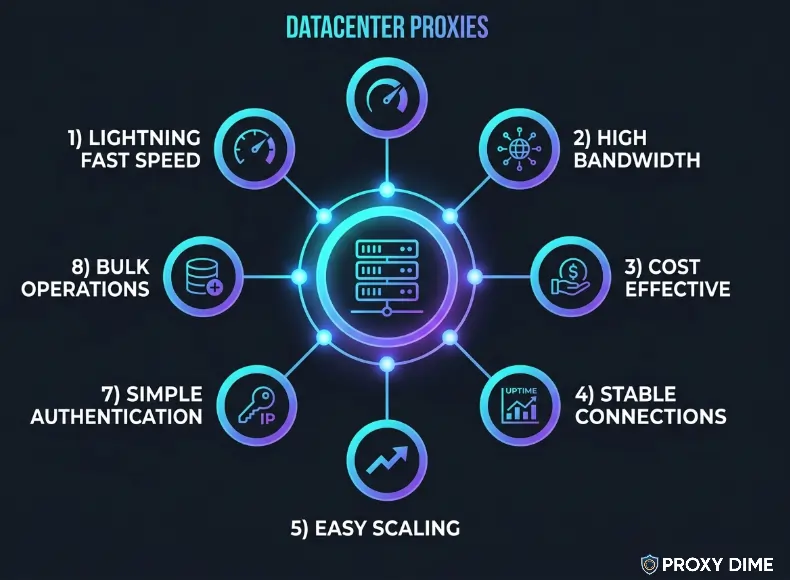
That distinction creates a trade-off. Datacenter IPs are faster and cheaper than residential alternatives. Response times sit under 0.3 seconds on good providers, and pricing drops below $0.10 per IP at scale.
But websites with aggressive bot detection (Cloudflare, PerimeterX) can identify datacenter IP ranges and block them more easily than residential ones.
So why use them at all? Because most scraping targets do not have aggressive protection. Product pages on mid-tier e-commerce sites, public directories, search engine results on less protected engines, job boards, and government data portals all respond fine to well-rotated datacenter IPs.
The speed advantage also matters. When you need to process 500,000 URLs in a day, the sub-second latency of a datacenter proxy completes the job in hours rather than days.
For bulk data collection, price monitoring, SERP tracking on secondary engines, and internal tool automation, datacenter proxies remain the most practical option per dollar spent.
Quick Tip: For targets with minimal anti-bot protection, shared datacenter proxies typically outperform residential proxies on both speed and cost. Prioritise providers offering large subnet diversity and automatic rotation to avoid pattern-based blocks.
High-Performance Datacenter Proxy Providers You Can Trust
| Proxy Provider | Primary Strength | Ideal User |
|---|---|---|
| Decodo | Fastest average response | High-throughput scrapers |
| Webshare | Free tier, 10 proxies | Developers on zero budget |
| Oxylabs | Largest dedicated DC pool | Enterprise automation teams |
| ZenRows | Built-in anti-bot bypass | Protected site scrapers |
| Thordata | 1M+ DC IPs, budget pricing | Cost-focused bulk operations |
| Bright Data | 1.3M IPs, granular control | Compliance-driven enterprises |
| Proxy-Seller | Per-country IP purchasing | Geo-specific targeting buyers |
| IPRoyal | Non-expiring DC bandwidth | Irregular scraping schedules |
| Geonode | $0.50/GB membership pricing | High-volume pipeline operators |
1. Decodo
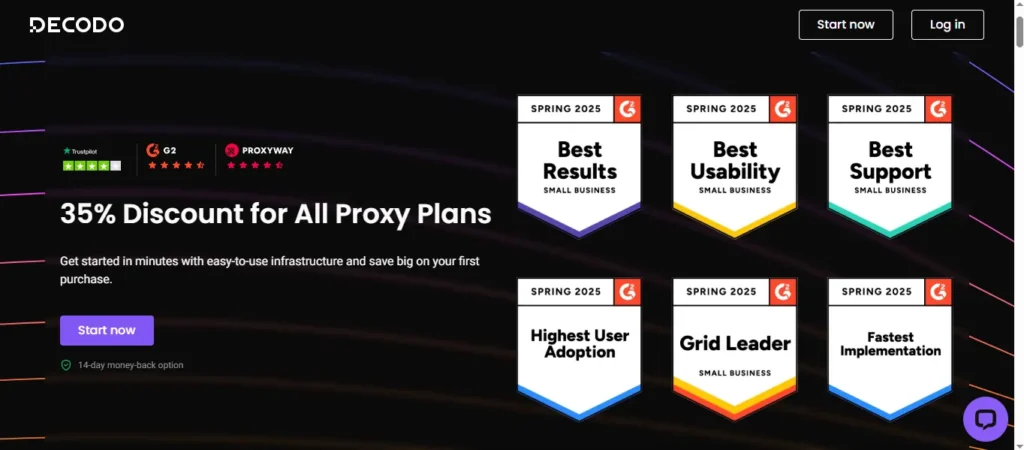
Decodo runs the fastest datacenter proxy infrastructure I have tested in the past 12 months. The average response time sits below 0.3 seconds across both shared and dedicated pools, which translates directly into scraping throughput.
Their shared datacenter pool gives you access to 100,000+ IPs from US and EU data centres, paid per GB with unlimited concurrent connections and threads. Dedicated datacenter proxies are also available when you need exclusive use IPs for sustained campaigns.
For scraping teams that measure success in requests per second, Decodo's datacenter speed consistently beats providers charging twice as much.
Pricing: Shared datacenter proxies from $0.65/GB. Dedicated datacenter from $2.25/IP per month for 3 IPs, dropping to $0.02/IP at 15,000 IPs. Free trial available without credit card.
Pros
Cons
Why Decodo for Datacenter Proxies
When throughput is the metric that matters, Decodo wins. The 0.3 second response time paired with unlimited threads means your Python scrapers, Scrapy spiders, or Node.js crawlers hit their theoretical throughput ceiling rather than waiting on proxy latency. The $0.65/GB shared pricing makes it practical for high-volume test runs before committing to dedicated IPs.
2. Webshare
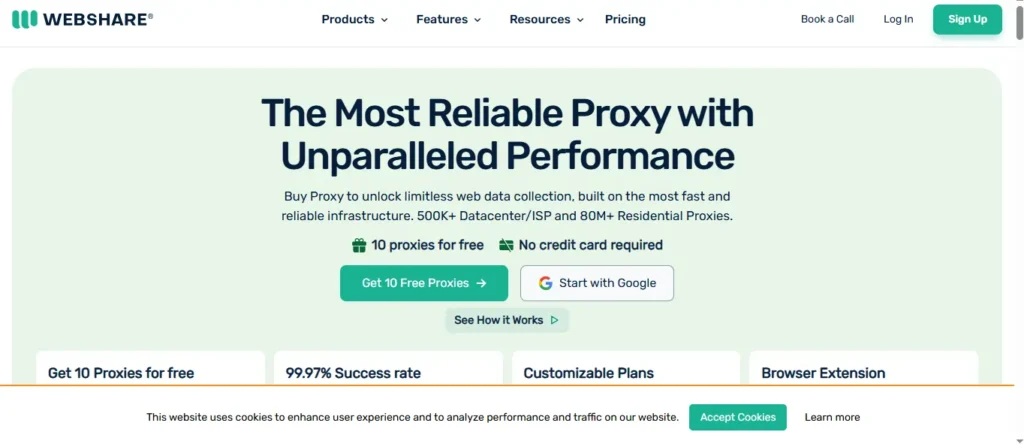
Webshare built its entire business model around making datacenter proxies accessible to everyone, including people who cannot spend a single dollar. The free tier gives you 10 datacenter proxies permanently, with no credit card and no expiry date.
Beyond that, paid shared datacenter IPs start at $0.018 per proxy when you buy in bulk, and private datacenter IPs sit at $0.43 per IP. That is the lowest entry pricing in the entire datacenter proxy market. The self-service dashboard generates proxy credentials in under a minute.
No sales calls, no demos, no onboarding. Just proxies. For solo developers building scrapers, running small automation projects, or testing proxy configurations before committing to premium providers, Webshare removes every barrier to getting started.
Pricing: Free tier with 10 proxies. Shared datacenter from $0.018/IP. Private from $0.43/IP. Dedicated from $0.77/IP. Residential rotating available from $1.40/GB on sale.
Pros
Cons
Why Webshare for Datacenter Proxies
No other provider lets you test datacenter proxies for free, indefinitely. The tiered pricing (shared at $0.018, private at $0.43, dedicated at $0.77) means you graduate from testing to production without migrating infrastructure. Developers building proxy logic into applications start here because there is literally no financial barrier.
3. Oxylabs
Oxylabs controls the largest dedicated datacenter proxy pool on the market at over 2 million exclusive-use IPs. That pool size matters when your automation runs thousands of concurrent sessions against the same target. Smaller pools recycle IPs quickly, triggering pattern detection.
With 2M+ addresses, Oxylabs spreads your traffic across enough unique IPs that recycling stays low even under heavy load. Shared datacenter proxies start at $0.59/GB with a 45K+ pool across 42 locations, while dedicated plans begin at $2.25/IP with unlimited bandwidth and SOCKS5 support.
For enterprise teams running always-on scrapers, monitoring dashboards, or ad verification at scale, the infrastructure behind Oxylabs justifies the premium pricing.
Pricing: Shared datacenter from $0.59/GB ($11.80/month minimum). Dedicated from $2.25/IP ($6.75/month for 3 IPs). Use code OXYLABS50 for 50% off your first month. Free 5 dedicated IP trial available.
Pros
Cons
Why Oxylabs for Datacenter Proxies
The 2M+ dedicated datacenter pool is not a marketing number. It is the largest verified exclusive-use DC pool available. When you need 500+ concurrent scraping tasks running 24/7 against targets that track IP patterns, this pool depth prevents the recycling that gets smaller providers blocked within hours.
4. ZenRows
ZenRows approaches the datacenter proxy problem from a different angle entirely. Instead of handing you raw proxy endpoints to configure yourself, ZenRows wraps datacenter and premium proxies inside a scraping API that handles anti-bot bypasses automatically. You send a URL.
ZenRows figures out whether it needs JavaScript rendering, premium residential rotation, or a standard datacenter pass-through. Basic requests cost $0.28 per thousand, and even heavily protected pages top out at $7 per thousand requests.
For developers who spend more time fighting CAPTCHAs and Cloudflare challenges than actually processing data, ZenRows removes the proxy management layer completely.
Pricing: Free trial with 1,000 credits. Paid plans from $69/month (Developer) scaling to $2,999/month (Enterprise). Credits roll into API calls based on complexity.
Pros
Cons
Why ZenRows for Datacenter Proxies
If your bottleneck is not proxy speed but anti-bot detection, ZenRows solves a different problem than raw datacenter endpoints. The API handles the entire request lifecycle, including proxy selection, rendering, and retry logic, so your engineering team focuses on data processing rather than infrastructure.
5. Thordata
Thordata operates a datacenter proxy pool of 650K+ dedicated IPs spread across 60+ countries with 99.99% uptime and pricing that undercuts most of the established competition. Their datacenter proxies start at $0.75/IP with dedicated allocation, and the static ISP proxies sit at $1.50/IP.
What caught my attention during testing was the concurrency handling. Thordata optimises for large-scale parallel requests, which matters when your data pipeline needs to hit hundreds of thousands of endpoints in a single run.
For budget-conscious teams running bulk collection jobs that do not require the pool depth of Oxylabs or the speed of Decodo, Thordata fills the gap between cheap and unusable.
Pricing: Datacenter proxies from $0.75/IP. Static ISP from $1.50/IP. Residential from $1.80/GB. Unlimited residential plan at $69/day. 1 GB free trial available on request.
Pros
Cons
6. Bright Data
Bright Data maintains 1.3 million datacenter proxies across shared and dedicated pools, making it the second largest datacenter infrastructure behind Oxylabs' dedicated pool. The difference is control. Bright Data's open-source Proxy Manager lets you define rotation rules, set bandwidth limits per target, whitelist and blacklist specific subnets, and route traffic through specific ASNs.
Shared datacenter bandwidth starts at just $0.077/GB on high-volume plans, and unlimited datacenter IPs begin at $0.90/IP.
For organisations that need audit trails, compliance controls, and granular traffic routing alongside raw datacenter speed, Bright Data provides a level of operational control that simpler providers cannot match.
Pricing: Shared datacenter pay-as-you-go at $0.60/GB. Volume plans from $0.42/GB at 5 TB. Dedicated IPs from $0.90/IP (1,000 IPs). Free trial available with first deposit matched up to $500.
Pros
Cons
Why Bright Data for Datacenter Proxies
The Proxy Manager is the real differentiator. If your workflow requires routing certain targets through specific subnets, setting per-domain bandwidth caps, or maintaining compliance logs for every request, Bright Data's tooling handles all of that natively. The 1.3M pool and $0.42/GB volume pricing make it practical at scale too.
7. Proxy-Seller
Proxy-Seller takes a different approach to datacenter proxies by selling individual IPs on a per-country basis. You pick the country, pick the quantity, and get dedicated IPs that are yours alone for the rental period.
Datacenter IPv4 proxies start at approximately $4.50/IP, and IPv6 options drop to around $1.60/month. That per-country model works well for geo-specific tasks like monitoring local search results, verifying geo-targeted ads, or accessing region-locked platforms.
The interface is straightforward. You buy IPs the way you buy domain names, one at a time or in packs.
Pricing: IPv4 datacenter from $4.50/IP. IPv6 datacenter from $1.60/IP. ISP proxies from $5/IP. Pricing varies by country and rental duration.
Pros
Cons
8. IPRoyal
IPRoyal sells datacenter proxies with a feature that matters more than most people realise. Non-expiring bandwidth. You buy traffic, and if you do not use it this month, it stays in your account until you do.
That is useful for teams with irregular scraping schedules, seasonal data collection, or project-based work where proxy usage spikes and drops unpredictably. Dedicated datacenter IPs start from $1.39/IP with speeds around 1.1 seconds average response time.
Not the fastest, but reliable enough for steady-state operations. Use code AFFMAVEN10 for 10% off your first purchase.
Pricing: Dedicated datacenter from $1.39/IP. Non-expiring bandwidth model. Use code AFFMAVEN10 for 10% discount.
Pros
Cons
9. Geonode
Geonode applies its membership pricing model to datacenter proxies the same way it does residential, and the economics are compelling. The pay-as-you-go rate sits at $3/GB for premium datacenter traffic, but the membership plan includes 100 GB for $50/month, bringing the effective cost to $0.50/GB.
For pipeline operators running sustained datacenter scraping jobs that consume hundreds of gigabytes monthly, that per-GB rate beats nearly every competitor.
The datacenter pool is smaller, and the feature set is simpler than enterprise providers. But if bandwidth cost is your primary concern, the maths here is hard to argue against.
Pricing: Premium pay-as-you-go at $3/GB. Membership at $50/month with 100 GB included. Extra bandwidth at $0.50/GB.
Pros
Cons
✨Picking the Right Datacenter Proxy Provider
1. Shared vs Dedicated IPs
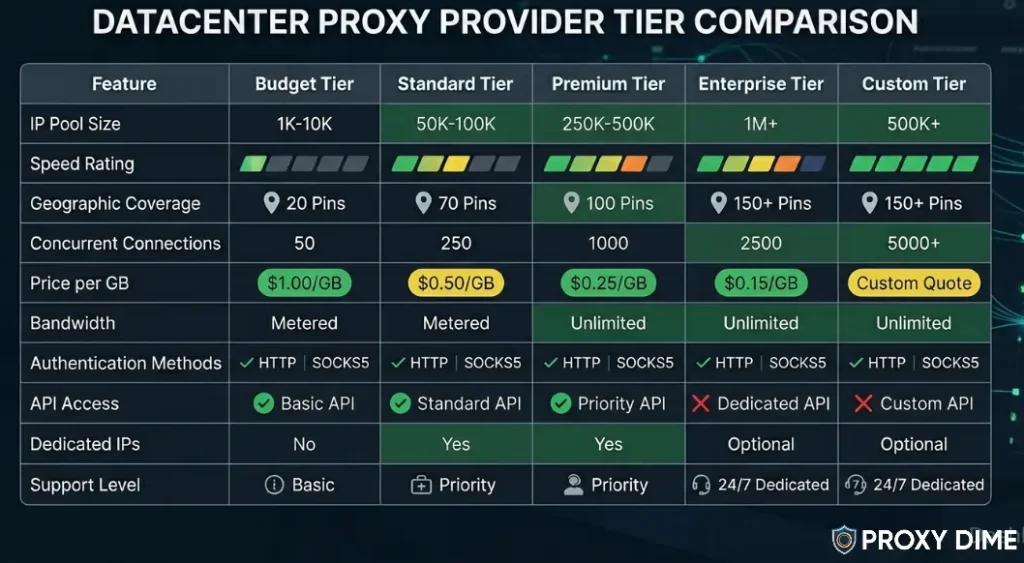
Shared datacenter proxies cost less because multiple users share the same pool. That works for general scraping against unprotected targets. Dedicated datacenter IPs are yours exclusively, which means no one else's traffic can burn them. If your targets track and ban individual IPs, dedicated is the safer choice. For testing and low-stakes jobs, shared saves money without meaningful risk.
2. Subnet Diversity Across Locations
A datacenter pool with 50,000 IPs from 3 subnets is worse than a pool with 10,000 IPs from 200 subnets. Websites ban entire subnets when they detect bot patterns. Providers like Decodo advertise hundreds of subnets in their US and EU pools. Ask about subnet count before buying, not just total IP count. Geographic spread matters too. If you scrape US targets, US-based datacenter IPs respond faster due to lower latency.
3. Throughput and Concurrency Limits
Datacenter proxies exist for speed. Check the provider's concurrent session limits before committing. Oxylabs supports 10,000 concurrent sessions. Decodo offers unlimited threads on shared plans. A provider that caps you at 100 concurrent connections will bottleneck your scraper regardless of how many IPs are in the pool. Match the concurrency limit to your peak workload, not your average.
4. Bandwidth Model vs Per-IP Model
Some providers charge per gigabyte of traffic. Others charge per IP with unlimited bandwidth. Your scraping pattern determines which saves money. If you scrape text-heavy pages (small payloads, high request count), per-IP with unlimited bandwidth is cheaper. If you scrape media, images, or large JSON responses, pay-per-GB can get expensive fast. Calculate your average payload size and multiply it by your daily request volume before choosing.
5. Rotation and Session Persistence
Rotating datacenter proxies assign a new IP per request, which works for stateless scraping. Sticky sessions hold the same IP for a set duration, which you need for multi-page navigation, logged-in scraping, or checkout flows. Most providers offer both. The difference is in how cleanly rotation distributes across the available pool and how long sticky sessions can hold. If your workflow requires session persistence, confirm the maximum sticky duration matches your needs.
🚀Frequently Asked Questions About Datacenter Proxies
What are datacenter proxies?
Datacenter proxies are IP addresses hosted on commercial servers in data centres rather than assigned by ISPs to household devices. They provide fast connection speeds and low latency at a fraction of residential proxy costs. Websites can identify them as non-residential, which makes them easier to block on protected targets.
How do datacenter proxies differ from residential proxies?
Datacenter proxies originate from cloud servers and offer faster speeds at lower prices. Residential proxies use real household IPs and carry higher trust scores with websites. Choose datacenter when speed and cost matter most. Choose residential when you need to bypass aggressive anti-bot systems.
Are datacenter proxies fast enough for bulk scraping?
Yes. Datacenter proxies are the fastest proxy type available, with response times under 0.3 seconds on top providers like Decodo. They handle thousands of concurrent requests efficiently, making them the preferred choice for large-scale data collection against moderately protected websites.
How much do datacenter proxies cost in 2026?
Pricing ranges from $0.018/IP for shared pools on Webshare to $4.50/IP for dedicated country-specific IPs on Proxy-Seller. Pay-per-GB models start at $0.42/GB on Bright Data's volume plans. Most mid-range providers charge between $0.60 and $2.25 per IP depending on pool type.
Can websites detect datacenter proxies?
Yes. Sophisticated anti-bot systems like Cloudflare and DataDome can identify datacenter IP ranges by checking ASN registrations. However, most websites do not employ this level of detection. Well-rotated datacenter proxies work reliably against the majority of scraping targets.
Are datacenter proxies legal to use?
Using datacenter proxies is legal. The legality depends on your activity, not the proxy type. Scraping publicly available information is generally permissible. Accessing private accounts, bypassing explicit access controls, or violating a site's terms of service creates legal risk regardless of the proxy infrastructure.
Can I use free datacenter proxies for production scraping?
Webshare offers 10 free datacenter proxies permanently, which works for development and testing. For production scraping, free proxies lack the speed, pool diversity, and reliability needed for consistent results. Budget paid options like Webshare's $0.018/IP shared tier offer far better production performance at minimal cost.

More Guides On Proxy Dime
🧠Final Thoughts
Decodo earns the top position for speed. Sub-0.3 second datacenter response times and unlimited threads make it the obvious pick for throughput-focused scraping teams. Webshare is where everyone should start, because ten free proxies and $0.018/IP shared pricing remove every financial barrier.
Oxylabs makes sense when your operation outgrows smaller pools and needs 2M+ dedicated IPs with enterprise concurrency. And if proxy management itself is the bottleneck, ZenRows takes a fundamentally different approach worth testing. Most providers here offer free trials.
Run your actual scraping targets through them before committing. A 20-minute test beats reading reviews every time.
👉 Speed Pick: Decodo — Fastest datacenter proxies in 2026
👉 Free Start: Webshare — 10 free proxies, $0.018/IP at scale
👉 Enterprise Scale: Oxylabs — 2M+ dedicated pool, 50% off with OXYLABS50