Your Python script ran perfectly in testing. Clean JSON output. Structured data. Fast. Then you pointed it at a production target with Cloudflare protection, and the whole pipeline collapsed. CAPTCHAs on every request. 403 errors flooding the logs. Three hours spent tweaking headers, rotating user agents, and adjusting request delays. Still blocked.
That is the exact problem proxy API providers exist to solve. Instead of managing proxy rotation, CAPTCHA solving, browser fingerprinting, and JavaScript rendering yourself, a proxy API handles all of it behind a single endpoint. You send a URL. You get back clean HTML, JSON, or structured data. The API figures out which proxy type, which headers, and which rendering method the target needs.
The proxy server software market is growing at a projected CAGR of 6.8% through 2033, with the broader proxy network sector on track to reach $13 billion. Scraping APIs represent the fastest growing segment because they collapse the entire proxy infrastructure stack into one API call.
Bright Data's SERP API alone achieved a 98.44% success rate in independent benchmarks, and Oxylabs' Web Scraper API starts at just $0.50 per 1,000 results. After integrating these 8 providers into real production pipelines, these are the ones that actually deliver clean data at scale.
What Makes Proxy API Providers Different From Raw Proxies
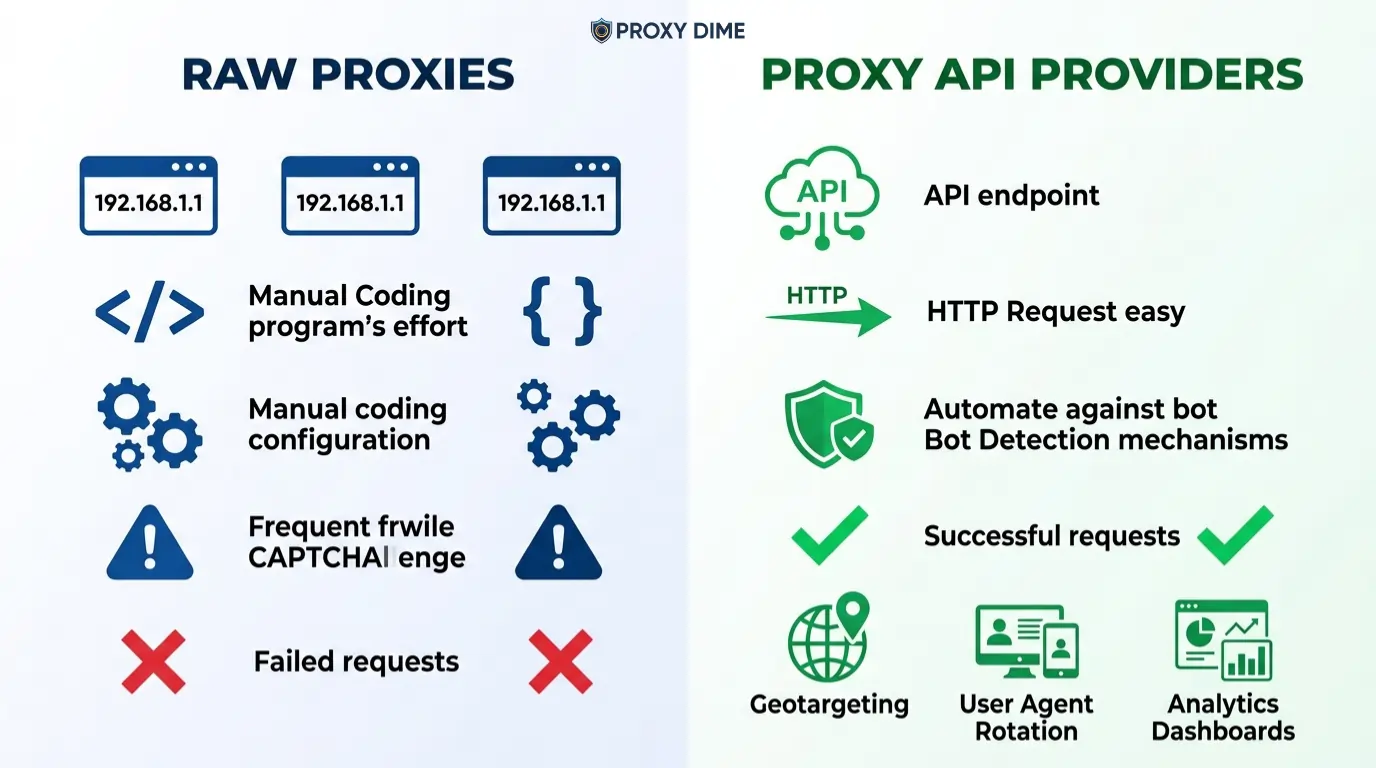
Proxy API providers sit a layer above traditional proxy services. A raw proxy gives you an IP address and a port. You still manage rotation logic, handle CAPTCHAs, render JavaScript, parse HTML, and retry failed requests in your own code. A proxy API abstracts all of that into a single HTTP request.
The difference matters most on protected targets. Sites running Cloudflare, Akamai, PerimeterX, or DataDome require more than a fresh IP to return data.
They check TLS fingerprints, analyse mouse movement patterns, evaluate JavaScript execution environments, and validate browser headers against known bot signatures. Building that evasion logic from scratch takes weeks of engineering. A proxy API provider maintains that logic continuously and exposes it through a simple GET or POST request.
For developers building scrapers in Python, Node.js, or Go, the integration is usually a one line change. Replace your direct HTTP request with a request to the proxy API endpoint, pass the target URL as a parameter, and receive the rendered page content back.
Most providers return data in JSON or raw HTML. Some offer structured parsing that extracts specific fields automatically, which saves the entire BeautifulSoup or Cheerio parsing step.
The trade off is cost. Raw residential bandwidth costs $1 to $3 per GB. Proxy API requests cost $0.10 to $7.00 per 1,000 results depending on complexity. For protected targets, the API route is almost always cheaper when you factor in engineering hours. For simple static pages, raw proxies win on cost.
Which Proxy API Providers Made the Cut
| Proxy Provider | API Strength | Ideal User |
|---|---|---|
| ZenRows | Anti-bot bypass engine | Python scraping developer |
| Thordata | 120+ scraper API endpoints | Full stack data engineer |
| Oxylabs | OxyCopilot AI parsing | Enterprise scraping team |
| Bright Data | 98.44% benchmark success | Large scale data operation |
| Decodo | Modular request pricing | Cost conscious scraping team |
| Webshare | REST API free tier | Solo developer prototyper |
| Proxy-Seller | Dedicated API endpoints | Compliance focused scraper |
| IPRoyal | Non-expiring API credits | Freelance data collector |
1. ZenRows
ZenRows was built from the ground up as a scraping API, not a proxy network with an API bolted on afterwards. That design focus shows in the anti-bot bypass engine. The Universal Scraper API handles Cloudflare, Akamai, PerimeterX, and DataDome protected sites through a single endpoint with automatic fingerprint rotation and CAPTCHA solving.
You send a URL. ZenRows figures out if the target needs JavaScript rendering, premium residential proxies, or basic datacenter rotation and applies the right combination automatically. The cost multiplier system means basic pages cost $0.28 per 1,000 requests while protected pages with JavaScript rendering and premium proxies cost $7.00 per 1,000.
That granular pricing prevents overpaying on easy targets. For developers running mixed pipelines that scrape both static product pages and heavily protected dashboards, this per request configuration is exactly how billing should work. The Scraping Browser product adds a full headless browser layer for the most stubborn targets.
ZenRows Pros
ZenRows Cons
14 day free trial, all features included
Every other provider on this list charges one flat rate regardless of target difficulty. That pricing structure saves serious money on mixed workloads.
2. Thordata
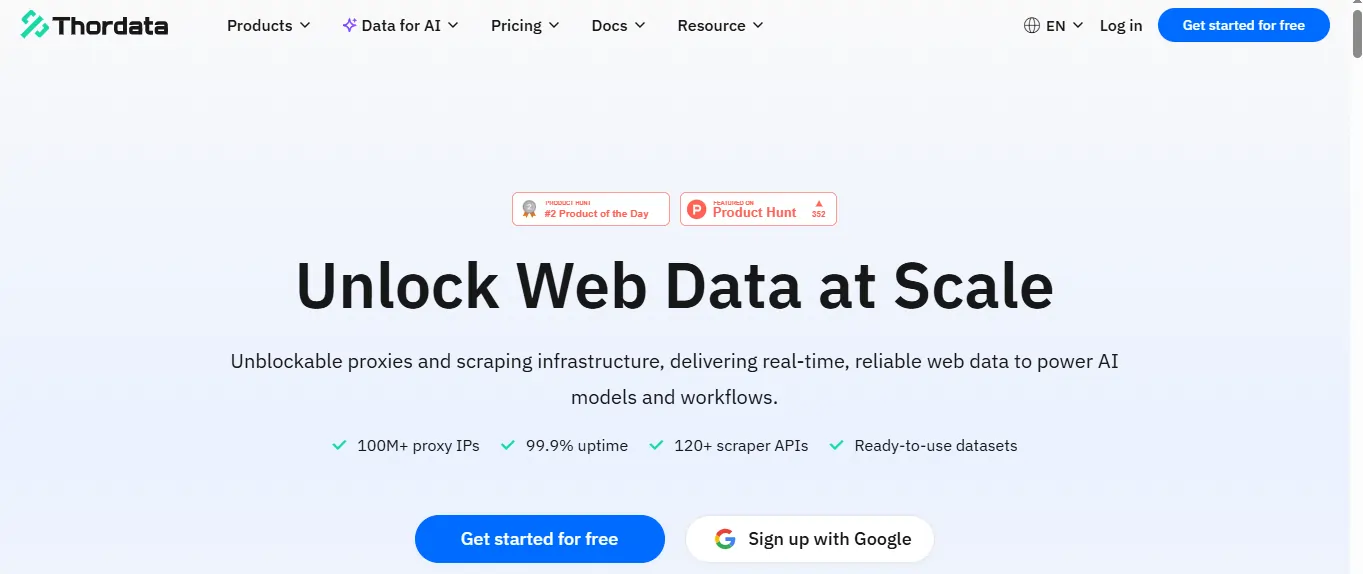
Thordata quietly built one of the most complete proxy API ecosystems available. The platform offers over 120 scraper API endpoints covering Google, Bing, Amazon, eBay, and dozens of other specific targets. Each endpoint is pre-configured with the optimal proxy type, rotation logic, and header management for that particular site.
Their SERP API pulls search results directly without your pipeline needing to handle any anti-bot logic. The Web Unlocker API bypasses blocks on arbitrary URLs. And the Scraping Browser runs headless Chrome sessions through their infrastructure for JavaScript heavy targets. All of this connects to a 100 million IP residential pool across 190 countries with 99.9% published uptime.
The unlimited bandwidth residential plan at $69/day is particularly relevant for API users running high volume production pipelines where per GB billing creates unpredictable costs.
Thordata Pros
Thordata Cons
$4 intro pack, 5 GB full access
3. Oxylabs
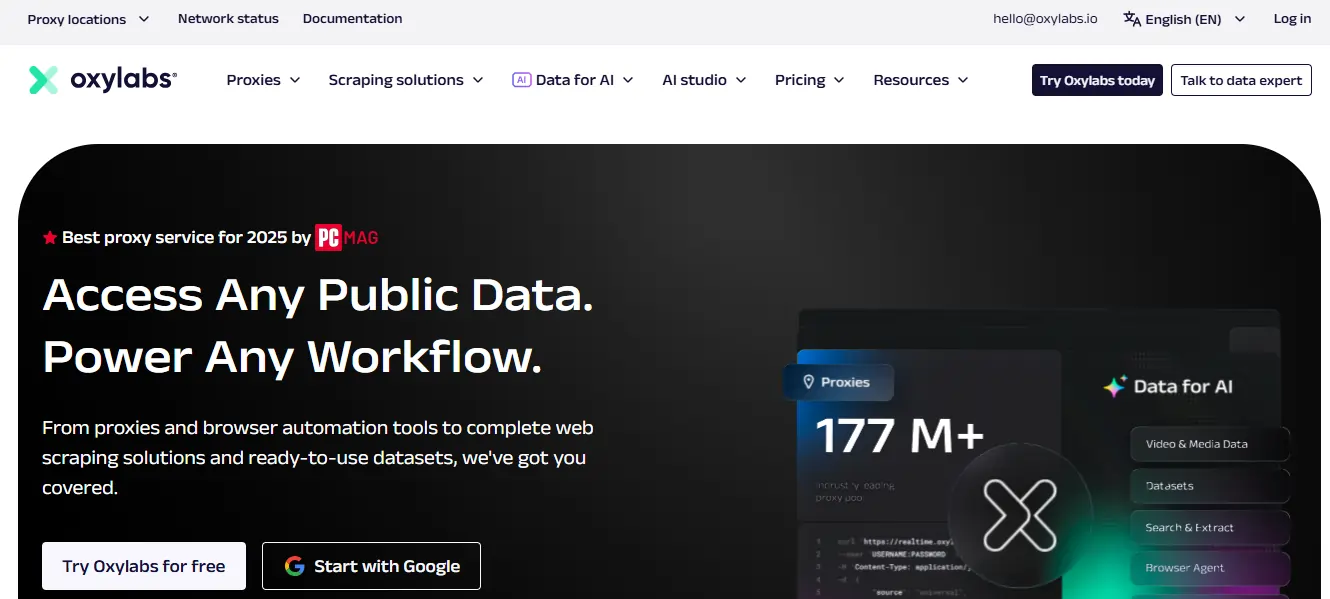
Oxylabs runs its Web Scraper API on top of the largest verified proxy pool in the industry. 177 million residential IPs feed into an API that handles proxy rotation, CAPTCHA solving, and JavaScript rendering through a single endpoint.
What separates Oxylabs from simpler scraping APIs is OxyCopilot. This AI layer generates parsing instructions from natural language prompts. Instead of writing XPath selectors or CSS queries to extract product prices from an Amazon page, you tell OxyCopilot what data you need and it builds the parser.
The API starts at $49/month for the Micro plan (up to 98,000 results) and scales through tiers to enterprise level at $999/month with 500K+ results and 100 requests per second. The structured output supports JSON, CSV, and HTML.
For enterprise data teams that scrape millions of pages monthly across multiple targets, the combination of pool depth, AI parsing, and dedicated account management makes Oxylabs the infrastructure grade option.
Oxylabs Pros
Oxylabs Cons
⚡ Epic 50% Oxylabs Proxy Promo

50% savings on Oxylabs' powerful proxy networks and datasets. Scale effortlessly for business intelligence. Apply code OXYLABS50 today—offer won't last!
4. Bright Data
Bright Data scored a 98.44% average success rate in Scrape.do's independent benchmark of 11 proxy API providers, the highest published figure in the industry for 2026. The Web Scraper API connects to 150 million residential, datacenter, ISP, and mobile IPs with automatic proxy selection per target.
The SERP API is a separate product specifically built for search engine result extraction, supporting Google, Bing, YouTube, and more with localized results from any country. What makes Bright Data's API architecture different is the no code playground. Non-technical team members can build and test scraping workflows visually before a developer writes a single line of code.
The API returns data in JSON, HTML, or structured records at $0.001 per record for the Web Scraper and $1 to $1.50 per 1,000 results for the SERP API. For organisations where data analysts and developers both need access to scraping infrastructure, the playground removes the engineering bottleneck.
Bright Data Pros
Bright Data Cons
7 day trial across all API products
5. Decodo
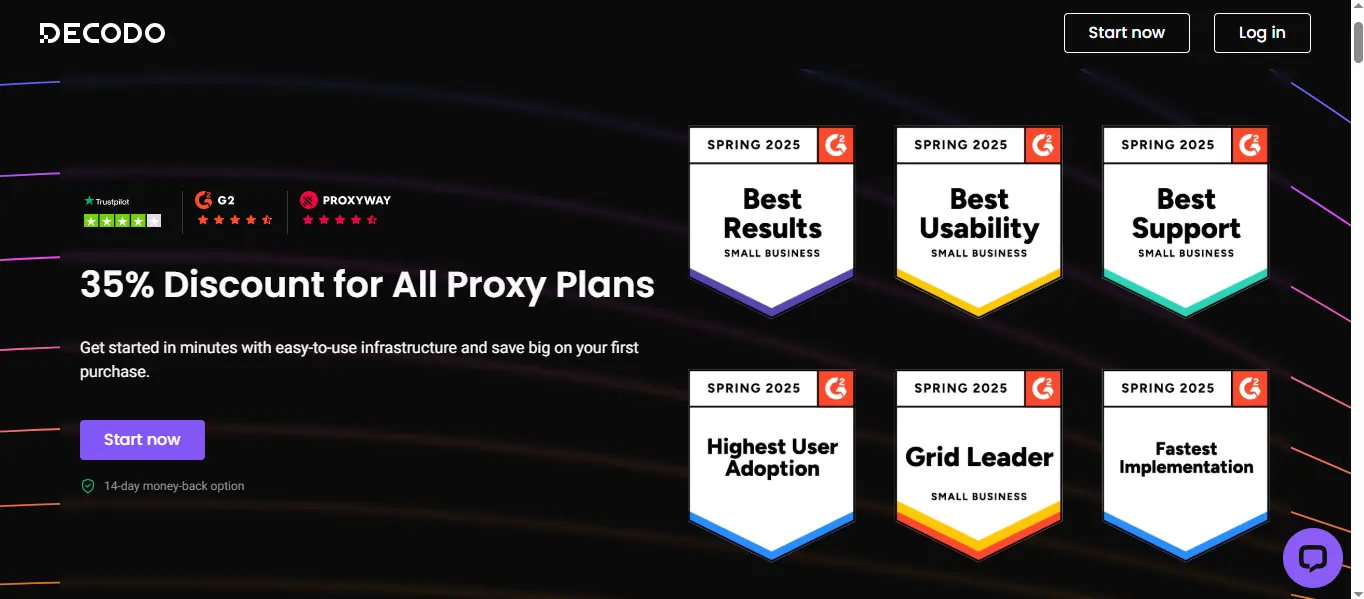
Decodo is about to reshape proxy API pricing with a modular, per request billing model that no other provider currently offers. The new scraping API (launching in 2026) lets you configure each individual request with exactly the infrastructure it needs.
Enable JavaScript rendering only when the target requires it. Select datacenter proxies for easy sites and residential for protected ones. Set retry behaviour and timeout thresholds per request. The result is a pipeline where simple HTML pages cost a fraction of what protected JavaScript rendered pages cost, all through the same API endpoint.
The current API already supports HTML, JSON, CSV, PNG, and Markdown output formats. Integration works through real time API calls, asynchronous batch processing, or direct proxy mode. The 125 million IP residential network with 195 country coverage provides the underlying proxy infrastructure.
For scraping teams frustrated by flat rate pricing that charges premium rates on easy targets, this request level configuration is the model that should have existed years ago.
Decodo Pros
Decodo Cons
7 day trial, 1K results, no card
Decodo's approach charges datacenter rates for the easy pages and residential rates for the protected ones. On a 500K page pipeline, that structure can cut costs by 40% or more.
6. Webshare
Webshare gives developers the cleanest REST API for raw proxy management available at this price point. The API follows proper REST architecture with predictable resource URLs, JSON encoded responses, and standard HTTP verbs. Every proxy operation is accessible programmatically. List proxies, rotate credentials, manage IP authorisations, filter by country and city, and monitor proxy health status.
All through documented endpoints with Python client libraries available on PyPI. The free tier provides 10 proxies with full API access, which lets developers build and test their proxy integration layer before spending anything. Paid plans scale from $2.99/month (100 datacenter proxies) up through residential bandwidth at $1.12/GB on annual plans.
The backwards compatibility guarantee means API integrations will not break when Webshare updates their system. For developers who want direct proxy control through a well documented API rather than a managed scraping service, Webshare delivers the infrastructure layer without the abstraction overhead.apidocs.
Webshare Pros
Webshare Cons
Free forever API access, 10 proxies included
7. Proxy-Seller
Proxy-Seller provides API access to dedicated proxy infrastructure where every IP is privately assigned to your account. The API supports order management, proxy list retrieval, and credential rotation across datacenter, ISP, mobile, and residential proxy types.
For scraping teams that need guaranteed clean IPs (no cross contamination from other users sharing the same addresses), the dedicated model eliminates a failure mode that rotating residential pools cannot. The 220+ location coverage with HTTP, HTTPS, and SOCKS5 support covers most geographic targeting needs.
The billing flexibility is relevant for API users. You can rent proxies for 24 hours, one week, or one month, which lets you spin up infrastructure for a specific scraping project and shut it down without carrying monthly costs. For compliance focused operations where audit trails require knowing exactly which IPs were used for which requests, the dedicated assignment model provides that accountability.
Proxy-Seller Pros
Proxy-Seller Cons
Private IPs, 24 hour rental available
8. IPRoyal
IPRoyal rounds out the list with an API that appeals to developers who scrape irregularly or on project timelines rather than continuously. The purchased residential bandwidth never expires. Buy 50 GB of API credits today, use 10 GB this month for a client project, and carry the remaining 40 GB forward indefinitely.
The API provides access to residential, datacenter, ISP, and mobile proxies with country and city targeting. Authentication supports both username/password and IP whitelist methods. The residential IPs come from Pawns.app, their own ethical sourcing network, which keeps the pool cleaner than aggregated multi-source providers.
For freelance developers, agencies running periodic scraping projects, and teams with unpredictable data collection schedules, the non-expiring credit model eliminates the “use it or lose it” pressure of monthly bandwidth allocations.
IPRoyal Pros
IPRoyal Cons
🔥 10% Off IPRoyal Proxies with AFFMAVEN10!

Get high-speed, residential proxies from IPRoyal today. Redeem AFFMAVEN10 for 10% off your first purchase and scale your projects affordably.
Picking the Right Proxy API Providers for Your Pipeline
Managed API vs Raw Proxy API for Your Targets
The first decision splits the list in two. ZenRows, Thordata, Oxylabs, Bright Data, and Decodo offer managed scraping APIs that handle rotation, CAPTCHA solving, and rendering for you. Webshare, Proxy-Seller, and IPRoyal provide proxy infrastructure APIs where you control the logic.
If your targets run Cloudflare or Akamai, a managed API saves weeks of engineering. If your targets are unprotected and you want maximum control, raw proxy APIs cost less per request. Choose based on your target's protection level, not the provider's marketing.
Success Rate and Its Impact on Data Completeness
A 95% success rate sounds acceptable until you calculate what 5% failure means at scale. On a 1 million request pipeline, 50,000 failed requests create data gaps that affect downstream analysis, pricing models, and machine learning training sets.
Bright Data's 98.44% and Oxylabs' published rates matter because that 3% difference compounds into tens of thousands of additional successful records monthly. Always run a benchmark on your specific targets before committing. Published success rates are averages across all targets, and your mileage will vary based on which sites you scrape.
Concurrent Request Capacity for Throughput
Pipeline speed depends on how many parallel requests the API handles. ZenRows scales from 20 to 400 concurrent requests across its tiers. Oxylabs supports 15 to 100 requests per second.
Bright Data offers unlimited concurrency. If your pipeline needs to process 100,000 URLs per hour, calculate the required concurrency and ensure your plan supports it. Upgrading mid-pipeline is disruptive, so choose a tier with headroom above your expected peak.
Output Format and Parsing Overhead
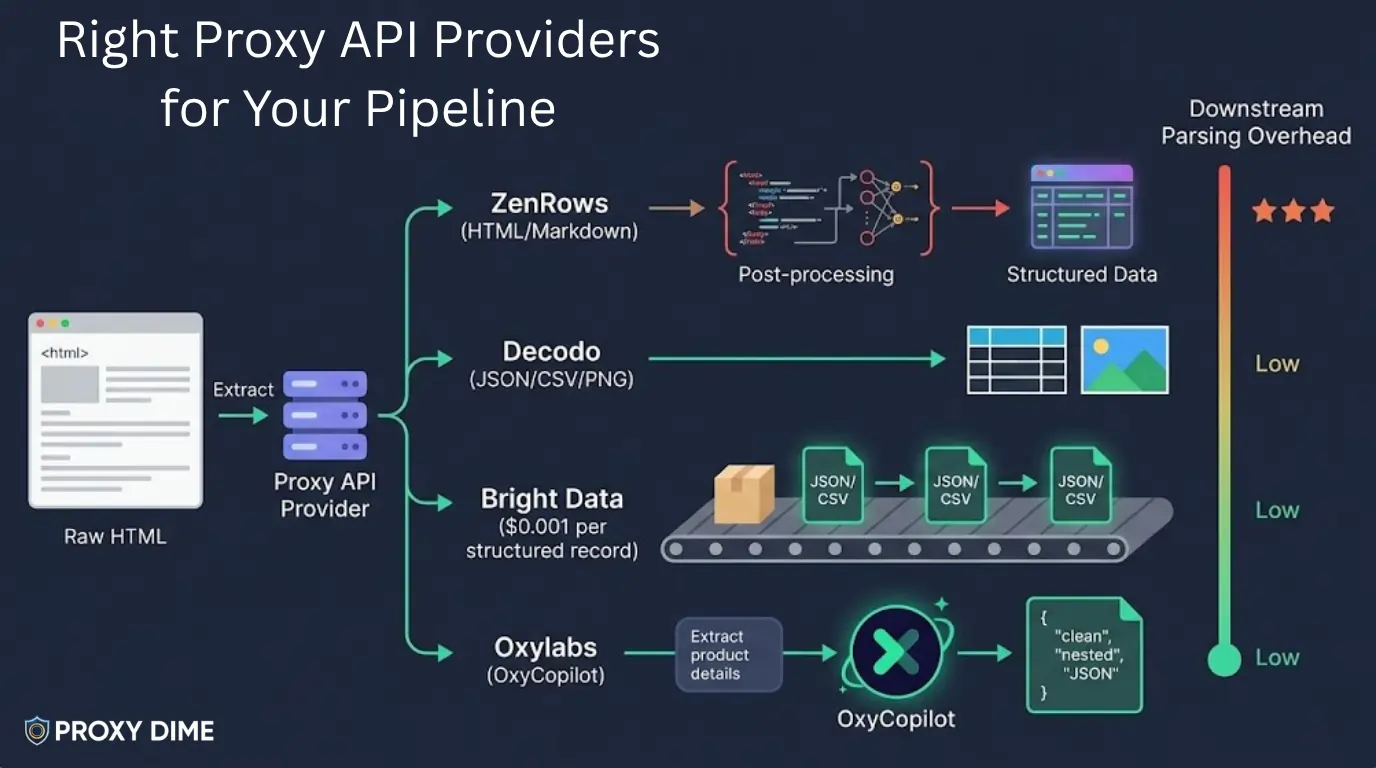
The API's output format determines how much post-processing your pipeline needs. Oxylabs' OxyCopilot generates structured JSON from natural language prompts. ZenRows returns HTML or Markdown. Decodo supports JSON, CSV, and PNG. Bright Data offers structured records at $0.001 per record.
If your pipeline feeds a database or analytics tool, structured JSON output eliminates the parsing layer entirely. If you need raw HTML for custom extraction, simpler APIs from Webshare or IPRoyal keep costs lower.
Cost Per Result vs Cost Per GB
Proxy API billing falls into two models. Per result billing (ZenRows, Oxylabs, Bright Data) charges for successful data returns. Per GB billing (Webshare, IPRoyal, Thordata) charges for bandwidth consumed. Per result is predictable when you know your request volume.
Per GB is cheaper when pages are small and requests are high volume. A typical product page is 200 to 500 KB. At $2/GB, that is roughly $0.001 per page. At $0.50/1K results, managed APIs cost $0.0005 per result. Run the maths on your specific page sizes and volumes before choosing a billing model.

More Guides On Proxy Dime
Final Thoughts
ZenRows delivers the best cost efficiency for mixed pipelines through its per request multiplier model. Oxylabs provides the most complete API platform with AI assisted parsing through OxyCopilot. And Webshare offers the only genuinely useful free tier for developers who need to prototype proxy integrations before committing budget.
Most of these providers offer 7 to 14 day trials. Test two or three against your actual target URLs and compare success rates, response times, and cost per result. The numbers tell you which API fits your pipeline better than any review can.
👉 Best for Mixed Targets: Start ZenRows Free Trial — 14 days, all features
👉 Best for Enterprise: Test Oxylabs Web Scraper API — Code OXYLABS50 for 50% off
👉 Best Free Start: Build on Webshare API — 10 proxies, full API, no card