Why Static IPs Fail at Scale — And Why Proxy Rotation Exists
Any website receiving hundreds of requests from the same IP address in a short window will flag that IP as automated traffic. Rate limiting, CAPTCHA challenges, and permanent bans follow. This is the central operational challenge of web scraping, price monitoring, and large-scale data collection.
A single IP can typically sustain 50–200 requests before triggering defenses on well-protected sites — far below the volumes required for enterprise data operations.
According to Apify's 2026 State of Web Scraping report, 65.8% of scraping professionals increased proxy usage in 2025, with proxy rotation and residential services cited as the most common method for bypassing anti-bot defenses alongside CAPTCHA solvers.
Anti-bot platforms like Cloudflare Enterprise now deploy behavioral analysis, IP reputation scoring, and browser fingerprinting — making IP rotation a necessary but not sufficient defense.
How Proxy Rotation Works: Technical Mechanics
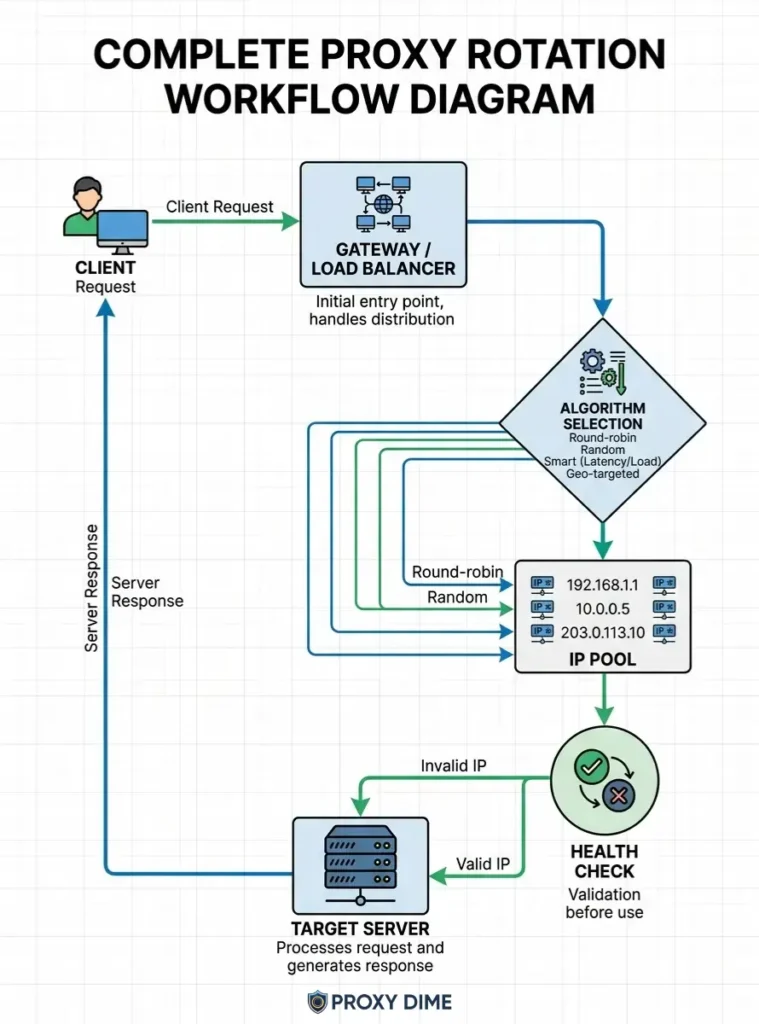
A rotating proxy service maintains an IP pool managed by a gateway server or load balancer. When you send a request, the rotation system selects an IP from the pool using one of several algorithms:
An IP health monitoring system continuously evaluates pool IPs — removing flagged, blocked, or slow IPs from active rotation. This self-healing pool management ensures consistent success rates without manual intervention.
Rotation Modes: Request-Based vs Sticky Sessions
| Mode | Mechanism | Best For | Limitation |
|---|---|---|---|
| Request-based | New IP every single request | High-volume scraping, price monitoring | Breaks session-dependent tasks |
| Sticky/Timed | Same IP for N minutes (e.g., 10–30 min) | Account management, login sessions | IP accumulates requests over time |
| Smart rotation | Rotates on failure/CAPTCHA detection | Protected targets, adaptive scraping | Requires smart proxy infrastructure |
| Geo-targeted | Rotates within specific country/city pool | Localized price/content research | Smaller regional pool = faster exhaustion |
What Rotation Defeats — and What It Doesn't
Proxy rotation with residential IPs is highly effective against: IP-based rate limiting, IP blacklisting, ASN-based blocking, and geographic blocking. Residential IP rotation achieves 90–95% success on IP-rotation-dependent targets alone.
What rotation alone cannot defeat: browser fingerprinting (TLS fingerprint, User-Agent consistency, header order), behavioral analysis (mouse movement, scroll patterns, click timing), and advanced ML-based bot scoring that evaluates the complete request context.
Combining residential rotation with Playwright stealth mode or similar browser fingerprint normalization addresses these additional detection vectors.
Rotating Proxies vs Backconnect Proxies: The Key Distinction
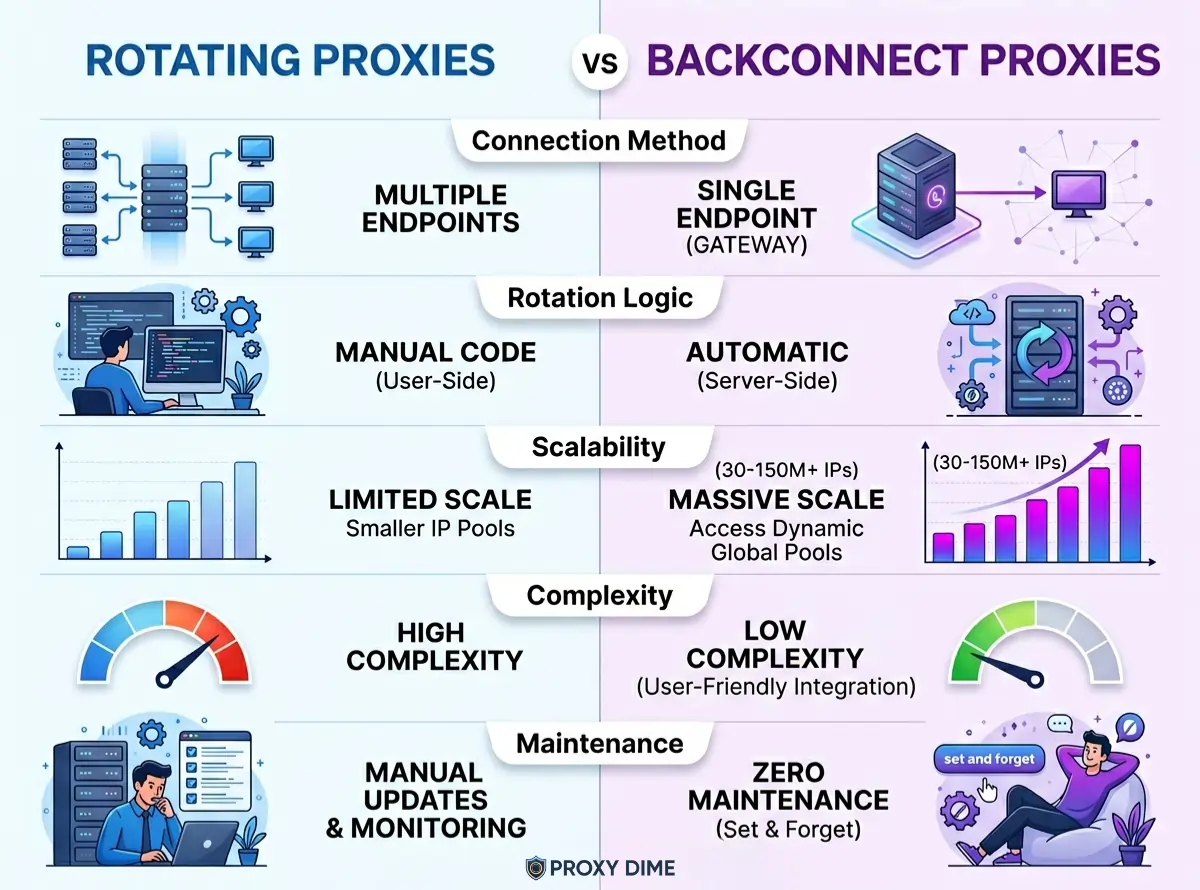
Traditional rotating proxy setups require you to maintain a proxy list and implement rotation logic in your own scraping code. Backconnect proxies handle all rotation server-side through a single gateway endpoint — you always connect to the same host:port, IP assignment happens invisibly.
For most users, backconnect proxies are operationally simpler and more scalable. Leading providers offer pools of 30–150 million IPs.
Key Use Cases for Rotating Proxies