The IPv4 Exhaustion Crisis: Why It Matters for Proxy Buyers
IPv4 — the 32-bit addressing scheme powering the majority of internet traffic — has been functionally exhausted at the regional registry level since APNIC (Asia-Pacific) ran out in 2011, ARIN (North America) in 2015, and RIPE NCC (Europe) in 2019. By 2026, all five Regional Internet Registries (RIRs) operate with minimal reserves, surviving primarily on address transfers and recycled blocks.
APNIC's January 2026 report confirms the total allocated IPv4 pool contracted by 237,000 addresses in 2025, with 3.687 billion addresses allocated globally across all five RIRs. In 2025, 33 million IPv4 addresses were transferred within the RIR registry system — a record-level transfer market driven by scarcity.
Average per-address prices dropped approximately 50% that year, suggesting IPv6 adoption is finally outpacing IPv4 demand.
For proxy buyers and operators, this creates a clear two-tier market: IPv4 proxy IPs are a finite, actively traded commodity with increasing cost pressure. IPv6 proxy IPs are virtually unlimited, dramatically cheaper, and growing in relevance as the web migrates to the newer protocol.
IPv4: Technical Architecture
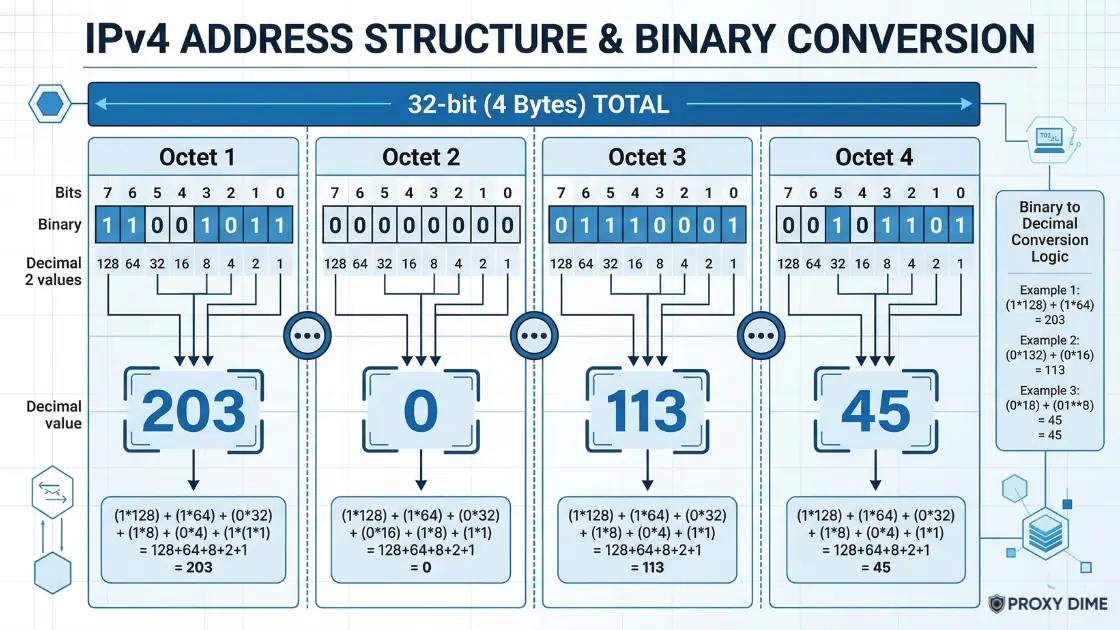
IPv4 uses a 32-bit binary address format, expressed as four decimal octets separated by dots — for example, 203.0.113.45. This format supports exactly 4,294,967,296 (~4.3 billion) unique addresses globally. To extend IPv4 beyond this ceiling, NAT (Network Address Translation) was introduced — allowing multiple devices behind a router to share a single public IP.
While NAT solved the exhaustion problem temporarily, it complicates proxy geolocation accuracy, disrupts end-to-end connectivity for certain protocols, and introduces routing overhead that pure IPv6 deployments avoid entirely.
IPv6: Technical Architecture
IPv6 uses a 128-bit address format, written as eight groups of four hexadecimal digits — for example, 2001:0db8:85a3:0000:0000:8a2e:0370:7334 (collapsible to 2001:db8:85a3::8a2e:370:7334). The address space is approximately 3.4 × 10³⁸ unique addresses — effectively unlimited.
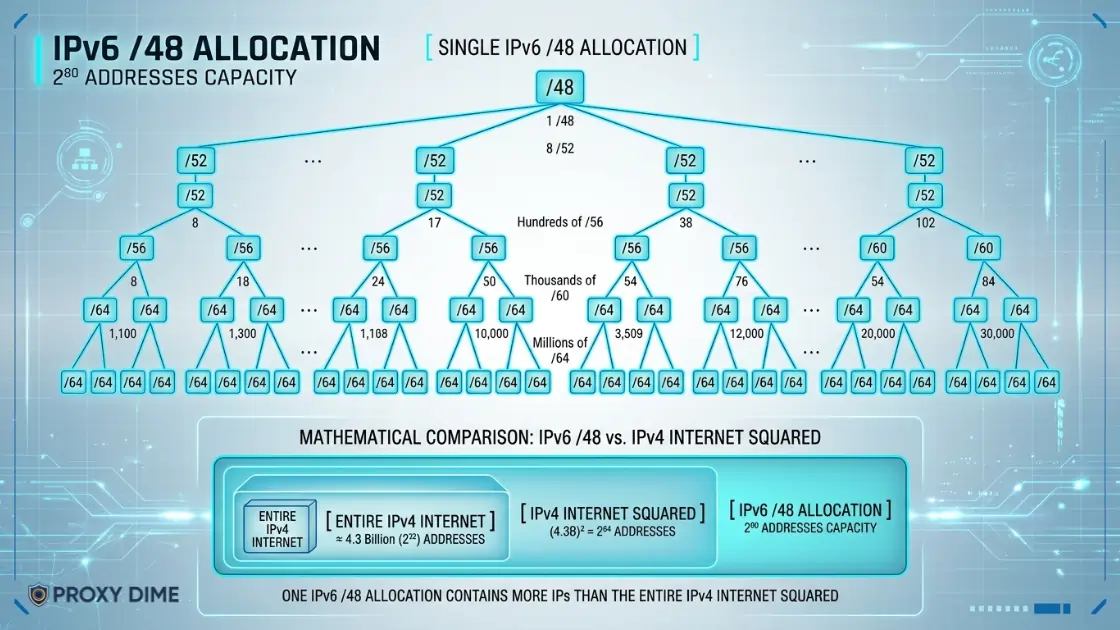
A single IPv6 /48 allocation contains 2⁸⁰ addresses — more unique IPs than the entire IPv4 internet squared. IPv6 also includes native IPsec support for end-to-end authentication and encryption, eliminates the NAT requirement, and enables direct peer-to-peer device addressing.
For proxy providers, IPv6's abundance means they can generate massive, diverse IP pools at a fraction of IPv4 cost — passing significant savings to buyers while offering superior IP diversity for anti-detection purposes.
IPv4 vs IPv6 Proxies: Full Technical Comparison
| Feature | IPv4 Proxy | IPv6 Proxy |
|---|---|---|
| Address Length | 32-bit (e.g., 192.168.1.1) | 128-bit (e.g., 2001:db8::1) |
| Total Address Space | ~4.3 billion (fully exhausted) | ~340 undecillion (unlimited) |
| Website Compatibility | Universal — 100% of sites | ~45–50% of top sites (2026) |
| Cost Per IP | Higher — scarcity-driven premium | Significantly lower — abundant supply |
| Anti-Bot Detection | Extensive, well-catalogued databases | Less historical data — fewer pre-bans |
| NAT Requirement | Common — shared IPs complicate routing | Eliminated — direct addressing |
| ASN Tracking Depth | Deeply catalogued by MaxMind/IPinfo | Less comprehensively indexed |
| Native Security | Bolt-on IPsec (optional) | Native IPsec built into protocol |
| IPv6-Only Sites | Cannot connect | Required for access |
| Dual-Stack Support | Compatible with dual-stack hosts | Compatible with dual-stack hosts |
IPv6 Proxies: The Cost and Volume Advantage
Because IPv6 address space is mathematically unlimited, providers can offer enormous IPv6 proxy pools at a fraction of IPv4 pricing. One major advantage often overlooked: legacy anti-bot databases (MaxMind GeoIP2, IPinfo, Scamalytics) have far less historical behavioral data on IPv6 ranges.
Many IPv6 IPs start with a completely clean reputation score — zero abuse reports, zero proxy flags, no detection history. This ‘clean slate' effect makes IPv6 proxies exceptionally effective on platforms that haven't yet built robust IPv6 reputation databases.
IPv6 Proxies: The Compatibility Wall
The critical limitation in 2026: approximately 50–55% of websites still do not support IPv6. Sending an IPv6 request to an IPv4-only server fails at the routing layer before any application logic is reached. For these targets, IPv4 proxies remain mandatory.
Many enterprise proxy providers now offer dual-stack proxy pools that automatically fall back from IPv6 to IPv4 when the target doesn't support the newer protocol — this hybrid approach maximizes IP diversity while ensuring 100% target compatibility.
Which to Choose: Decision Framework
| Scenario | Recommended Proxy Protocol |
|---|---|
| General-purpose web scraping (any target) | IPv4 — universal compatibility |
| High-volume ops on IPv6-compatible platforms | IPv6 — cost savings + clean reputation |
| Enterprise scraping requiring both | Dual-stack pool with auto-failover |
| Accessing IPv6-only services | IPv6 required |
| Account management on social platforms | IPv4 residential (platform trust established) |
| Cost-sensitive bulk data collection | IPv6 datacenter — cheapest per IP |