The Architectural Split
Both proxies and VPNs route your traffic through an intermediary server and mask your IP. But they differ fundamentally in three dimensions: encryption scope, traffic coverage, and scalability. A proxy operates at the application layer — rerouting only specific app or browser traffic with zero encryption.
A VPN creates a full encrypted tunnel at OS level, covering every application and network connection on your device. This architectural difference defines every practical implication.
Encryption: What Gets Protected
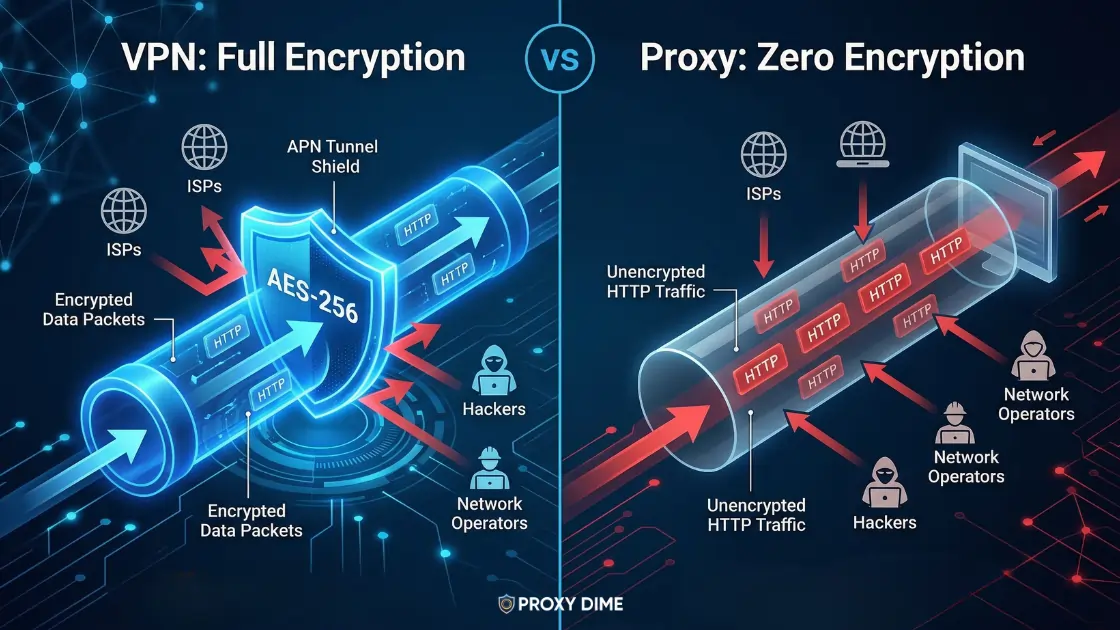
VPNs encrypt every packet using AES-256 (OpenVPN/IKEv2) or ChaCha20 (WireGuard). This prevents ISPs, network operators, and attackers on shared networks from reading your traffic contents.
WireGuard is 2–4x faster than OpenVPN for the same encryption strength. Premium VPNs including NordVPN, Mullvad, and Surfshark cause an average download speed loss of under 20% — imperceptible on connections above 50 Mbps.
Proxies provide zero transport-layer encryption. If you access an HTTPS site through a proxy, TLS still encrypts the connection end-to-end — but the proxy itself adds no cryptographic protection. Any HTTP traffic through a proxy is fully visible to network observers.
Speed: Proxy Wins at Scale
Running 1,000 concurrent requests through a datacenter proxy takes approximately 10 seconds. The same workload routed through a VPN would take 30–60 seconds — and is limited to a single source IP. The proxy speed advantage compounds with request volume.
For any operation requiring parallel requests from multiple IPs simultaneously — web scraping, price monitoring, ad verification — proxies are categorically faster. For single-user browsing, the speed difference is marginal.
Head-to-Head Proxy vs VPN Comparison
| Feature | Proxy Server | VPN |
|---|---|---|
| Encryption | None (cleartext) | Full AES-256 or WireGuard |
| IP Masking | Yes — per app/browser | Yes — entire device |
| Speed | Faster (no crypto overhead) | 10–20% slower |
| Concurrent IPs | Thousands simultaneously | Single server IP |
| Traffic Coverage | App-specific only | All device traffic |
| Protocol | HTTP, HTTPS, SOCKS5 | OpenVPN, WireGuard, IKEv2 |
| Security Level | Low (no encryption) | High (full tunnel) |
| Best For | Scraping, automation, multi-IP ops | Personal privacy, corporate access |
| Cost | $0.10–$15/GB or per IP | $3–$12/month |
When to Use a Proxy
Choose proxies for large-scale web scraping, price intelligence, SEO rank tracking, ad verification, social media automation, sneaker bots, and any operation requiring multiple parallel IP identities.
The multi-provider model is growing: 43.1% of scraping professionals now use 2–3 proxy providers simultaneously for redundancy and risk mitigation.

When to Use a VPN
Choose a VPN for personal privacy on public Wi-Fi, bypassing government censorship, corporate remote access, and protecting sensitive personal data from ISP surveillance. VPN encryption is essential when the confidentiality of data in transit matters — proxies provide no such protection.

Using Both Together
Many enterprise teams operate a VPN for corporate network security while routing specific automation tasks through dedicated proxy pools. These are complementary infrastructure layers, not mutually exclusive choices.